
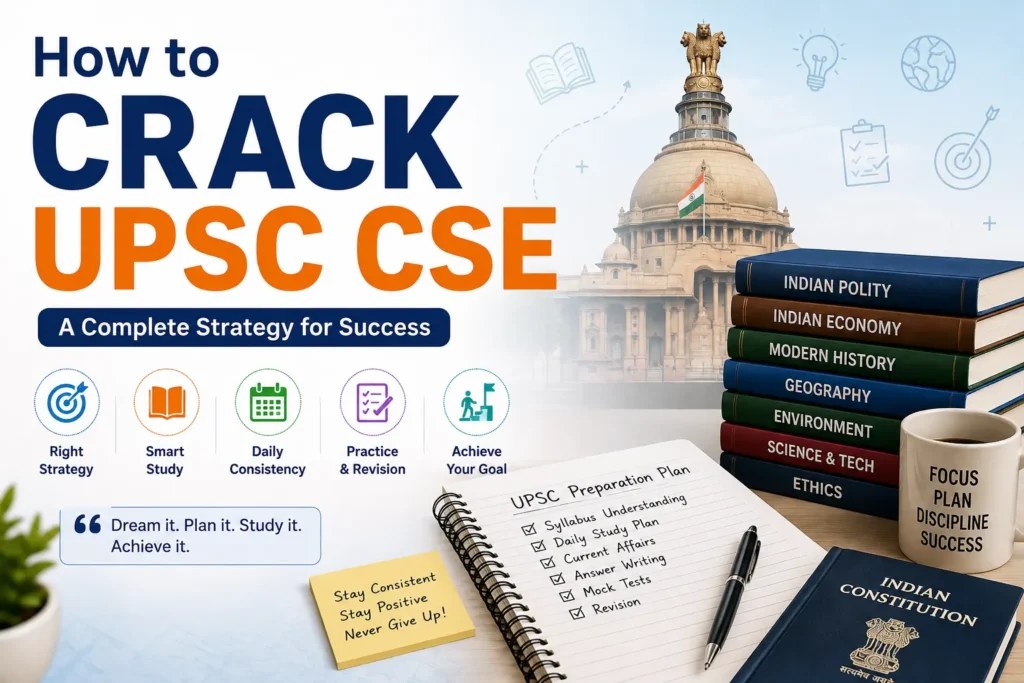
How to Crack UPSC CSE in 2027: A Complete Strategy for Beginners
The Union Public Service Commission Civil Services Examination (UPSC CSE) is one of India’s most competitive exams, attracting over a million applicants every year. While the success rate is low, thousands of aspirants clear the exam through the right strategy, consistent preparation, and disciplined execution.
If you’re wondering how to crack UPSC CSE, this guide will walk you through a practical preparation strategy that works for both beginners and repeat aspirants.
How to Crack UPSC CSE: Step-by-Step Preparation Strategy
Understand the UPSC CSE Exam
Before starting your preparation, understand the exam structure.
The UPSC Civil Services Examination consists of three stages:
- Preliminary Examination – Objective-type screening test.
- Main Examination – Descriptive written exam.
- Personality Test (Interview) – Assesses communication, decision-making, and overall personality.
Since each stage tests different skills, your preparation should focus on all three rather than studying only for the prelims.
Know the UPSC CSE Syllabus Thoroughly
One of the biggest mistakes aspirants make is studying without understanding the syllabus.
Download the official UPSC syllabus and keep it handy throughout your preparation. Every topic you study should directly relate to the syllabus.
Break the syllabus into manageable sections such as:
- History
- Geography
- Polity
- Economy
- Environment
- Science & Technology
- Ethics
- Essay
- Optional Subject
- Current Affairs
Studying according to the syllabus helps you avoid wasting time on unnecessary topics.
Build a Strong Foundation with NCERT Books
Most UPSC toppers recommend starting with NCERT books because they explain concepts in simple language.
Begin with NCERTs for:
- History
- Geography
- Political Science
- Economics
- Science
Once your fundamentals are clear, move on to standard reference books.
Strong basics make advanced topics much easier to understand.
Choose Standard Study Materials
Avoid collecting too many books.
Instead, use a limited number of trusted resources and revise them multiple times.
Focus on quality rather than quantity.
Maintain concise notes while studying so revision becomes easier during the final months before the examination.
Read Current Affairs Every Day
Current affairs play a crucial role in both the Preliminary and Main examinations.
Develop a habit of reading reliable newspapers daily and make short notes on important developments related to governance, economy, international relations, environment, science, and social issues.
Spend around one hour every day on current affairs instead of trying to cover everything at once before the exam.
Consistency matters more than volume.
Create a Realistic Study Plan
Many aspirants fail because they create unrealistic schedules.
Instead of studying for 14–16 hours initially, build a sustainable routine.
A sample daily schedule could include:
- Concept study
- Current affairs
- Revision
- Answer writing
- Practice questions
Even six to eight focused hours every day can produce excellent results when maintained consistently.
Practice Previous Year Question Papers
Previous Year Question Papers are one of the most valuable preparation resources.
They help you understand:
- Question trends
- Important topics
- Difficulty level
- UPSC’s questioning style
Analyze at least the last 10 years of UPSC CSE papers before the examination.
You’ll notice that many concepts are repeatedly tested in different forms.
Start Answer Writing Early
Many aspirants prepare well but struggle in the Main examination because they lack answer-writing practice.
Start writing answers after completing your basic subjects.
Focus on:
- Clear introduction
- Structured body
- Logical conclusion
- Diagrams wherever appropriate
- Relevant examples
Writing one or two answers daily significantly improves speed and presentation over time.
Revise Multiple Times
Revision is the key to retaining information.
Instead of reading new books repeatedly, revise your existing notes several times.
A practical revision cycle is:
- Weekly revision
- Monthly revision
- Final revision before the examination
Multiple revisions improve recall and boost confidence during the exam.
Take Mock Tests Regularly
Mock tests help you evaluate your preparation.
Benefits include:
- Time management
- Identifying weak areas
- Improving accuracy
- Building exam confidence
Attempt both Preliminary mock tests and Main answer-writing tests.
After every test, spend time analyzing mistakes instead of only checking your score.
Stay Consistent and Avoid Burnout
UPSC preparation is a marathon, not a sprint.
Avoid comparing yourself with other aspirants.
Take short breaks, maintain good sleep, exercise regularly, and stay physically and mentally healthy.
A balanced routine helps you remain productive throughout your preparation journey.
Common Mistakes to Avoid
Many aspirants repeat the same mistakes every year.
Avoid these common errors:
- Ignoring the official syllabus
- Collecting too many books
- Not revising regularly
- Skipping answer-writing practice
- Neglecting previous year papers
- Studying without a daily plan
- Ignoring current affairs
Eliminating these mistakes can improve your chances of success significantly.
Final Tips to “how to Crack UPSC CSE”
Cracking UPSC is not about studying the most hours—it is about studying smart.
Remember these principles:
- Understand the syllabus completely.
- Build strong fundamentals.
- Follow limited study resources.
- Read current affairs consistently.
- Practice previous year papers.
- Write answers regularly.
- Revise multiple times.
- Stay disciplined and patient.
Every successful UPSC candidate started as a beginner. With the right strategy and consistent effort, you can also achieve your goal.
Frequently Asked Questions (FAQs)
Is one year enough to crack UPSC CSE?
Yes. If you study consistently with a structured plan, one year can be sufficient for many candidates.
How many hours should I study for UPSC?
Quality matters more than quantity. Six to eight focused hours every day are generally more effective than long, distracted study sessions.
Should beginners start with NCERT books?
Yes. NCERT books help build conceptual clarity and provide a strong foundation for advanced preparation.
Are previous year question papers important?
Absolutely. They help you understand UPSC’s question pattern, recurring themes, and level of difficulty.
What is the most important factor for cracking UPSC CSE?
Consistency, regular revision, answer-writing practice, and understanding the syllabus are among the most important factors for success.
Follow us on Social media for daily updates