

Choosing between the Indian Administrative Service (IAS) and the Indian Foreign Service (IFS) is one of the biggest decisions for aspirants preparing for the UPSC Civil Services Examination (CSE). Both services are among the most prestigious careers in India, offering the opportunity to serve the nation at the highest level. However, the nature of work, responsibilities, career growth, work environment, authority, and lifestyle are significantly different.
An IAS Officer is responsible for the administration and governance of India. From managing districts and implementing government policies to leading state and central government departments, IAS officers play a crucial role in the country’s development and public administration.
An IFS Officer, on the other hand, represents India on the global stage. They handle diplomacy, foreign policy, international negotiations, trade relations, consular services, and strengthen India’s relationships with other countries while serving in embassies, high commissions, and international organizations across the world.
Many UPSC aspirants often ask questions such as:
- Which is better: IAS or IFS?
- What is the difference between IAS and IFS?
- Who has more power?
- Which service offers a better salary?
- Which has a better work-life balance?
- Which career provides more international exposure?
- Which service should I choose after UPSC?
The answer depends entirely on your interests, personality, and long-term career aspirations. If you enjoy governance, leadership, and public administration, the IAS may be the ideal choice. If you are passionate about international relations, diplomacy, foreign affairs, and representing India abroad, the Indian Foreign Service could be a better fit.
In this comprehensive guide, we’ll compare IAS vs IFS across every important aspect, including:
- Roles and responsibilities
- Recruitment process
- Eligibility
- Salary and allowances
- Powers and authority
- Career growth
- Promotions
- Work environment
- Foreign postings
- Lifestyle
- Work-life balance
- Advantages and challenges
- Which service is better for different career goals
By the end of this guide, you’ll have a clear understanding of the differences between the Indian Administrative Service (IAS) and the Indian Foreign Service (IFS), helping you make an informed decision about your UPSC career path.
What You’ll Learn in This Guide
- Difference between IAS and IFS
- IAS vs IFS roles and responsibilities
- IAS vs IFS salary comparison
- IAS vs IFS powers and authority
- IAS vs IFS career growth
- IAS vs IFS work environment
- IAS vs IFS foreign postings
- IAS vs IFS lifestyle and work-life balance
- Advantages and challenges of both services
- Which service is better for your career goals
IAS vs IFS: Highlights
While both the Indian Administrative Service (IAS) and the Indian Foreign Service (IFS) are among the most prestigious services recruited through the UPSC Civil Services Examination (CSE), they differ significantly in their nature of work, career opportunities, authority, work environment, and lifestyle.
An IAS Officer is responsible for governing and administering the country at the district, state, and central levels. Their work directly impacts public administration, policy implementation, and the delivery of government services to citizens.
An IFS Officer, on the other hand, serves as India’s diplomat. They represent the country abroad, manage diplomatic relations, negotiate international agreements, protect Indian citizens overseas, and promote India’s political, economic, and strategic interests across the world.
The comparison below provides a quick overview of the major differences between these two prestigious civil services.
IAS vs IFS Highlights
| Feature | IAS (Indian Administrative Service) | IFS (Indian Foreign Service) |
|---|---|---|
| Full Form | Indian Administrative Service | Indian Foreign Service |
| Service Type | All India Service | Group A Central Civil Service |
| Recruitment | UPSC Civil Services Examination | UPSC Civil Services Examination |
| Cadre Allocation | State Cadre | Ministry of External Affairs (MEA) |
| Controlling Authority | Department of Personnel & Training (DoPT) | Ministry of External Affairs (MEA) |
| Primary Responsibility | Administration, Governance & Policy Implementation | Diplomacy, Foreign Policy & International Relations |
| Work Location | Primarily India | India and Foreign Countries |
| First Posting | Sub-Divisional Magistrate (SDM) / Assistant Collector | Third Secretary in an Indian Mission Abroad |
| Highest Position | Cabinet Secretary of India | Foreign Secretary of India |
| Nature of Work | Administrative & Executive | Diplomatic & Strategic |
| Public Interaction | Very High | Moderate |
| Administrative Authority | Extensive | Limited (Diplomatic Authority) |
| International Exposure | Limited | Extensive |
| Foreign Postings | Rare | Regular Throughout Career |
| Foreign Language Training | No | Yes (Compulsory) |
| Uniform | No | No |
| Basic Entry-Level Salary | ₹56,100/month | ₹56,100/month |
| Special Allowances | DA, HRA, TA, Government Benefits | Foreign Allowance, Diplomatic Benefits, DA, Government Benefits |
| Official Residence | Government Accommodation | Government Accommodation in India & Abroad |
| Official Vehicle | Yes (Based on Post) | Yes (Based on Posting) |
| Travel Requirements | Moderate | Very High |
| Decision-Making Scope | Domestic Governance | International Diplomacy |
| Career Progression | SDM → DM → Commissioner → Secretary → Cabinet Secretary | Third Secretary → Ambassador → Foreign Secretary |
| Work Environment | Districts, State Secretariat, Central Ministries | Embassies, High Commissions, Consulates, MEA |
| Prestige | Very High | Very High |
Key Differences at a Glance
IAS Officer
- Works within India on governance and administration.
- Implements government policies and development programmes.
- Leads district and state administration.
- Exercises significant executive and administrative authority.
- Interacts directly with citizens and public representatives.
- Primarily serves in state and central government departments.
IFS Officer
- Represents India in foreign countries.
- Handles diplomacy and international negotiations.
- Implements India’s foreign policy.
- Works in embassies, high commissions, and consulates.
- Protects Indian citizens abroad.
- Promotes India’s trade, cultural, and strategic interests globally.
IAS vs IFS: Which Service Is Right for You?
Choose IAS if you:
- Want to work in governance and public administration.
- Aspire to lead districts, states, or central ministries.
- Enjoy solving public policy and administrative challenges.
- Want to make a direct impact on citizens’ lives.
- Prefer serving primarily within India.
Choose IFS if you:
- Are passionate about international relations and diplomacy.
- Want to represent India on the global stage.
- Enjoy learning about different countries and cultures.
- Are interested in foreign policy and international negotiations.
- Prefer a career with overseas postings and global exposure.
IAS vs IFS: Detailed Comparison
While both the Indian Administrative Service (IAS) and the Indian Foreign Service (IFS) are among the most prestigious services recruited through the UPSC Civil Services Examination, they differ significantly in their responsibilities, work environment, career progression, authority, and lifestyle.
An IAS officer is responsible for governing and administering the country, whereas an IFS officer represents India internationally by managing diplomatic relations and protecting the nation’s interests abroad.
The comparison below highlights the key differences between the two services.
IAS vs IFS: Side-by-Side Comparison
| Parameter | IAS (Indian Administrative Service) | IFS (Indian Foreign Service) |
|---|---|---|
| Full Form | Indian Administrative Service | Indian Foreign Service |
| Service Type | All India Service | Group A Central Civil Service |
| Recruitment | UPSC Civil Services Examination | UPSC Civil Services Examination |
| Cadre Allocation | State Cadre | Ministry of External Affairs (MEA) |
| Controlling Authority | Department of Personnel & Training (DoPT) | Ministry of External Affairs (MEA) |
| Primary Objective | Governance and Public Administration | Diplomacy and Foreign Relations |
| Work Area | India | India & Foreign Countries |
| Nature of Work | Administrative, Executive and Developmental | Diplomatic, Strategic and International |
| Primary Responsibilities | Policy implementation, district administration, governance | Foreign policy, diplomacy, international negotiations |
| Initial Posting | Sub-Divisional Magistrate (SDM) / Assistant Collector | Third Secretary |
| Highest Position | Cabinet Secretary of India | Foreign Secretary of India |
| Public Interaction | Very High | Moderate |
| Administrative Authority | Extensive | Limited Administrative Authority |
| Diplomatic Authority | No | Yes |
| International Exposure | Limited | Extensive |
| Foreign Postings | Rare | Regular throughout career |
| Foreign Language Training | No | Yes (Compulsory) |
| Official Uniform | No | No |
| Basic Entry-Level Pay | ₹56,100/month | ₹56,100/month |
| Additional Benefits | DA, HRA, TA, Government Accommodation, Medical | Foreign Allowance, Diplomatic Privileges, Government Accommodation, Medical |
| Official Residence | Government Accommodation | Government Accommodation in India & Abroad |
| Official Vehicle | Yes (Based on Post) | Yes (Based on Posting) |
| Travel Requirement | Moderate | Very High |
| Decision-Making Scope | Domestic Governance | International Relations & Diplomacy |
| Transfer Pattern | Within State & Central Deputation | India and Overseas Missions |
| Work Environment | Districts, State Secretariats, Central Ministries | Embassies, High Commissions, Consulates, MEA |
| Leadership Role | Districts, Departments and Ministries | Diplomatic Missions & International Negotiations |
| Career Focus | National Administration | Global Representation |
| Prestige | Very High | Very High |
Major Differences Between IAS and IFS
1. Nature of Work
The biggest difference between IAS and IFS lies in the nature of their responsibilities.
IAS officers work within India and are responsible for public administration, governance, development programmes, and implementing government policies. Their decisions directly affect citizens and the functioning of government institutions.
IFS officers, on the other hand, represent India internationally. Their work revolves around diplomacy, foreign policy, trade relations, international negotiations, and protecting India’s interests in other countries.
2. Place of Posting
An IAS officer spends most of their career serving within India at the district, state, and central government levels.
An IFS officer alternates between postings in India and Indian diplomatic missions abroad, serving in embassies, high commissions, consulates, and permanent missions.
3. Scope of Work
IAS officers manage:
- District administration
- Policy implementation
- Revenue administration
- Public welfare programmes
- Disaster management
- Government departments
IFS officers handle:
- Diplomatic relations
- Foreign policy
- International negotiations
- Trade promotion
- Consular services
- International cooperation
4. International Exposure
IAS officers may occasionally participate in international conferences or receive foreign training, but their primary responsibilities remain within India.
IFS officers spend a significant portion of their careers overseas, interacting with foreign governments, international organizations, and global institutions.
5. Career Objective
The primary goal of an IAS officer is to ensure efficient governance and improve public administration within India.
The primary goal of an IFS officer is to strengthen India’s relationships with other nations, safeguard national interests abroad, and promote India’s diplomatic, economic, and strategic objectives.
IAS vs IFS: Roles & Responsibilities
Although both IAS and IFS officers are selected through the UPSC Civil Services Examination, their day-to-day responsibilities, decision-making roles, and areas of service are entirely different.
An IAS Officer focuses on governance, administration, public welfare, and implementing government policies within India. In contrast, an IFS Officer is responsible for representing India internationally, managing diplomatic relations, protecting national interests abroad, and strengthening ties with foreign governments.
Understanding the roles and responsibilities of both services can help UPSC aspirants choose the career that best matches their interests and aspirations.
IAS vs IFS: Roles & Responsibilities Comparison
| Area | IAS Officer | IFS Officer |
|---|---|---|
| Primary Role | Administration & Governance | Diplomacy & International Relations |
| Main Objective | Implement government policies and manage public administration | Represent India globally and implement foreign policy |
| Work Location | Districts, States & Central Government | Embassies, High Commissions, Consulates & MEA |
| Public Interaction | Very High | Moderate |
| Policy Role | Domestic Policy Implementation | Foreign Policy Execution |
| Leadership | Administrative Leadership | Diplomatic Leadership |
| International Negotiations | Rare | Core Responsibility |
| Citizen Services | Public Administration & Welfare | Consular Services for Indians Abroad |
| Decision Making | Administrative & Developmental | Diplomatic & Strategic |
Roles and Responsibilities of an IAS Officer
IAS officers are responsible for managing the administrative machinery of the government and ensuring that policies and welfare schemes are implemented effectively across the country.
Their major responsibilities include:
- Implementing central and state government policies
- Managing district administration
- Supervising revenue collection and land administration
- Coordinating law and order with police authorities
- Monitoring government departments
- Implementing public welfare schemes
- Managing disaster response and emergency situations
- Preparing policy recommendations
- Managing government budgets and public resources
- Ensuring efficient delivery of public services
IAS officers work closely with elected representatives, government officials, and citizens to improve governance and development.
Roles and Responsibilities of an IFS Officer
IFS officers serve as India’s diplomatic representatives and work to strengthen the country’s relationships with foreign nations and international organizations.
Their key responsibilities include:
- Representing India in foreign countries
- Implementing India’s foreign policy
- Negotiating bilateral and multilateral agreements
- Promoting India’s trade and investment interests
- Strengthening diplomatic relations
- Protecting Indian citizens abroad
- Issuing passports, visas, and providing consular assistance
- Promoting Indian culture and tourism
- Monitoring political and economic developments in host countries
- Reporting international developments to the Government of India
IFS officers play a vital role in advancing India’s strategic, economic, and diplomatic interests on the global stage.
Day-to-Day Work Comparison
IAS Officer
A typical day for an IAS officer may involve:
- Reviewing administrative reports
- Conducting meetings with government officials
- Inspecting development projects
- Addressing public grievances
- Monitoring implementation of government schemes
- Coordinating with various departments
- Responding to emergencies and crises
- Taking administrative decisions
- Preparing official reports and policy recommendations
Their work is dynamic and directly connected to governance and public administration.
IFS Officer
A typical day for an IFS officer may include:
- Meeting foreign diplomats and government officials
- Participating in diplomatic negotiations
- Preparing policy briefs and diplomatic reports
- Organizing official visits and bilateral meetings
- Attending international conferences and events
- Assisting Indian citizens in emergencies abroad
- Promoting trade, tourism, and cultural cooperation
- Monitoring international political and economic developments
- Coordinating with the Ministry of External Affairs
Their work requires strong communication, negotiation, and cross-cultural skills.
Impact of Their Work
IAS Officer
The work of an IAS officer directly impacts:
- Governance
- Public administration
- Infrastructure development
- Healthcare
- Education
- Agriculture
- Revenue administration
- Rural and urban development
- Social welfare
- Disaster management
Their decisions affect the daily lives of millions of citizens.
IFS Officer
The work of an IFS officer influences:
- India’s diplomatic relations
- International trade and investment
- Foreign policy implementation
- Global partnerships
- Consular assistance
- International cooperation
- Cultural diplomacy
- Strategic and security interests
- India’s image on the global stage
Their efforts contribute to strengthening India’s position in international affairs.
Which Role Offers Greater Responsibility?
Both services carry significant responsibility, but in different domains.
IAS officers shoulder extensive responsibility for governance, administration, and public service within India. They work closely with government departments and citizens to implement policies and manage development.
IFS officers are entrusted with representing India’s interests abroad. Their responsibilities involve diplomacy, international negotiations, crisis management, and maintaining strong bilateral and multilateral relations.
Neither role is inherently greater than the other—the scope of responsibility depends on the area of service.
Key Takeaway
The responsibilities of an IAS Officer revolve around governance, administration, and public welfare within India, while an IFS Officer focuses on diplomacy, international relations, and representing India abroad.
IAS vs IFS: Work Environment
One of the biggest differences between the Indian Administrative Service (IAS) and the Indian Foreign Service (IFS) is their work environment. While both services involve serving the nation at the highest level, the places where officers work, the people they interact with, and the nature of their daily responsibilities are entirely different.
IAS officers primarily work within India, managing administration, implementing government policies, and interacting directly with citizens, elected representatives, and government departments. Their work often combines office responsibilities with field visits and administrative inspections.
IFS officers, on the other hand, divide their careers between the Ministry of External Affairs (MEA) in India and Indian diplomatic missions abroad. They work in embassies, high commissions, consulates, and international organizations, representing India’s interests while engaging with foreign governments and global institutions.
IAS vs IFS: Work Environment Comparison
| Aspect | IAS Officer | IFS Officer |
|---|---|---|
| Primary Workplace | District Offices, State Secretariats, Central Ministries | Embassies, High Commissions, Consulates, MEA |
| Country of Service | Primarily India | India & Foreign Countries |
| Nature of Work | Administrative & Field-Based | Diplomatic & Office-Based |
| Public Interaction | Very High | Moderate |
| Interaction With | Citizens, Government Departments, Ministers | Diplomats, Foreign Governments, International Organizations |
| Travel Requirements | Moderate | Extensive International Travel |
| Field Visits | Frequent | Occasional |
| Office Meetings | Daily | Daily |
| International Exposure | Limited | Extensive |
| Transfer Pattern | Within State & Central Deputation | India and Overseas Missions |
Work Environment of an IAS Officer
An IAS officer works in a fast-paced administrative environment where every day brings new challenges and responsibilities.
Typical workplaces include:
- District Collector’s Office
- Sub-Divisional Office
- State Secretariat
- Central Government Ministries
- Government Departments
- Public Sector Organizations
- Commissions and Authorities
Their work is not limited to office administration. IAS officers regularly conduct:
- Field inspections
- Public grievance hearings
- Development project reviews
- Meetings with government officials
- Coordination with police and local authorities
- Disaster management operations
- Visits to villages, schools, hospitals, and public facilities
This combination of office work and field responsibilities makes the role dynamic and closely connected to public administration.
Work Environment of an IFS Officer
The work environment of an IFS officer is significantly different, focusing on diplomacy and international engagement.
IFS officers typically work in:
- Indian Embassies
- High Commissions
- Consulates
- Permanent Missions
- Ministry of External Affairs
- International Conferences
- Bilateral and Multilateral Meetings
Their responsibilities involve:
- Diplomatic meetings
- Policy discussions
- Negotiations with foreign governments
- Trade and investment promotion
- Cultural diplomacy
- Consular assistance
- International conferences
- Preparing diplomatic reports
- Coordinating official visits
The work environment is professional, multicultural, and internationally oriented, requiring strong communication and interpersonal skills.
Domestic vs International Exposure
IAS Officer
IAS officers spend most of their careers serving within India.
Their work focuses on:
- District administration
- State governance
- Central government assignments
- Public welfare programmes
- Policy implementation
- Administrative reforms
Although they may attend international conferences or training programmes, overseas assignments are not a regular part of their career.
IFS Officer
International exposure is a defining feature of the Indian Foreign Service.
IFS officers serve in different countries throughout their careers and gain experience in:
- Diplomatic negotiations
- International organizations
- Cross-cultural communication
- Global policy discussions
- Bilateral and multilateral cooperation
- International trade and investment
Frequent overseas postings allow them to develop a global perspective while representing India’s interests abroad.
Nature of Daily Work
IAS Officer
A typical day may involve:
- Reviewing administrative files
- Conducting departmental meetings
- Inspecting government projects
- Addressing public grievances
- Monitoring implementation of welfare schemes
- Coordinating with multiple departments
- Responding to emergencies and crises
- Making administrative decisions
The work is often fast-paced and requires balancing office duties with field responsibilities.
IFS Officer
A typical day may include:
- Meeting foreign diplomats
- Attending diplomatic negotiations
- Drafting policy briefs and reports
- Organizing official visits
- Promoting trade and cultural cooperation
- Assisting Indian citizens abroad
- Participating in international conferences
- Coordinating with the Ministry of External Affairs
The work is primarily office-based but involves frequent interactions with international stakeholders and official events.
Work-Life Balance
IAS Officer
The work-life balance of an IAS officer depends on the posting and responsibilities.
During district postings, officers may:
- Work long hours
- Handle emergency situations
- Attend late-night meetings
- Respond to natural disasters or law-and-order issues
- Remain available beyond regular office hours
Senior administrative positions may offer a more structured routine, but the level of responsibility remains high.
IFS Officer
IFS officers generally have a structured professional schedule, particularly during overseas postings.
However, they may also need to:
- Attend official receptions and diplomatic events
- Handle emergencies involving Indian citizens abroad
- Coordinate high-level international visits
- Respond to global crises affecting India’s interests
Frequent relocations and adapting to different countries can also present personal and family challenges.
Which Work Environment Is Better?
The answer depends on your career aspirations.
Choose IAS if you prefer:
- Working directly with citizens
- Solving administrative challenges
- Leading public welfare initiatives
- Managing governance and development projects
- A career focused primarily within India
Choose IFS if you prefer:
- International relations and diplomacy
- Representing India abroad
- Working in multicultural environments
- Frequent overseas postings
- Building relationships with foreign governments and international organizations
Both services provide unique opportunities to serve the nation, but they differ greatly in terms of workplace, responsibilities, and professional experiences.
IAS vs IFS: Salary Comparison
Salary is one of the most searched aspects by UPSC aspirants when comparing the Indian Administrative Service (IAS) and the Indian Foreign Service (IFS). Since both services are recruited through the UPSC Civil Services Examination, they follow the 7th Central Pay Commission (CPC) pay structure. The basic salary at each pay level is generally the same.
However, the overall compensation can differ significantly because IFS officers posted abroad receive Foreign Allowances, diplomatic privileges, and overseas benefits, while IAS officers receive allowances based on their postings within India.
Although salary is an important factor, candidates should choose a service based on their interests, responsibilities, and long-term career goals rather than compensation alone.
IAS vs IFS: Salary Comparison Table
| Component | IAS Officer | IFS Officer |
|---|---|---|
| Pay Commission | 7th Central Pay Commission | 7th Central Pay Commission |
| Entry-Level Basic Pay | ₹56,100/month | ₹56,100/month |
| Cabinet Secretary / Foreign Secretary Level | ₹2,50,000/month (Fixed) | ₹2,50,000/month (Fixed) |
| Dearness Allowance (DA) | Applicable | Applicable (India Posting) |
| House Rent Allowance (HRA) | As per government rules (if accommodation not provided) | As per government rules (India Posting) |
| Foreign Allowance | No | Yes (During Overseas Posting) |
| Government Accommodation | Yes | Yes (India & Abroad) |
| Official Vehicle | Yes (As per Post) | Yes (As per Posting) |
| Medical Benefits | Yes | Yes |
| Pension & Retirement Benefits | Yes | Yes |
| Travel Benefits | Official Travel | Official Domestic & International Travel |
| Diplomatic Privileges | No | Yes (During Overseas Posting) |
IAS Salary Structure
IAS officers receive their salary according to the 7th Central Pay Commission, with pay increasing through promotions and higher responsibilities.
IAS Pay Levels
| Designation | Approximate Basic Pay |
|---|---|
| Junior Scale (SDM/Assistant Collector) | ₹56,100 |
| Senior Time Scale | ₹67,700 |
| Junior Administrative Grade | ₹78,800 |
| Selection Grade | ₹1,18,500 |
| Super Time Scale | ₹1,44,200 |
| Additional Secretary | ₹2,05,400 |
| Secretary | ₹2,25,000 |
| Cabinet Secretary | ₹2,50,000 (Fixed) |
In addition to the basic salary, IAS officers may receive government accommodation, official vehicles (based on post), medical facilities, leave benefits, travel allowances, and retirement benefits as per government rules.
IFS Salary Structure
The basic salary of IFS officers is also governed by the 7th Central Pay Commission, making it comparable to IAS officers at the same pay level.
However, IFS officers receive additional financial benefits when posted abroad.
IFS Pay Levels
| Designation | Approximate Basic Pay |
|---|---|
| Third Secretary | ₹56,100 |
| Second Secretary | ₹67,700 |
| First Secretary | ₹78,800 |
| Counsellor | ₹1,18,500 |
| Minister | ₹1,44,200 |
| Ambassador / High Commissioner | ₹2,05,400 – ₹2,25,000 |
| Foreign Secretary | ₹2,50,000 (Fixed) |
Along with the basic pay, officers serving overseas may receive foreign allowances and government-provided facilities according to their posting and applicable government regulations.
Allowances Comparison
IAS Officer
Common benefits may include:
- Dearness Allowance (DA)
- House Rent Allowance (where applicable)
- Travel Allowance (TA)
- Government accommodation
- Medical facilities
- Official vehicle (based on posting)
- Leave Travel Concession (LTC)
- Pension and retirement benefits
The exact allowances depend on the posting, location, and government rules.
IFS Officer
During overseas postings, IFS officers may receive additional benefits such as:
- Foreign Allowance
- Government accommodation abroad
- Official vehicle (where applicable)
- Medical facilities
- Official travel support
- Diplomatic privileges related to official duties
- Pension and retirement benefits
The amount of foreign allowance varies depending on the country of posting and other government-prescribed factors.
Which Service Offers Better Financial Benefits?
IAS Officer
IAS officers receive stable salaries and comprehensive government benefits throughout their careers. Their compensation remains consistent and increases with promotions and seniority.
IFS Officer
IFS officers receive the same basic pay structure but may have a higher overall compensation during overseas postings because of foreign allowances and additional government-provided facilities.
However, these additional benefits are linked to foreign assignments and are subject to government policies.
Salary Should Not Be the Only Decision Factor
Many UPSC aspirants compare IAS and IFS solely based on salary. In reality, both services offer competitive pay, excellent benefits, and long-term financial security.
Instead of choosing a service based only on compensation, consider:
- Nature of work
- Career interests
- Responsibilities
- Work environment
- Lifestyle
- Opportunities for growth
- Type of public service you wish to perform
These factors have a much greater impact on long-term career satisfaction.
IAS vs IFS: Powers & Authority
One of the most debated questions among UPSC aspirants is “Who is more powerful: IAS or IFS?” The answer depends on how you define power.
An IAS Officer holds extensive administrative authority within India. They are responsible for implementing government policies, managing districts, supervising government departments, and coordinating with law enforcement and other agencies. Their decisions have a direct impact on governance and public administration.
An IFS Officer, on the other hand, exercises diplomatic authority on behalf of the Government of India. Instead of administering districts or states, they represent India in foreign countries, negotiate international agreements, protect India’s strategic interests, and strengthen diplomatic relations across the world.
Both services are highly influential, but their powers operate in different domains—domestic governance for IAS and international diplomacy for IFS.
IAS vs IFS: Powers & Authority Comparison
| Parameter | IAS Officer | IFS Officer |
|---|---|---|
| Primary Authority | Administrative | Diplomatic |
| Area of Influence | India | Global |
| Decision-Making | Governance & Administration | Foreign Policy & Diplomacy |
| Policy Role | Implements Government Policies | Executes Foreign Policy |
| Administrative Control | Government Departments & District Administration | Indian Missions Abroad |
| Public Authority | Very High | Moderate |
| Law & Order Coordination | Yes | No |
| International Negotiations | Limited | Core Responsibility |
| Government Representation | State & Central Government | Government of India Overseas |
| Global Influence | Limited | High |
| Interaction with Foreign Governments | Rare | Regular |
| Diplomatic Privileges | No | Yes (During Official Overseas Postings) |
Administrative Powers of an IAS Officer
IAS officers are entrusted with significant administrative responsibilities that directly affect governance and public service delivery across the country.
Depending on their posting and seniority, an IAS officer may:
- Implement Central and State Government policies.
- Supervise district administration and government departments.
- Coordinate with police, revenue, and local authorities.
- Manage public welfare and development programmes.
- Oversee disaster management and emergency response.
- Allocate and monitor government resources.
- Lead policy implementation at district, state, and national levels.
- Advise ministers and senior government officials on administrative matters.
Their authority enables them to make critical decisions that impact millions of citizens and ensure the smooth functioning of government machinery.
Diplomatic Authority of an IFS Officer
IFS officers represent India on the international stage and are responsible for advancing the country’s foreign policy objectives.
Their authority includes:
- Representing India before foreign governments and international organizations.
- Negotiating bilateral and multilateral agreements.
- Protecting India’s diplomatic and strategic interests.
- Promoting trade, investment, tourism, and cultural cooperation.
- Providing consular assistance to Indian citizens abroad.
- Reporting political, economic, and security developments to the Government of India.
- Supporting high-level diplomatic visits and international summits.
- Managing India’s diplomatic missions in foreign countries.
Their influence is exercised through diplomacy, negotiation, and international engagement rather than administrative control.
Decision-Making Authority
IAS Officer
IAS officers make decisions related to:
- District administration
- Public welfare schemes
- Revenue administration
- Infrastructure development
- Disaster management
- Government programmes
- Administrative reforms
- Resource allocation
Many of these decisions directly influence the daily lives of citizens and the implementation of government policies.
IFS Officer
IFS officers contribute to decisions involving:
- Diplomatic negotiations
- Foreign policy execution
- International cooperation
- Bilateral and multilateral relations
- Trade and economic diplomacy
- Strategic partnerships
- Consular affairs
- India’s representation in global forums
Their recommendations and negotiations shape India’s engagement with the international community.
Leadership Roles
IAS Officer
Senior IAS officers lead:
- District administrations
- State government departments
- Central ministries
- Government commissions
- Public sector organizations
- National administrative initiatives
Their leadership is focused on governance, policy implementation, and institutional management.
IFS Officer
Senior IFS officers lead:
- Indian Embassies
- High Commissions
- Consulates
- Permanent Missions
- Diplomatic delegations
- Ministry of External Affairs divisions
Their leadership centres on diplomacy, international cooperation, and representing India’s interests abroad.
Who Has More Power?
This question has no single answer because both services operate in different spheres.
IAS officers generally have greater administrative authority within India. They play a central role in governance, development, and public administration, often making decisions that directly affect citizens.
IFS officers have greater diplomatic influence internationally. They represent India in foreign countries, negotiate with global leaders, and contribute to the country’s foreign policy and international standing.
Rather than comparing one as more powerful than the other, it is more accurate to say that each service holds significant authority within its own area of responsibility.
IAS vs IFS: Career Growth & Promotions
Both the Indian Administrative Service (IAS) and the Indian Foreign Service (IFS) offer structured career progression, leadership opportunities, and the chance to serve India at the highest levels of government. Since both services are recruited through the UPSC Civil Services Examination, officers begin their careers at junior positions and gradually move to senior leadership roles based on experience, performance, and vacancies.
While IAS officers advance through administrative positions in district, state, and central governments, IFS officers rise through the diplomatic hierarchy, serving in Indian missions across the world and eventually leading India’s foreign policy at the highest level.
IAS vs IFS: Career Growth Comparison
| Career Aspect | IAS Officer | IFS Officer |
|---|---|---|
| Career Focus | Governance & Administration | Diplomacy & Foreign Relations |
| Initial Position | Sub-Divisional Magistrate (SDM) / Assistant Collector | Third Secretary |
| Mid-Level Roles | District Magistrate, Commissioner, Secretary | Second Secretary, First Secretary, Counsellor |
| Senior Leadership | Chief Secretary, Secretary to Government of India | Ambassador, High Commissioner, Foreign Secretary |
| Highest Position | Cabinet Secretary of India | Foreign Secretary of India |
| Foreign Assignments | Limited (on deputation) | Regular throughout career |
| Central Government Opportunities | Extensive | Ministry of External Affairs & International Organizations |
| Leadership Scope | Districts, States & Central Ministries | Embassies, High Commissions & Global Missions |
IAS Career Progression
An IAS officer’s career begins with administrative responsibilities at the district level and gradually expands to leadership roles in state and central governments.
Typical IAS Promotion Hierarchy
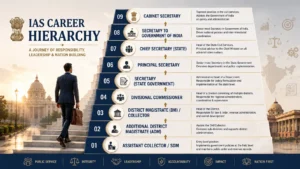
As officers gain experience, they handle larger administrative responsibilities, oversee multiple departments, and contribute to policymaking at the national level.
IFS Career Progression
IFS officers spend their careers representing India in different countries while also serving at the Ministry of External Affairs in New Delhi.
Typical IFS Promotion Hierarchy
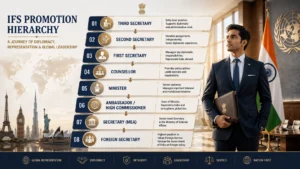
Promotion Opportunities
IAS Officers
Promotion depends on:
- Years of service
- Performance and Annual Performance Appraisal Reports (APAR)
- Departmental requirements
- Vacancies
- Government rules
As they progress, IAS officers take on greater administrative responsibilities and lead major government initiatives.
IFS Officers
Promotion is based on:
- Experience
- Performance evaluations
- Vacancies
- Government regulations
- Diplomatic assignments
Senior IFS officers often lead embassies, negotiate international agreements, and represent India in major global forums.
Opportunities Beyond Regular Postings
IAS Officer
IAS officers may get opportunities to:
- Serve in Central Government ministries
- Lead major national missions
- Head regulatory authorities
- Work with public sector enterprises
- Join constitutional or statutory bodies
- Represent India in select international organizations on deputation
IFS Officer
IFS officers may serve in:
- Indian Embassies
- High Commissions
- Consulates
- Permanent Missions to the United Nations and other international organizations
- Ministry of External Affairs
- International negotiations and global summits
Their careers provide continuous exposure to international diplomacy and foreign policy.
Leadership at the Highest Level
IAS Officer
The highest career achievement is becoming the Cabinet Secretary of India, the senior-most civil servant in the country, who coordinates the work of the Union Government and advises the Prime Minister and the Cabinet.
IFS Officer
The highest position is the Foreign Secretary of India, who heads the Ministry of External Affairs and is responsible for implementing India’s foreign policy and overseeing diplomatic missions worldwide.
Both positions are among the most prestigious and influential roles in the Indian Civil Services.
Which Service Offers Better Career Growth?
Both IAS and IFS provide excellent long-term career prospects, but the nature of growth differs.
Choose IAS if you aspire to:
- Lead district and state administration
- Shape domestic governance
- Manage large government departments
- Influence public policy and development
Choose IFS if you aspire to:
- Represent India internationally
- Build a career in diplomacy
- Lead embassies and high commissions
- Work on global issues and international negotiations
Neither service offers objectively “better” career growth the opportunities align with different career paths and interests.
IAS vs IFS: Which Should You Choose?
Choosing between the Indian Administrative Service (IAS) and the Indian Foreign Service (IFS) is one of the most important decisions for UPSC aspirants. Both services offer prestige, leadership opportunities, and the chance to serve the nation, but they differ significantly in terms of responsibilities, work environment, career goals, and lifestyle.
There is no universally “better” service. The right choice depends on your interests, personality, skills, and long-term career aspirations.
If you enjoy solving administrative challenges, working closely with citizens, and contributing to governance within India, the IAS may be a better fit. On the other hand, if you are passionate about international relations, diplomacy, foreign policy, and representing India globally, the IFS could be the ideal career.
IAS vs IFS: Which Service Is Right for You?
| Choose IAS If You… | Choose IFS If You… |
|---|---|
| Want to work directly with people | Want to represent India abroad |
| Enjoy administration and governance | Have a strong interest in diplomacy |
| Want to implement government policies | Want to shape India’s foreign relations |
| Prefer working within India | Want regular overseas postings |
| Like solving public administration challenges | Enjoy multicultural environments |
| Want to lead districts and government departments | Want to work with foreign governments |
| Aspire to influence domestic policies | Aspire to influence international affairs |
| Prefer fieldwork and administrative leadership | Prefer diplomatic negotiations and international cooperation |
Choose IAS If…
The Indian Administrative Service is ideal for candidates who want to play a direct role in governing the country and improving public administration.
You may enjoy an IAS career if you:
- Want to make a direct impact on people’s lives.
- Are interested in governance and public policy.
- Enjoy leadership and decision-making.
- Like managing large teams and government departments.
- Prefer solving real-world administrative problems.
- Want to work on development, infrastructure, healthcare, education, and public welfare.
- Are comfortable with challenging field postings and administrative responsibilities.
IAS officers often work at the grassroots level before moving into senior leadership roles, making it an excellent choice for those passionate about nation-building within India.
Choose IFS If…
The Indian Foreign Service is best suited for candidates who aspire to represent India on the global stage.
You may enjoy an IFS career if you:
- Have a strong interest in international relations.
- Enjoy diplomacy and foreign policy.
- Like learning about different cultures and countries.
- Are comfortable relocating to different parts of the world.
- Have strong communication and negotiation skills.
- Want to work with international organizations and foreign governments.
- Aspire to strengthen India’s global presence through diplomacy.
IFS officers build careers that combine public service with international engagement, making it an excellent choice for those with a global outlook.
Personality Comparison
| Personality Trait | IAS | IFS |
|---|---|---|
| Leadership | ⭐⭐⭐⭐⭐ | ⭐⭐⭐⭐☆ |
| Public Interaction | ⭐⭐⭐⭐⭐ | ⭐⭐⭐☆☆ |
| Administrative Skills | ⭐⭐⭐⭐⭐ | ⭐⭐⭐☆☆ |
| Communication Skills | ⭐⭐⭐⭐☆ | ⭐⭐⭐⭐⭐ |
| Diplomacy & Negotiation | ⭐⭐⭐☆☆ | ⭐⭐⭐⭐⭐ |
| International Exposure | ⭐⭐☆☆☆ | ⭐⭐⭐⭐⭐ |
| Field Work | ⭐⭐⭐⭐⭐ | ⭐⭐☆☆☆ |
| Global Perspective | ⭐⭐☆☆☆ | ⭐⭐⭐⭐⭐ |
| Adaptability | ⭐⭐⭐⭐☆ | ⭐⭐⭐⭐⭐ |
Common Misconceptions
“IAS is always better than IFS.”
Both services are equally prestigious and selected through the same UPSC examination. They simply serve different purposes.
“IFS officers only travel.”
While international postings are a key feature, IFS officers also handle negotiations, policy implementation, crisis management, and consular responsibilities.
“IAS officers have more authority everywhere.”
IAS officers have greater administrative authority within India, whereas IFS officers hold significant diplomatic authority in international affairs.
“Choose the service with the higher salary.”
Both services offer excellent pay and benefits. Your decision should be based on your interests and career goals rather than compensation alone.
Final Recommendation
Before filling your UPSC service preferences, ask yourself these questions:
- Do I want to improve governance within India or represent India internationally?
- Do I enjoy administration or diplomacy?
- Would I prefer working closely with citizens or engaging with foreign governments?
- Am I comfortable with frequent overseas postings?
- Which role aligns better with my long-term career vision?
Your answers will help you determine which service is the right fit for you.