
CAT Exam Pattern 2027: Section-wise Pattern, Questions & Marking Scheme
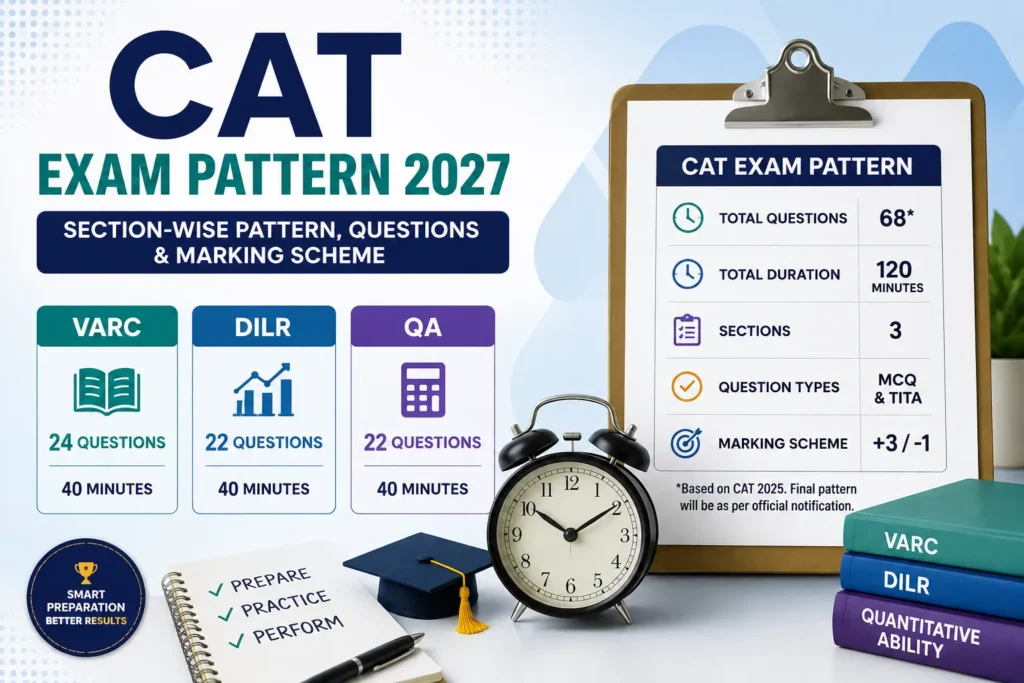
Before you start preparing for CAT, it’s important to know what the actual exam looks like. The CAT exam pattern tells you how much time you get, how the questions are divided between sections, and how marks are awarded.
CAT has three sections:
- Verbal Ability and Reading Comprehension (VARC)
- Data Interpretation and Logical Reasoning (DILR)
- Quantitative Aptitude (QA)
In the latest completed exam, CAT 2025, there were 68 questions to be attempted in 120 minutes. Each section had a separate 40-minute time limit.
The CAT 2027 pattern has not been announced yet, so the figures below are based on the latest available pattern. We should update this page when the official CAT 2027 notification is released.
CAT Exam Pattern at a Glance
| Particular | Details |
|---|---|
| Exam Mode | Computer-Based Test (CBT) |
| Total Questions | 68* |
| Total Duration | 120 minutes* |
| Sections | VARC, DILR & QA |
| Time per Section | 40 minutes* |
| Question Types | MCQ & TITA |
| Correct Answer | +3 marks |
| Incorrect MCQ | -1 mark |
| Incorrect TITA | No negative marking |
| Section Order | VARC → DILR → QA |
Based on CAT 2025. The final CAT 2027 pattern will depend on the official notification.
CAT Section-Wise Exam Pattern
The latest CAT paper had a slightly different number of questions in each section.
| Section | Questions | Maximum Marks | Time |
|---|---|---|---|
| VARC | 24 | 72 | 40 minutes |
| DILR | 22 | 66 | 40 minutes |
| QA | 22 | 66 | 40 minutes |
| Total | 68 | 204 | 120 minutes |
The CAT 2025 question paper followed this 24-22-22 distribution.
If you haven’t looked at the topics yet, it’s worth checking the CAT Syllabus before making your preparation plan.
1. Verbal Ability & Reading Comprehension (VARC)
VARC is the first section of the CAT paper. It checks how well you understand written information and deal with different types of verbal questions.
The section generally includes:
- Reading Comprehension
- Para Summary
- Para Jumbles
- Odd Sentence Out
- Verbal Ability questions
In CAT 2025, VARC had 24 questions, with 40 minutes to complete the section and a maximum of 72 marks.
If reading comprehension takes you a lot of time, don’t leave it until the end of your preparation. Regular reading and timed practice can make a noticeable difference.
2. Data Interpretation & Logical Reasoning (DILR)
DILR combines two skills that often require a different approach from the other CAT sections. You need to understand the information given in a set and then use logic or calculations to reach the answer.
Topics generally include:
- Tables
- Charts
- Graphs
- Caselets
- Seating arrangements
- Puzzles
- Arrangements
- Logical reasoning
The DILR section had 22 questions in CAT 2025 and was allotted 40 minutes, making the maximum score 66 marks.
One useful habit during preparation is to practise different types of sets rather than repeatedly solving the same kind of question.
3. Quantitative Aptitude (QA)
QA tests your understanding of mathematical concepts and your ability to solve numerical problems within a limited time.
The major areas generally include:
- Arithmetic
- Algebra
- Geometry
- Number System
- Modern Mathematics
CAT 2025 had 22 QA questions, with 40 minutes available for the section. The maximum score was 66 marks.
If you’re preparing from scratch, build your basics first. Once you’re comfortable with the concepts, start working on speed and question selection.
CAT Marking Scheme
CAT has two main types of questions: MCQs and TITA (Type in the Answer) questions.
The marking system used in CAT 2025 was:
| Response | Marks |
|---|---|
| Correct MCQ | +3 |
| Incorrect MCQ | -1 |
| Correct TITA | +3 |
| Incorrect TITA | 0 |
| Unattempted | 0 |
So, a wrong MCQ can reduce your score, while an incorrect TITA answer does not carry a negative mark.
This makes question selection important. You don’t have to attempt every question to perform well.
CAT Sectional Time Limit
The total exam time is divided equally between the three sections.
| Section | Time |
|---|---|
| VARC | 40 minutes |
| DILR | 40 minutes |
| QA | 40 minutes |
| Total | 120 minutes |
Candidates cannot freely move between the sections. Once the time for one section ends, they move to the next section.
The CAT 2025 paper instructions specified 40 minutes for each section.
This is something you should keep in mind while taking mock tests. Practising without a time limit won’t fully prepare you for the actual exam.
Can You Choose Which CAT Section to Attempt First?
No.
The section order is fixed. In the latest pattern, candidates move through:
VARC → DILR → QA
You therefore don’t get to start with the section you find easiest or return to an earlier section after its time has ended.
Instead, your preparation should focus on becoming comfortable with all three sections.
MCQ vs TITA Questions in CAT
CAT includes both Multiple Choice Questions (MCQs) and Type in the Answer (TITA) questions.
With an MCQ, you select one of the given options. With a TITA question, you enter the answer instead of choosing from options.
The main difference in the marking scheme is that an incorrect MCQ attracts -1 mark, while an incorrect TITA answer has no negative marking under the CAT 2025 pattern.
The exact mix of MCQs and TITA questions can vary, so candidates shouldn’t assume that every year’s paper will have the same distribution.
How the CAT Exam Pattern Affects Your Preparation
Knowing the number of questions isn’t enough. You also need to prepare with the time limit in mind.
VARC
Work on reading speed and comprehension rather than simply trying to read faster. Practise different types of passages and learn to identify the main argument, tone and important details.
DILR
DILR needs regular practice with different sets. Spend time learning how to identify which set is worth attempting instead of getting stuck on the first difficult set you see.
QA
Start with the basic concepts in Arithmetic, Algebra, Geometry and other important areas. Once your fundamentals are clear, timed practice can help improve your speed.
For a complete preparation plan, see our CAT Preparation Strategy.
CAT Exam Pattern and Time Management
The 40-minute limit for each section means that you cannot afford to spend too much time on one difficult question.
During practice, try to develop three habits:
- Recognise easier questions quickly.
- Don’t spend too long on a question that isn’t working out.
- Review your mistakes after every mock test.
Full-length mocks are particularly useful because they let you practise the complete 120-minute format rather than preparing each section in isolation.
You can also use CAT Previous Year Question Papers to get familiar with the types of questions that have appeared in recent exams.
CAT Exam Pattern: Important Points
Before you start taking mocks, keep these points in mind:
- CAT has three sections: VARC, DILR and QA.
- The latest completed CAT had 68 questions.
- The total test time was 120 minutes.
- Each section had 40 minutes.
- Both MCQs and TITA questions are included.
- A correct answer carries 3 marks.
- An incorrect MCQ carries -1 mark.
- TITA questions have no negative marking under the latest pattern.
- Candidates cannot freely switch between sections.
- The number of questions and other details can change in a future CAT edition.
Related CAT Resources
Once you understand the exam pattern, these resources can help you plan the next stage of your preparation:
| Guide | What You’ll Learn |
|---|---|
| CAT Exam | Understand the CAT examination, its sections, eligibility, and admission pathway. |
| CAT Eligibility | Check the educational qualification, minimum marks, age requirements, and eligibility criteria for CAT. |
| CAT Syllabus | Explore the complete VARC, DILR, and Quantitative Ability syllabus and important topics. |
| How to Prepare for CAT | Follow a structured preparation strategy to improve concepts, accuracy, speed, and exam performance. |
| CAT Previous Year Question Papers | Practice previous CAT questions to understand question types, difficulty levels, and exam trends. |
| Top IIM Colleges in India | Explore leading IIMs, their rankings, MBA programmes, and CAT admission process. |
Frequently Asked Questions
What is the CAT exam pattern?
CAT has three sections: VARC, DILR and QA. In the latest completed exam, each section had a 40-minute time limit, making the total exam duration 120 minutes.
How many questions are there in CAT?
The latest CAT paper had 68 questions: 24 in VARC, 22 in DILR and 22 in QA.
The number can change in future editions.
What is the duration of the CAT exam?
The latest pattern had a total duration of 120 minutes, with 40 minutes for each section.
Is there negative marking in CAT?
Yes. Under the latest pattern, an incorrect MCQ carries a -1 mark. TITA questions do not have negative marking.
Can I switch between CAT sections?
No. Each section has its own time limit, and candidates cannot freely move between sections.
What are the three sections in CAT?
The three sections are:
- VARC – Verbal Ability & Reading Comprehension
- DILR – Data Interpretation & Logical Reasoning
- QA – Quantitative Aptitude
How many marks is a correct CAT question worth?
A correct question carries 3 marks under the latest pattern.
Are all CAT questions MCQs?
No. CAT includes both MCQs and TITA questions.
Which section should I attempt first?
You don’t choose the section order. The sections are presented in a fixed sequence, so your preparation should cover all three rather than relying on one preferred section.
Does the CAT exam pattern change?
It can. The number of questions, timing and other exam details may be changed in a future CAT edition. For CAT 2027, candidates should check the official notification once it is released.
The official CAT website should be treated as the final source for the 2027 examination details.