
UPSC vs SSC: Which is Better? Complete Comparison 2027
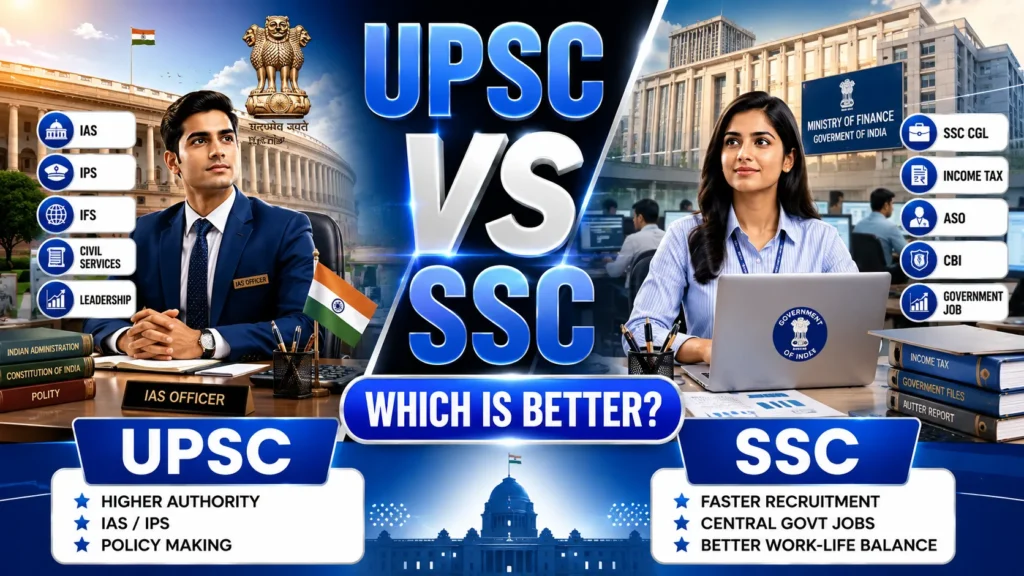
Choosing between UPSC (Union Public Service Commission) and SSC (Staff Selection Commission) is one of the most important decisions for candidates
preparing for government jobs in India. Both organizations recruit candidates for Central Government positions, but they differ significantly in terms of eligibility, exam pattern, difficulty level, salary, job responsibilities, career growth, and the type of roles they offer.
UPSC is responsible for recruiting candidates to prestigious Group A and Group B Civil Services, including the Indian Administrative Service (IAS), Indian Police Service (IPS), Indian Foreign Service (IFS), and Indian Revenue Service (IRS). On the other hand, SSC conducts recruitment for Group B and Group C posts in various Central Government ministries, departments, and organizations through examinations such as SSC CGL, SSC CHSL, SSC MTS, SSC CPO, and SSC JE.
If you’re confused about whether to prepare for UPSC or SSC, this detailed comparison will help you understand the key differences between the two examinations and choose the one that best aligns with your educational qualifications, career goals, preparation strategy, and long-term aspirations.
UPSC vs SSC: Quick Comparison
| Feature | UPSC | SSC |
|---|---|---|
| Full Form | Union Public Service Commission | Staff Selection Commission |
| Established | 1926 | 1975 |
| Primary Purpose | Recruitment to Civil Services and Group A & B Officer Posts | Recruitment to Group B & Group C Central Government Posts |
| Popular Exams | UPSC CSE, NDA, CDS, CAPF, IES | SSC CGL, CHSL, CPO, JE, MTS, Stenographer |
| Minimum Qualification | Graduation | 10th, 12th, or Graduation (depending on the exam) |
| Age Limit | Usually 21–32 Years | Generally 18–32 Years (varies by exam) |
| Selection Process | Prelims, Mains & Interview | Tier I, Tier II, Skill Test (Post-wise) |
| Difficulty Level | Very High | Moderate to High |
| Competition | Extremely High | High |
| Starting Salary | ₹56,100+ | ₹25,500–₹56,100+ (Post-wise) |
| Job Type | Administrative, Policy Making, Leadership | Administrative, Clerical, Investigation, Taxation, Enforcement, Technical |
| Posting | Across India & Abroad (Certain Services) | Central Government Offices Across India |
| Career Growth | Excellent | Good to Excellent |
| Best For | Candidates aspiring to become Civil Servants and Administrative Officers | Candidates seeking stable Central Government jobs with faster recruitment |
Key Differences Between UPSC and SSC
Although both UPSC and SSC recruit candidates for Central Government jobs, they differ significantly in terms of recruitment objectives, job profiles, eligibility, competition, and career progression. Understanding these differences will help you choose the examination that best suits your qualifications, interests, and long-term career goals.
The table below provides a detailed comparison between UPSC and SSC across the most important parameters.
| Parameter | UPSC | SSC |
|---|---|---|
| Conducting Body | Union Public Service Commission | Staff Selection Commission |
| Primary Objective | Recruit Group A & Group B Officers for Civil Services and other prestigious government services | Recruit Group B & Group C employees for various Central Government departments and ministries |
| Educational Qualification | Graduation from a recognized university | 10th, 12th, or Graduation depending on the examination |
| Popular Examinations | Civil Services (CSE), NDA, CDS, CAPF, Engineering Services | SSC CGL, CHSL, CPO, JE, MTS, Stenographer |
| Job Roles | IAS, IPS, IFS, IRS, IRTS, IAAS and other Civil Services | Income Tax Inspector, CBI Inspector, ASO, Auditor, Tax Assistant, Junior Engineer, Constable and more |
| Selection Process | Preliminary Examination, Mains Examination, Personality Test (Interview) | Tier I, Tier II, Skill Test / Physical Test (Post-wise) |
| Difficulty Level | Very High | Moderate to High |
| Competition | Extremely Competitive | Highly Competitive |
| Exam Duration | Usually 8–12 months from notification to final result | Generally 4–8 months depending on the recruitment |
| Salary | Higher starting salary with additional government perks | Good salary with regular promotions and allowances |
| Decision-Making Authority | High administrative and policy-making responsibilities | Departmental execution, administration, investigation, taxation, and clerical responsibilities |
| Career Growth | Faster promotion to senior administrative positions | Stable promotions with departmental career progression |
| Work Pressure | Generally High | Moderate (varies by department and post) |
| Work-Life Balance | Depends on the service and posting | Generally better compared to UPSC services |
| Posting | Anywhere in India and abroad (certain services) | Across Central Government offices in India |
UPSC vs SSC Eligibility Comparison
Eligibility is one of the biggest differences between UPSC and SSC examinations. While UPSC primarily conducts recruitment for graduates, SSC offers opportunities for candidates who have completed Class 10, Class 12, and Graduation, making it accessible to a wider range of aspirants.
Candidates should carefully check the eligibility criteria before choosing an examination, as age limits, educational qualifications, nationality, and physical standards vary depending on the recruitment.
Eligibility Comparison
| Criteria | UPSC | SSC |
|---|---|---|
| Minimum Educational Qualification | Bachelor’s Degree from a recognized university | 10th, 12th, or Graduation (Depends on the exam) |
| Minimum Age | 21 Years | 18 Years (Post-wise) |
| Maximum Age | Generally 32 Years (General Category) | Usually 27–32 Years (Varies by examination) |
| Nationality | Indian Citizen (Certain services have additional conditions) | Indian Citizen (As per official notification) |
| Physical Standards | Required for services such as IPS, CAPF, and some defence-related posts | Required only for specific recruitments like SSC CPO |
| Number of Attempts | Limited (Category-wise) | No fixed attempt limit; candidates can apply until they reach the maximum age limit |
| Experience Required | Not Required | Not Required |
Age Relaxation
Both UPSC and SSC provide age relaxation to reserved category candidates according to Government of India rules.
| Category | UPSC | SSC |
|---|---|---|
| SC / ST | 5 Years | 5 Years |
| OBC (Non-Creamy Layer) | 3 Years | 3 Years |
| PwBD | As per Government Rules | As per Government Rules |
| Ex-Servicemen | Applicable (Post-wise) | Applicable (Post-wise) |
Educational Qualification Comparison
| Qualification | UPSC | SSC |
|---|---|---|
| 10th Pass | ❌ | ✅ SSC MTS, Havaldar & Other Exams |
| 12th Pass | ❌ | ✅ SSC CHSL, Stenographer & Other Exams |
| Graduate | ✅ Civil Services, CDS, CAPF & Other Exams | ✅ SSC CGL, CPO, JE (Relevant Qualification), Selection Posts |
| Postgraduate | ✅ Eligible | ✅ Eligible |
Who Should Choose Which?
| If You Are… | Recommended Exam |
|---|---|
| 10th Pass | SSC |
| 12th Pass | SSC |
| Graduate aspiring for IAS/IPS/IFS | UPSC |
| Graduate seeking a Central Government office job | SSC CGL |
| Engineering Graduate | UPSC Engineering Services / SSC JE |
| Looking for multiple recruitment opportunities every year | SSC |
UPSC vs SSC Exam Pattern Comparison
The exam pattern is one of the biggest differences between UPSC and SSC. While UPSC focuses on evaluating analytical thinking, decision-making, writing ability, and overall personality through multiple stages, SSC primarily tests aptitude, reasoning, English, general awareness, and subject-specific skills through computer-based examinations.
Understanding the exam pattern helps candidates choose the right examination and prepare with a clear strategy.
Exam Pattern Comparison
| Feature | UPSC | SSC |
|---|---|---|
| Mode of Examination | Offline (Prelims OMR & Mains Written) | Mostly Online (Computer-Based Test) |
| Selection Stages | Prelims → Mains → Interview | Tier I → Tier II → Skill/Physical Test (Post-wise) |
| Question Type | Objective + Descriptive | Mostly Objective |
| Negative Marking | Yes (Prelims) | Yes (Most SSC Exams) |
| Interview | Yes (Civil Services Personality Test) | Only for a few posts; most SSC exams do not include interviews |
| Skill Test | Not Applicable (Except Post-specific Services) | Required for selected posts such as CHSL, Stenographer, and CPO |
| Duration of Selection Process | Approximately 8–12 Months | Approximately 4–8 Months |
UPSC Exam Pattern
The UPSC Civil Services Examination is conducted in three stages, and candidates must qualify each stage to move to the next.
| Stage | Description |
|---|---|
| Preliminary Examination | Two objective papers (General Studies Paper I & CSAT). Only GS Paper I is counted for merit, while CSAT is qualifying. |
| Main Examination | Nine descriptive papers, including Essay, General Studies, Optional Subject, and qualifying language papers. |
| Personality Test (Interview) | Evaluates personality, communication skills, decision-making ability, leadership qualities, and overall suitability for Civil Services. |
SSC Exam Pattern
SSC conducts different examinations such as SSC CGL, SSC CHSL, SSC MTS, SSC CPO, SSC JE, and Stenographer, each with its own pattern. However, most follow a multi-tier computer-based selection process.
| Stage | Description |
|---|---|
| Tier I | Computer-Based Test covering General Intelligence, General Awareness, Quantitative Aptitude, and English. |
| Tier II | Advanced Computer-Based Examination with post-specific subjects depending on the recruitment. |
| Skill Test / Physical Test | Conducted only for specific posts such as CHSL, Stenographer, CPO, and others where required. |
| Document Verification | Verification of educational certificates, identity proof, and other required documents before final appointment. |
Which Exam Pattern is More Challenging?
| Parameter | UPSC | SSC |
|---|---|---|
| Syllabus Size | ⭐⭐⭐⭐⭐ | ⭐⭐⭐☆☆ |
| Analytical Thinking | ⭐⭐⭐⭐⭐ | ⭐⭐⭐☆☆ |
| Writing Skills | ⭐⭐⭐⭐⭐ | ⭐⭐☆☆☆ |
| Aptitude Focus | ⭐⭐⭐☆☆ | ⭐⭐⭐⭐⭐ |
| Current Affairs Weightage | ⭐⭐⭐⭐⭐ | ⭐⭐⭐☆☆ |
| Overall Difficulty | ⭐⭐⭐⭐⭐ | ⭐⭐⭐⭐☆ |
UPSC vs SSC Difficulty Level
One of the most common questions among government job aspirants is whether UPSC is more difficult than SSC. While both examinations are highly competitive, they are designed for different purposes and test different skill sets.
UPSC focuses on evaluating a candidate’s analytical thinking, conceptual understanding, decision-making ability, writing skills, and personality, whereas SSC primarily assesses aptitude, reasoning, English language, general awareness, and subject-specific knowledge through objective examinations.
The level of difficulty depends on your preparation, educational background, and career goals. However, UPSC is generally considered more challenging because of its extensive syllabus, multi-stage selection process, and lower success rate.
Difficulty Comparison
| Parameter | UPSC | SSC |
|---|---|---|
| Overall Difficulty | ⭐⭐⭐⭐⭐ Very High | ⭐⭐⭐⭐☆ Moderate to High |
| Syllabus Size | Very Large | Moderate |
| Competition Level | Extremely High | High |
| Conceptual Depth | Very High | Moderate |
| Current Affairs Weightage | Very High | Moderate |
| Writing Skills Required | Extensive (Mains) | Minimal |
| Analytical Thinking | Very High | Moderate |
| Aptitude & Reasoning | Moderate | High |
| Preparation Time | 1–2 Years (Average) | 6–12 Months (Average) |
| Success Rate | Very Low | Comparatively Higher |
Why is UPSC Considered More Difficult?
UPSC is often regarded as India’s toughest competitive examination because candidates must clear multiple stages while demonstrating knowledge across a wide range of subjects.
Major reasons include:
- Extensive and dynamic syllabus.
- Multi-stage selection process (Prelims, Mains, and Interview).
- Descriptive answer writing in the Mains examination.
- High emphasis on analytical thinking and decision-making.
- Integration of current affairs with static subjects.
- Extremely limited vacancies compared to the number of applicants.
Why Do Many Candidates Choose SSC?
Although SSC is also highly competitive, many aspirants prefer it because the recruitment process is comparatively shorter and the syllabus is more focused.
Advantages of SSC include:
- Smaller syllabus compared to UPSC.
- Multiple recruitment examinations every year.
- Computer-based objective examinations.
- Faster recruitment cycle.
- Good salary and Central Government job security.
- Better work-life balance in many posts.
Which Exam Requires More Preparation?
| Preparation Area | UPSC | SSC |
|---|---|---|
| Current Affairs | ⭐⭐⭐⭐⭐ | ⭐⭐⭐☆☆ |
| General Studies | ⭐⭐⭐⭐⭐ | ⭐⭐⭐☆☆ |
| Quantitative Aptitude | ⭐⭐⭐☆☆ | ⭐⭐⭐⭐⭐ |
| Reasoning Ability | ⭐⭐⭐☆☆ | ⭐⭐⭐⭐⭐ |
| English Language | ⭐⭐⭐☆☆ | ⭐⭐⭐⭐☆ |
| Answer Writing | ⭐⭐⭐⭐⭐ | ⭐☆☆☆☆ |
| Interview Preparation | ⭐⭐⭐⭐⭐ | ⭐☆☆☆☆ |
UPSC vs SSC Salary Comparison
Salary is one of the most important factors candidates consider while choosing between UPSC and SSC. Both organizations offer attractive pay, government allowances, job security, and career growth. However, UPSC Civil Services officers generally receive higher salaries, greater administrative authority, and faster long-term career progression, while SSC jobs provide stable Central Government employment with competitive pay and a better work-life balance in many posts.
Apart from the basic salary, employees recruited through UPSC and SSC are also entitled to benefits such as Dearness Allowance (DA), House Rent Allowance (HRA), Travel Allowance (TA), medical facilities, pension benefits (as applicable), paid leave, and other government perks.
| Parameter | UPSC | SSC |
|---|---|---|
| Starting Basic Pay | ₹56,100 (Level 10) | ₹25,500–₹56,100 (Depending on Post) |
| Gross Monthly Salary | ₹80,000–₹1,20,000+ | ₹40,000–₹80,000+ |
| Pay Level | Level 10 and Above | Level 4–Level 8 (Post-wise) |
| Government Allowances | DA, HRA, TA, Medical & Other Benefits | DA, HRA, TA, Medical & Other Benefits |
| Promotion Opportunities | Excellent | Good to Excellent |
| Highest Career Salary | Very High | High |
Popular UPSC Posts & Salary
| Post | Pay Level | Approx. Monthly Salary |
|---|---|---|
| IAS Officer | Level 10 | ₹80,000–₹1,00,000+ |
| IPS Officer | Level 10 | ₹80,000–₹1,00,000+ |
| IFS Officer | Level 10 | ₹80,000–₹1,00,000+ |
| IRS Officer | Level 10 | ₹80,000–₹1,00,000+ |
| Other Group A Services | Level 10 | ₹75,000–₹95,000+ |
Popular SSC Posts & Salary
| Post | Pay Level | Approx. Monthly Salary |
|---|---|---|
| Assistant Section Officer (ASO) | Level 7 | ₹60,000–₹75,000 |
| Income Tax Inspector | Level 7 | ₹60,000–₹75,000 |
| CBI Inspector | Level 7 | ₹60,000–₹75,000 |
| Excise Inspector | Level 7 | ₹55,000–₹70,000 |
| Auditor / Accountant | Level 5 | ₹45,000–₹60,000 |
| Tax Assistant | Level 4 | ₹40,000–₹55,000 |
Which Offers Better Financial Growth?
| Factor | Better Choice |
|---|---|
| Higher Starting Salary | UPSC |
| Long-Term Salary Growth | UPSC |
| Administrative Benefits | UPSC |
| Stable Income with Faster Recruitment | SSC |
| Better Initial Return on Preparation Time | SSC |
| Senior Leadership Positions | UPSC |
UPSC vs SSC Job Profiles
One of the biggest differences between UPSC and SSC lies in the type of jobs they offer. UPSC recruits candidates for leadership, policy-making, administrative, diplomatic, and law enforcement roles, while SSC recruits candidates for executive, administrative, investigative, taxation, clerical, and technical positions across various Central Government ministries and departments.
If your career goal is to become a senior administrative officer with decision-making authority, UPSC is the ideal choice. On the other hand, if you prefer a stable Central Government office job with good career progression and work-life balance, SSC offers a wide range of excellent opportunities.
Popular UPSC Job Profiles
UPSC recruits officers for some of the most prestigious services in the country.
| Job Profile | Department / Service | Primary Responsibilities |
|---|---|---|
| IAS (Indian Administrative Service) | State & Central Government | District administration, policy implementation, governance, public administration |
| IPS (Indian Police Service) | Police Departments | Law enforcement, public safety, crime investigation, policing |
| IFS (Indian Foreign Service) | Ministry of External Affairs | Diplomacy, foreign relations, international negotiations |
| IRS (Indian Revenue Service) | Income Tax & Customs | Tax administration, revenue collection, financial investigations |
| IAAS | Indian Audit & Accounts Department | Government auditing and financial accountability |
| Other Group A Services | Various Ministries | Policy formulation, administration, regulation, and public service delivery |
Popular SSC Job Profiles
SSC recruits candidates for a wide variety of Central Government departments and organizations.
| Job Profile | Department | Primary Responsibilities |
|---|---|---|
| Assistant Section Officer (ASO) | Central Ministries | File management, policy support, administrative work |
| Income Tax Inspector | Income Tax Department | Tax assessment, investigation, compliance |
| CBI Inspector | Central Bureau of Investigation | Criminal investigations and enforcement |
| Excise Inspector | CBIC | GST, customs, and excise enforcement |
| Preventive Officer | Customs Department | Border security and customs inspections |
| Auditor | CAG, CGDA & Other Departments | Financial audits and accounts verification |
| Accountant / Junior Accountant | Government Departments | Accounting and financial management |
| Tax Assistant | CBDT & CBIC | Tax administration and office support |
| Junior Engineer (SSC JE) | CPWD, MES & Other Departments | Civil, Electrical, and Mechanical engineering work |
| Sub-Inspector (SSC CPO) | Delhi Police & CAPFs | Law enforcement and internal security |
Job Nature Comparison
| Parameter | UPSC | SSC |
|---|---|---|
| Leadership Role | ⭐⭐⭐⭐⭐ | ⭐⭐⭐☆☆ |
| Administrative Authority | Very High | Moderate |
| Policy Making | Yes | Limited |
| Field Work | High (Post-wise) | Moderate (Post-wise) |
| Office-Based Roles | Limited | Common |
| Public Interaction | High | Moderate |
| Transfers | Frequent | Moderate |
| Department Variety | High | Very High |
Which Job Profile is Right for You?
| If You Want… | Recommended Option |
|---|---|
| Become an IAS, IPS, or IFS Officer | UPSC |
| Work in district administration and governance | UPSC |
| Represent India internationally | UPSC (IFS) |
| Join the Income Tax or Customs Department | SSC CGL |
| Work in a Central Government ministry | SSC CGL (ASO) |
| Join CBI or enforcement agencies | SSC CGL |
| Become a Government Engineer | SSC JE |
| Join Delhi Police or CAPFs | SSC CPO |
UPSC vs SSC Career Growth
Career growth is another important factor to consider when choosing between UPSC and SSC. Both offer structured promotion systems, salary increments, and long-term job security. However, UPSC officers generally progress to senior leadership and policy-making positions, while SSC employees advance within their respective departments through departmental promotions and experience.
If your goal is to reach top administrative positions with significant decision-making authority, UPSC provides greater opportunities. If you prefer a stable Central Government career with regular promotions and departmental specialization, SSC is an excellent option.
Career Growth Comparison
| Parameter | UPSC | SSC |
|---|---|---|
| Promotion Speed | Fast (Performance & Seniority Based) | Moderate (Department & Vacancy Based) |
| Highest Position | Cabinet Secretary, Chief Secretary, DGP, Ambassador, Secretary to Government | Director, Joint Secretary (Department-wise), Senior Administrative Officer |
| Administrative Authority | Very High | Moderate |
| Leadership Opportunities | Excellent | Good |
| Inter-Department Transfers | Common | Limited |
| Foreign Posting Opportunities | Available in Services like IFS | Available for selected departments, but limited |
| Long-Term Salary Growth | Excellent | Good to Excellent |
Typical Career Progression in UPSC
Although promotions vary by service, a Civil Services Officer generally progresses through the following hierarchy:
| Career Stage | Example Position |
|---|---|
| Entry Level | IAS / IPS / IFS / IRS Officer (Level 10) |
| Mid-Level | District Magistrate, Superintendent of Police, Deputy Secretary |
| Senior Level | Divisional Commissioner, Inspector General, Joint Secretary |
| Top Leadership | Additional Secretary, Secretary to Government of India, Cabinet Secretary / DGP / Ambassador (Service-wise) |
Typical Career Progression in SSC
Career progression depends on the department and post. Promotions are generally based on departmental examinations, seniority, and vacancies.
| Career Stage | Example Position |
|---|---|
| Entry Level | Assistant Section Officer, Inspector, Auditor, Tax Assistant |
| Mid-Level | Section Officer, Superintendent, Senior Inspector |
| Senior Level | Assistant Director, Deputy Director, Senior Administrative Officer |
| Top Level | Director / Departmental Head (Department-wise) |
Which Offers Better Career Growth?
| Career Goal | Better Choice |
|---|---|
| Reach the highest administrative positions | UPSC |
| Lead districts, states, or national-level departments | UPSC |
| Build a specialized departmental career | SSC |
| Faster access to leadership roles | UPSC |
| Stable promotions within Central Government departments | SSC |
| Greater decision-making authority | UPSC |
UPSC vs SSC: Which Should You Choose?
There is no single “better” examination between UPSC and SSC. The right choice depends on your educational qualifications, career aspirations, preparation time, interests, and preferred work environment. While UPSC offers opportunities to become senior civil servants with significant administrative authority, SSC provides stable and rewarding careers across various Central Government departments with comparatively shorter recruitment cycles.
Before deciding, consider factors such as the type of work you want to do, the amount of time you can dedicate to preparation, your strengths, and your long-term career goals.
Choose UPSC If You…
- Aspire to become an IAS, IPS, IFS, IRS, or other Civil Services Officer.
- Want to work in public administration, governance, diplomacy, or policy-making.
- Enjoy analytical thinking, writing, and current affairs.
- Are willing to invest 1–2 years in dedicated preparation.
- Can handle a vast syllabus and a highly competitive examination.
- Want leadership roles with significant administrative responsibilities.
- Aim for higher long-term career growth and decision-making authority.
Choose SSC If You…
- Want a stable Central Government job with attractive salary and benefits.
- Prefer objective-type examinations over descriptive papers.
- Are strong in Quantitative Aptitude, Reasoning, and English.
- Want multiple recruitment opportunities every year.
- Prefer a comparatively shorter preparation cycle.
- Are looking for office-based, investigation, taxation, or departmental roles.
- Value work-life balance and steady career progression.
Frequently Asked Questions (FAQs) – IAS vs IFS
Which is better, UPSC or SSC?
Is UPSC more difficult than SSC?
Which offers a higher salary, UPSC or SSC?
Can I prepare for UPSC and SSC together?
Which exam has a larger syllabus?
Is SSC easier than UPSC?
Which examination has more competition?
Can a graduate apply for both UPSC and SSC?
Can SSC employees later prepare for UPSC?
How do I decide between UPSC and SSC?
Related Resources
Continue your preparation with these helpful CareerMint guides:
| Resource | Description |
|---|---|
| UPSC | Complete guide to the UPSC Civil Services Examination, eligibility, syllabus, and preparation. |
| SSC | Learn about SSC exams, eligibility, recruitment process, and career opportunities. |
| UPSC Syllabus | Explore the complete Prelims and Mains syllabus subject-wise. |
| UPSC Preparation Strategy | Follow a step-by-step preparation plan for UPSC success. |
| UPSC Previous Year Question Papers | Download and practice year-wise Prelims and Mains papers. |
| Government Jobs | Discover the latest government job opportunities across India. |
| Competitive Exams | Explore popular competitive exams after 10th, 12th, graduation, diploma, and post-graduation. |