
JEE Syllabus 2027: Subject-wise Syllabus for JEE Main & JEE Advanced
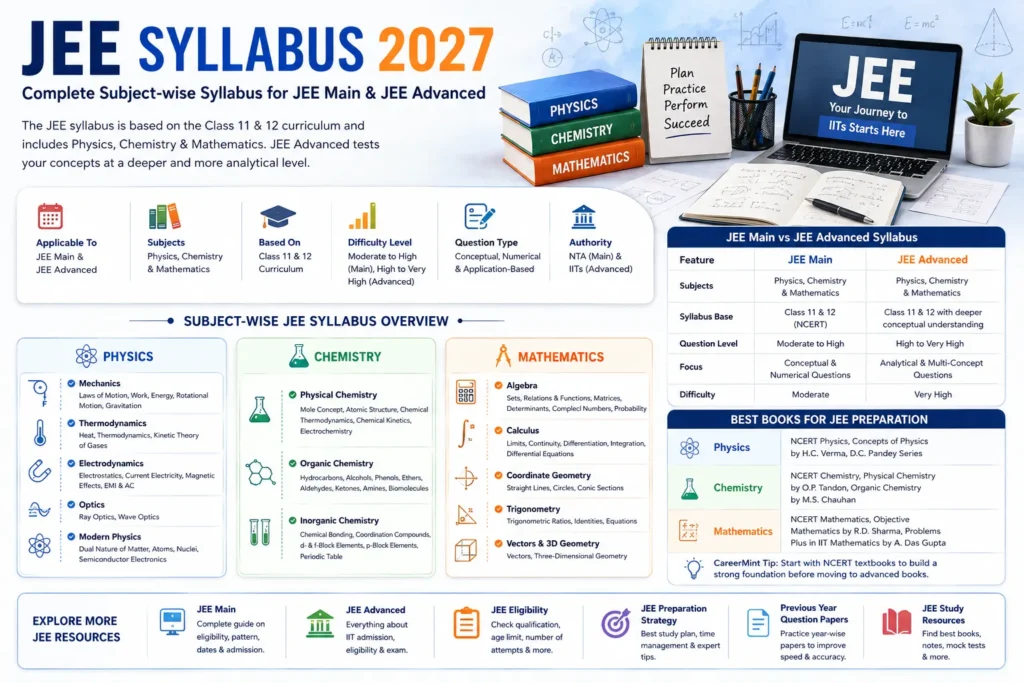
The JEE syllabus covers the topics students need to prepare for JEE Main and JEE Advanced. Both examinations test Physics, Chemistry and Mathematics, with the syllabus primarily based on the Class 11 and Class 12 curriculum.
There is considerable overlap between JEE Main and JEE Advanced, but Advanced generally requires a deeper understanding of concepts and more analytical problem-solving.
This guide covers the JEE Syllabus 2027, including subject-wise topics, the difference between JEE Main and JEE Advanced, recommended books and preparation resources.
JEE Syllabus 2027 Highlights
| Particular | Details |
|---|---|
| Exam | Joint Entrance Examination (JEE) |
| Applicable To | JEE Main & JEE Advanced |
| Subjects | Physics, Chemistry & Mathematics |
| Syllabus Base | Class 11 & Class 12 Curriculum |
| JEE Main Level | Moderate to High |
| JEE Advanced Level | High to Very High |
| Question Focus | Conceptual, Numerical & Application-Based |
| Official Authorities | NTA for JEE Main & IITs for JEE Advanced |
JEE Syllabus Overview
The JEE syllabus is divided into three subjects:
- Physics
- Chemistry
- Mathematics
The syllabus for both examinations is largely based on the Class 11 and Class 12 curriculum. However, JEE Advanced generally expects candidates to apply concepts in more analytical and multi-step problems.
Subject-wise JEE Syllabus
| Subject | Major Topics |
|---|---|
| Physics | Mechanics, Thermodynamics, Electrodynamics, Optics, Modern Physics |
| Chemistry | Physical Chemistry, Organic Chemistry, Inorganic Chemistry |
| Mathematics | Algebra, Calculus, Coordinate Geometry, Trigonometry, Vectors & 3D Geometry |
JEE Physics Syllabus
Physics requires a combination of conceptual understanding, mathematical application and numerical problem-solving.
| Unit | Important Topics |
|---|---|
| Mechanics | Laws of Motion, Work, Energy & Power, Rotational Motion, Gravitation |
| Thermodynamics | Heat, Thermodynamics, Kinetic Theory of Gases |
| Electrodynamics | Electrostatics, Current Electricity, Magnetic Effects, EMI & AC |
| Optics | Ray Optics, Wave Optics |
| Modern Physics | Dual Nature of Matter, Atoms, Nuclei, Semiconductor Electronics |
How to Study Physics
Start by understanding the concepts and formulas behind each chapter. After learning a topic, solve numerical problems and then move to previous year questions.
For additional practice, you can use the JEE Previous Year Question Papers page.
JEE Chemistry Syllabus
Chemistry is divided into Physical Chemistry, Organic Chemistry and Inorganic Chemistry.
| Section | Important Topics |
|---|---|
| Physical Chemistry | Mole Concept, Atomic Structure, Chemical Thermodynamics, Chemical Kinetics, Electrochemistry |
| Organic Chemistry | Hydrocarbons, Alcohols, Phenols, Ethers, Aldehydes, Ketones, Amines, Biomolecules |
| Inorganic Chemistry | Chemical Bonding, Coordination Compounds, d- & f-Block Elements, p-Block Elements, Periodic Table |
How to Study Chemistry
Use NCERT textbooks as your starting point and make short revision notes for important reactions, concepts and formulas. After covering the basics, practise questions and previous year papers.
JEE Mathematics Syllabus
Mathematics focuses on logical thinking, analytical ability and mathematical problem-solving.
| Unit | Important Topics |
|---|---|
| Algebra | Sets, Relations & Functions, Matrices, Determinants, Complex Numbers, Probability |
| Calculus | Limits, Continuity, Differentiation, Integration, Differential Equations |
| Coordinate Geometry | Straight Lines, Circles, Conic Sections |
| Trigonometry | Trigonometric Ratios, Identities, Equations |
| Vectors & 3D Geometry | Vectors, Three-Dimensional Geometry |
How to Study Mathematics
Mathematics improves mainly through regular problem-solving. Learn the concept first, solve basic questions, and gradually move towards more difficult problems.
JEE Main vs JEE Advanced Syllabus
Both examinations cover Physics, Chemistry and Mathematics, but the way these concepts are tested is different. JEE Main focuses more on core concepts and numerical application, while JEE Advanced places greater emphasis on analytical thinking and multi-concept problem solving.
| Feature | JEE Main | JEE Advanced |
|---|---|---|
| Subjects | Physics, Chemistry & Mathematics | Physics, Chemistry & Mathematics |
| Syllabus Base | Class 11 & 12 | Class 11 & 12 with deeper conceptual application |
| Question Focus | Conceptual & Numerical | Analytical & Multi-Concept |
| Difficulty | Moderate to High | High to Very High |
If you are preparing specifically for IIT admission, also see the JEE Advanced guide.
Best Books for JEE Preparation
Books should be used to strengthen concepts and provide additional practice. You don’t need to study from a large number of books at the same time.
| Subject | Recommended Books |
|---|---|
| Physics | NCERT Physics, Concepts of Physics by H.C. Verma, D.C. Pandey Series |
| Chemistry | NCERT Chemistry, Physical Chemistry by O.P. Tandon, Organic Chemistry by M.S. Chauhan |
| Mathematics | NCERT Mathematics, R.D. Sharma, Problems Plus in IIT Mathematics by A. Das Gupta |
CareerMint Tip: Start with NCERT textbooks to build your foundation, then use reference books for additional practice and more difficult questions.
How to Complete the JEE Syllabus
A practical approach is to work through the syllabus in stages rather than trying to finish every topic at once.
Step 1: Understand the Concept
Study the chapter and make sure you understand the basic principles before moving to questions.
Step 2: Practise Topic-wise Questions
After completing a topic, solve questions based specifically on that topic.
Step 3: Solve Previous Year Questions
Use PYQs to understand how the concept has appeared in actual JEE examinations.
Step 4: Take Mock Tests
Once you have covered a substantial portion of the syllabus, begin taking sectional and full-length tests.
Step 5: Revise Regularly
Maintain short notes, formulas and an error list so that difficult concepts can be revised quickly.
The source recommends concept-by-concept learning, topic-wise practice, PYQs, mock tests and regular revision.
For a complete study plan, visit the JEE Preparation Strategy page.
Is JEE Syllabus Based on NCERT?
Yes. The JEE syllabus is primarily based on the Class 11 and Class 12 curriculum, making NCERT an important starting point for preparation.
However, reading NCERT alone may not provide enough practice for every type of JEE question. Students should also solve previous year questions, reference-book problems and mock tests.
Does JEE Advanced Have a Different Syllabus?
There is substantial overlap between JEE Main and JEE Advanced, but the questions in Advanced generally require deeper conceptual understanding and more application of multiple concepts.
Therefore, students preparing for JEE Advanced should not only memorize formulas or solve routine questions. They should practise applying concepts to unfamiliar problems.
How to Revise the JEE Syllabus
Once you have completed a significant portion of the syllabus, revision should become a regular part of your routine.
Focus on:
- Short notes
- Formula sheets
- Important concepts
- Topic-wise questions
- Previous year papers
- Mock-test mistakes
- Weak chapters
Regular error analysis can help you identify topics that need another round of preparation.
Frequently Asked Questions
What is the JEE syllabus?
The JEE syllabus includes Physics, Chemistry and Mathematics, primarily based on the Class 11 and Class 12 curriculum. It is used for preparation for both JEE Main and JEE Advanced.
Is JEE Main syllabus the same as JEE Advanced?
There is significant overlap, but JEE Advanced generally tests concepts at a deeper level and includes more analytical and application-based problems.
Which subjects are included in JEE?
The three subjects are:
- Physics
- Chemistry
- Mathematics
Is JEE syllabus based on NCERT?
Yes. The syllabus is primarily based on the NCERT Class 11 and Class 12 curriculum. However, additional practice is needed for JEE-level questions.
Which subject is most important for JEE?
All three subjects are important. A balanced preparation covering Physics, Chemistry and Mathematics is recommended.
Does JEE Advanced have additional topics?
The source highlights that JEE Advanced places greater emphasis on deeper conceptual understanding and application. While there is significant syllabus overlap, its questions are generally more analytical and challenging.
Should I study only NCERT for JEE?
NCERT is a useful starting point, particularly for Chemistry and fundamental concepts. Students should also use reference books, previous year papers and mock tests for additional practice.
How should I complete the JEE syllabus?
A practical approach is:
- Understand concepts chapter by chapter.
- Solve topic-wise questions.
- Practise previous year questions.
- Take regular mock tests.
- Revise frequently.
Which books are recommended for JEE preparation?
The source recommends:
- Physics: NCERT, H.C. Verma, D.C. Pandey
- Chemistry: NCERT, O.P. Tandon, M.S. Chauhan
- Mathematics: NCERT, R.D. Sharma, A. Das Gupta
Can I prepare for JEE without coaching?
Yes. Self-study can be done using NCERT books, standard reference books, online resources and regular practice.
How long does it take to complete the JEE syllabus?
Preparation time varies depending on the student’s academic level and study schedule. The source notes that many aspirants prepare over 1–2 years.
Is the JEE syllabus revised every year?
Minor changes can occur. Candidates should check the latest syllabus published by NTA for JEE Main and the relevant IIT authority for JEE Advanced.
Where can I download the latest JEE syllabus?
The latest syllabus can be obtained from the official JEE Main and JEE Advanced websites. CareerMint can also provide a simplified subject-wise version for easier reference.
What is the best way to revise the JEE syllabus?
Use short notes, formula sheets, topic-wise revision, previous year papers, mock tests and error analysis as part of your revision routine.