
NEET Syllabus 2027: Subject-Wise Physics, Chemistry & Biology Syllabus
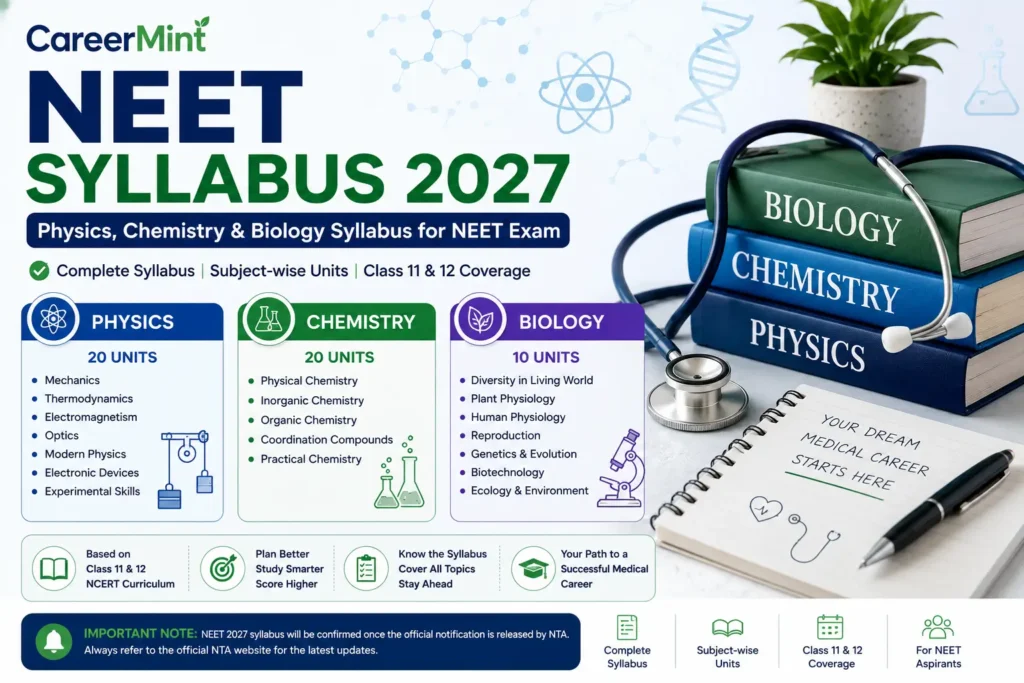
The NEET syllabus covers Physics, Chemistry, and Biology from the prescribed Class 11 and Class 12 curriculum. Understanding the syllabus before starting preparation helps you organize topics, prioritize revision, and track your progress.
For NEET 2027, the official syllabus should be confirmed when the NTA/NMC releases the 2027 examination information. The latest published syllabus available is for NEET UG 2026. NTA’s official website currently lists the 2026 syllabus notice and information bulletin.
Important: The topic lists below are based on the latest available NEET syllabus. Update this page if the official NEET 2027 syllabus introduces any changes.
NEET Syllabus 2027: Quick Overview
| Subject | Coverage | Units |
|---|---|---|
| Physics | Class 11 & 12 topics + Experimental Skills | 20 |
| Chemistry | Physical, Inorganic & Organic Chemistry | 20 |
| Biology | Botany & Zoology | 10 |
The current syllabus covers 20 Chemistry units and 10 Biology units; Physics is organized into 19 core units plus Experimental Skills.
NEET Physics Syllabus
The Physics syllabus includes concepts from mechanics, thermodynamics, electricity, magnetism, optics, modern physics, and experimental skills. The latest syllabus contains 19 core units plus Experimental Skills.
Physics Units
- Physics and Measurement
- Kinematics
- Laws of Motion
- Work, Energy and Power
- Rotational Motion
- Gravitation
- Properties of Solids and Liquids
- Thermodynamics
- Kinetic Theory of Gases
- Oscillations and Waves
- Electrostatics
- Current Electricity
- Magnetic Effects of Current and Magnetism
- Electromagnetic Induction and Alternating Currents
- Electromagnetic Waves
- Optics
- Dual Nature of Matter and Radiation
- Atoms and Nuclei
- Electronic Devices
- Experimental Skills
The Physics syllabus includes both theoretical concepts and experimental skills relevant to the examination.
NEET Chemistry Syllabus
Chemistry is divided into Physical Chemistry, Inorganic Chemistry, and Organic Chemistry. The current syllabus contains 20 units.
Physical Chemistry
- Some Basic Concepts of Chemistry
- Atomic Structure
- Chemical Bonding and Molecular Structure
- Chemical Thermodynamics
- Solutions
- Equilibrium
- Redox Reactions and Electrochemistry
- Chemical Kinetics
Inorganic Chemistry
- Classification of Elements and Periodicity in Properties
- P-Block Elements
- D- and F-Block Elements
- Coordination Compounds
Organic Chemistry
- Purification and Characterisation of Organic Compounds
- Some Basic Principles of Organic Chemistry
- Hydrocarbons
- Organic Compounds Containing Halogens
- Organic Compounds Containing Oxygen
- Organic Compounds Containing Nitrogen
- Biomolecules
- Principles Related to Practical Chemistry
The latest syllabus also includes practical chemistry topics such as qualitative analysis, preparation of selected compounds, titrimetric exercises, and principles behind specific experiments.
NEET Biology Syllabus
Biology is divided into Botany and Zoology and contains 10 units covering major areas of plant biology, animal biology, human physiology, genetics, biotechnology, and ecology.
Biology Units
- Diversity in Living World
- Structural Organisation in Animals and Plants
- Cell Structure and Function
- Plant Physiology
- Human Physiology
- Reproduction
- Genetics and Evolution
- Biology and Human Welfare
- Biotechnology and Its Applications
- Ecology and Environment
These units cover topics such as classification, cell biology, plant processes, human body systems, reproduction, genetics, diseases, biotechnology, ecosystems, and biodiversity.
NEET Syllabus: Class 11 vs Class 12
The syllabus draws from both Class 11 and Class 12-level content.
| Subject | Class 11 Focus | Class 12 Focus |
|---|---|---|
| Physics | Mechanics, properties of matter, thermodynamics, oscillations and waves | Electricity, magnetism, optics, modern physics, electronic devices |
| Chemistry | Basic concepts, atomic structure, bonding, thermodynamics, equilibrium and fundamentals | Solutions, electrochemistry, kinetics, organic and inorganic chemistry |
| Biology | Diversity, structural organisation, cell, plant physiology, human physiology | Reproduction, genetics, biotechnology, human welfare, ecology |
Most Important NEET Syllabus Areas
Instead of studying only the topics that appear frequently, candidates should cover the complete official syllabus. However, some broad areas are particularly important for building a strong preparation base.
Physics
- Mechanics
- Electricity
- Magnetism
- Optics
- Modern Physics
- Thermodynamics
Chemistry
- Chemical Bonding
- Thermodynamics
- Equilibrium
- Electrochemistry
- Organic Chemistry
- Coordination Compounds
Biology
- Human Physiology
- Genetics and Evolution
- Cell Biology
- Reproduction
- Ecology
- Biotechnology
These are useful preparation categories, but they should not be treated as a substitute for the official syllabus.
How to Complete the NEET Syllabus
A practical approach is to divide the syllabus into three stages:
1. Complete the Concepts
Study each topic systematically and build your fundamentals before moving to intensive question practice.
2. Practice Questions
After completing a topic, solve NEET-level questions and identify concepts that need additional work.
3. Revise and Test
Regularly revise completed topics and use mock tests and previous year question papers to evaluate your preparation.
NEET Syllabus and NCERT
NCERT textbooks are an important foundation for NEET preparation, particularly for Biology. However, students should use the official NEET syllabus as the final checklist rather than assuming that every NCERT topic is automatically part of the examination syllabus.
The latest syllabus is based on the prescribed curriculum and was officially notified for NEET 2026.
Frequently Asked Questions (FAQs)
What is the syllabus of NEET?
The NEET syllabus covers Physics, Chemistry, and Biology, with content from the prescribed Class 11 and Class 12 curriculum.
How many subjects are in the NEET syllabus?
There are three main subjects: Physics, Chemistry, and Biology.
Is the NEET syllabus based on NCERT?
The syllabus is aligned with the prescribed school-level curriculum, and NCERT forms an important foundation for NEET preparation. Candidates should follow the officially notified syllabus.
Is the NEET 2027 syllabus released?
As of now, the latest official syllabus available is for NEET 2026. The NEET 2027 syllabus should be updated when the official notification is released.
How many units are in NEET Biology?
The current Biology syllabus contains 10 units.
How many units are in NEET Chemistry?
The current Chemistry syllabus contains 20 units.
How many units are in NEET Physics?
The current Physics syllabus has 19 core units plus Experimental Skills.
Related NEET Guides
| Guide | What You’ll Learn |
|---|---|
| NEET Exam | Understand NEET, its purpose, subjects, and medical admission pathway. |
| NEET Eligibility 2027 | Check qualification, age, subjects, marks, and other eligibility requirements. |
| NEET Exam Pattern 2027 | Learn about questions, marks, duration, and the marking scheme. |
| How to Prepare for NEET | Follow a structured strategy for completing the syllabus and improving your preparation. |
| NEET Previous Year Question Papers | Practice previous NEET questions and understand actual exam-level difficulty. |