

Introduction
Balancing a full-time job with UPSC preparation may seem challenging, but it is entirely possible with the right strategy, discipline, and consistency. Every year, thousands of working professionals from fields such as IT, banking, engineering, teaching, healthcare, and the corporate sector appear for the UPSC Civil Services Examination while continuing their jobs. Many of them successfully achieve their dream of becoming IAS, IPS, or IFS officers without taking a career break.
One of the biggest misconceptions about the UPSC exam is that only full-time students can crack it. In reality, success in UPSC depends more on smart planning, quality study, regular revision, and effective time management than on the number of hours spent studying. Working professionals often develop valuable skills such as discipline, responsibility, problem-solving, and time management through their jobs, which can become significant advantages during UPSC preparation.
However, preparing for UPSC while working also comes with challenges, including office responsibilities, long commuting hours, physical fatigue, and limited study time. Overcoming these obstacles requires a realistic study schedule, clear daily goals, and consistent effort over a long period.
In this guide, you will learn whether working professionals can truly crack UPSC, the benefits and challenges of preparing alongside a job, practical time management strategies, study schedules, common mistakes to avoid, and inspiring success stories of candidates who achieved success while working full-time. If you are determined to serve the nation but do not want to leave your job immediately, this comprehensive guide will help you plan your UPSC journey with confidence and clarity.
Is It Really Possible to Crack UPSC While Working?
Yes, it is absolutely possible to crack the UPSC Civil Services Examination while working full-time. Every year, many candidates from professions such as engineering, banking, teaching, healthcare, IT, and the corporate sector successfully clear the examination without leaving their jobs. Their success proves that UPSC is not about studying for the maximum number of hours but about studying with consistency, focus, and the right strategy.
Working professionals may have less free time than full-time aspirants, but they often possess qualities that are extremely valuable for UPSC preparation. Skills such as discipline, time management, problem-solving, and the ability to work under pressure help them maintain a structured study routine. By making the best use of early mornings, evenings, weekends, and short breaks during the day, many candidates complete the entire syllabus effectively.
Preparing while working requires careful planning. Instead of aiming for long study sessions, working professionals should focus on daily targets, regular revision, answer writing practice, and current affairs. Even studying 3–5 focused hours on weekdays and 8–10 hours on weekends can produce excellent results when maintained consistently over several months.
It is also important to set realistic expectations. Balancing office responsibilities with UPSC preparation can be physically and mentally demanding, but proper rest, a healthy lifestyle, and consistent motivation make the journey manageable.
Ultimately, your job does not determine your success in UPSC. Your commitment, smart planning, and ability to stay consistent matter far more. With patience, determination, and a well-structured preparation strategy, working professionals can confidently compete with full-time aspirants and achieve their dream of joining the Indian Civil Services.

Biggest Advantages of Preparing While Doing a Job
Preparing for the UPSC Civil Services Examination while working full-time may seem difficult, but it offers several advantages that many full-time aspirants do not have. A stable job not only provides financial security but also helps develop valuable skills that are useful throughout the UPSC preparation journey.
One of the biggest advantages is financial independence. Working professionals can manage expenses such as coaching, books, online courses, test series, and travel without depending on their families. This financial stability reduces stress and allows candidates to focus on preparation with confidence.
Another important benefit is discipline and time management. Employees are accustomed to following schedules, meeting deadlines, and balancing multiple responsibilities. These habits help create a consistent study routine, making it easier to complete the UPSC syllabus in a planned manner.
A full-time job also helps candidates develop professional skills such as communication, problem-solving, decision-making, teamwork, and leadership. These qualities are valuable during the UPSC Personality Test (Interview) and later in a career as a civil servant.
Working professionals often experience less pressure because they have a secure source of income while preparing. This allows them to make long-term preparation plans without worrying about immediate financial challenges.
In addition, exposure to a professional work environment improves maturity, confidence, and practical understanding of real-life situations. These experiences can help candidates answer ethics, governance, and situation-based questions more effectively in both the Mains Examination and the Interview.
Finally, balancing a job with UPSC preparation teaches consistency, patience, and resilience. Although the journey requires dedication and careful planning, the ability to manage work and studies together builds strong character and self-confidence.
With smart planning, regular revision, and effective time management, working professionals can turn their daily work experience into a major strength and successfully achieve their dream of becoming an IAS, IPS, or IFS officer.
Biggest Challenges Working Professionals Face
Preparing for the UPSC Civil Services Examination while managing a full-time job is not easy. Although many working professionals successfully clear the exam every year, they also face several challenges that require discipline, determination, and smart planning.
One of the biggest challenges is limited study time. After spending eight to ten hours at work, many candidates feel physically and mentally exhausted. Finding enough energy to study in the morning or after office hours can be difficult, especially during busy workdays.
Another common challenge is work-life balance. Office meetings, deadlines, overtime, business travel, and family responsibilities often reduce the time available for UPSC preparation. Missing a few study sessions can affect consistency if candidates do not have a proper backup plan.
Mental fatigue and stress are also major obstacles. After handling workplace pressure throughout the day, it becomes difficult to concentrate on subjects like Polity, History, Economy, or Ethics. Maintaining focus for long study sessions requires proper rest, healthy eating, and regular breaks.
Many working professionals also struggle with current affairs and revision. Reading newspapers daily, making notes, revising old topics, and practicing answer writing become challenging when study time is limited. Without regular revision, candidates may forget important concepts before the examination.
Another challenge is social commitments and distractions. Family functions, office events, and social media can reduce productive study hours. Successful candidates learn to prioritize their goals and avoid unnecessary distractions.
Finally, many aspirants face self-doubt after comparing themselves with full-time students. However, UPSC success depends on consistency, smart preparation, and quality study rather than the number of hours spent studying.
Despite these challenges, working professionals can crack UPSC with a realistic study plan, effective time management, and unwavering determination. Every small step taken consistently brings them closer to achieving their dream of becoming a civil servant.

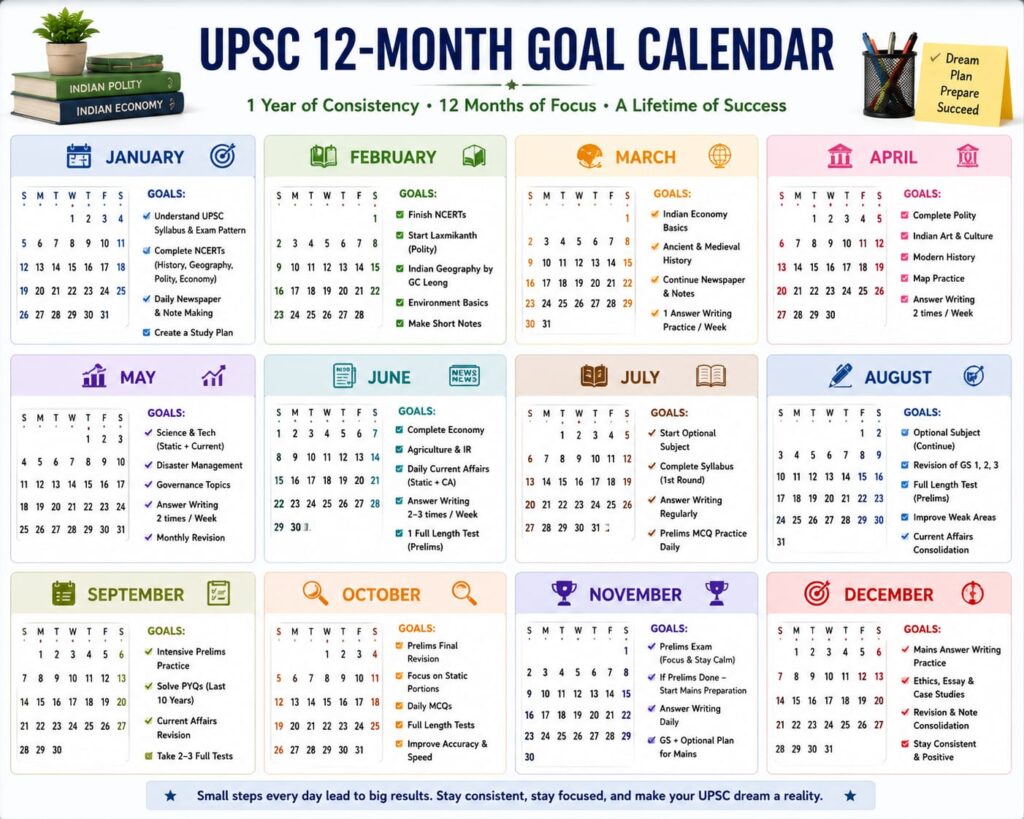
How to Make a 365-Day UPSC Plan with a Full-Time Job
Preparing for the UPSC Civil Services Examination while working full-time requires a well-structured long-term plan. Instead of trying to complete the entire syllabus quickly, divide your preparation into manageable phases spread across one year. A 365-day UPSC plan helps working professionals stay consistent without feeling overwhelmed.
Phase 1: Build a Strong Foundation (Months 1–3)
Begin by completing the NCERT books and understanding the basics of History, Geography, Polity, Economy, Environment, and Science. Read a newspaper daily for current affairs and make concise notes. Study for 3–4 hours on weekdays and 6–8 hours on weekends.
Phase 2: Cover the Standard Books (Months 4–6)
After completing NCERTs, move on to standard reference books such as Laxmikanth for Polity and other recommended resources. Start answer writing practice once or twice a week and revise previously completed topics every Sunday.
Phase 3: Optional Subject & Revision (Months 7–9)
Focus on completing your optional subject while continuing current affairs preparation. Increase answer writing practice and solve previous years’ UPSC question papers to understand the exam pattern. Regular revision should become a daily habit.
Phase 4: Mock Tests & Final Preparation (Months 10–12)
Dedicate the final three months to full-length mock tests, Prelims practice, revision, and improving weak areas. Analyse every mock test carefully and work on mistakes instead of simply attempting more tests.
To stay consistent throughout the year, set daily, weekly, and monthly goals. Use a planner or digital calendar to track your progress and celebrate small milestones. Avoid comparing your preparation with others and focus on improving a little every day.
Remember, clearing UPSC while working is a marathon, not a sprint. Even 3–5 hours of focused study on weekdays and productive weekends can lead to success if maintained consistently for an entire year. Discipline, regular revision, and smart planning are the real keys to cracking UPSC while balancing a full-time job.
10 Smart Productivity Hacks for Working Professionals Preparing for UPSC
10 Smart Productivity Hacks for Working Professionals Preparing for UPSC
Balancing a full-time job with UPSC preparation requires more than hard work—it demands smart productivity. Since working professionals have limited study time, using effective techniques can help maximize learning and improve consistency. Here are ten practical productivity hacks that can make your UPSC journey more efficient.
1. Wake Up Early
Study your most difficult subject in the morning when your mind is fresh and free from work-related stress. Even 2–3 focused hours before office can make a significant difference.
2. Plan Your Day in Advance
Before going to bed, prepare a simple study plan for the next day. Setting clear goals helps you stay organized and prevents wasting valuable time.
3. Follow the Pomodoro Technique
Study for 25–50 minutes, then take a 5–10 minute break. This technique improves concentration and reduces mental fatigue during long study sessions.
4. Utilize Your Commute
If you travel by metro, bus, or train, use the time to read current affairs, revise short notes, or listen to educational podcasts related to UPSC.
5. Make Short Revision Notes
Prepare concise notes containing important facts, formulas, and key concepts. These are extremely useful for quick revision before exams.
6. Limit Social Media Usage
Reduce unnecessary screen time by turning off notifications and setting specific times to check social media. Every saved minute can be invested in preparation.
7. Use Weekends Wisely
Reserve weekends for completing pending topics, solving mock tests, revising difficult subjects, and practicing answer writing. Weekend productivity is crucial for working professionals.
8. Prioritize Quality Over Quantity
Studying for 4 focused hours is far more effective than spending 8–10 distracted hours with books. Stay fully engaged during every study session.
9. Take Care of Your Health
Eat nutritious food, stay hydrated, exercise regularly, and sleep for 7–8 hours. Good health improves memory, concentration, and long-term productivity.
10. Stay Consistent and Positive
There will be busy workdays when you cannot study as planned. Instead of feeling discouraged, resume your routine the next day. Small, consistent efforts over months lead to remarkable results in the UPSC examination.
By following these smart productivity hacks, working professionals can make the best use of their limited time and build a sustainable preparation strategy. Consistency, discipline, and effective time management are the real secrets to cracking the UPSC Civil Services Examination while continuing a full-time.
Best Study Timetable for Working Professionals
Balancing a full-time job with UPSC preparation requires a practical and sustainable timetable. Instead of studying for long hours every day, working professionals should focus on consistency, quality learning, and regular revision. A well-planned daily routine can help cover the UPSC syllabus without affecting work performance.
Monday to Friday
5:00 AM – 5:30 AM: Wake up, freshen up, and do light exercise or meditation.
5:30 AM – 7:30 AM: Study your most challenging subject such as Polity, Economy, Optional Subject, or History.
7:30 AM – 8:30 AM: Breakfast and get ready for the office. Read newspaper headlines or current affairs while commuting if possible.
9:00 AM – 6:00 PM: Office hours. During lunch breaks, spend 15–20 minutes revising short notes, current affairs, or flashcards.
7:30 PM – 9:30 PM: Revise morning topics, solve MCQs, practice answer writing, or watch online UPSC lectures.
9:30 PM – 10:00 PM: Plan the next day’s study targets.
10:30 PM: Sleep to maintain energy and productivity.
Saturday
Dedicate 6–8 hours to completing pending topics, practicing answer writing, revising difficult subjects, and solving sectional mock tests.
Sunday
Study for 7–8 hours. Attempt a full-length mock test, analyse mistakes, revise the week’s topics, and prepare the study plan for the upcoming week.
The key to success is not studying for 12 hours every day but maintaining a realistic routine throughout the year. Even 3–5 focused study hours on weekdays and productive weekends are enough to crack UPSC if used wisely. Consistency, revision, and smart planning always outperform irregular long study sessions.
Can I Crack UPSC Without Coaching?
Should You Quit Your Job for UPSC?
Deciding whether to quit your job for UPSC preparation is a personal decision that depends on your financial situation, preparation level, and confidence. There is no universal answer because many candidates have cleared UPSC both while working and after leaving their jobs.
Pros of Quitting Your Job
More time to study and revise.
Easier to attend coaching classes or test series.
Better focus on answer writing and mock tests.
Flexible study schedule.
Faster syllabus completion.
Cons of Quitting Your Job
Loss of regular income.
Increased financial pressure.
Higher expectations from family.
Mental stress if results are delayed.
No work experience if multiple attempts are unsuccessful.
If your office schedule allows you to study consistently for 3–5 hours on weekdays and more on weekends, you may not need to resign immediately. Many successful IAS officers prepared while working because financial stability helped them stay focused.
However, if your job demands extremely long hours, frequent travel, or leaves almost no time for preparation, taking a break or resigning may be worth considering after careful planning. Before making such a decision, save enough money to support yourself for at least one year and create a structured UPSC preparation plan.
Ultimately, your success depends on consistency, smart preparation, and determination—not simply on whether you are employed or not.
Best Jobs for UPSC Aspirants
Many working professionals wonder which job is most suitable for UPSC preparation. The ideal job is one that provides financial security while leaving enough time and mental energy for regular study. Here are some of the best career options for UPSC aspirants.
*Government Job
Government jobs often have fixed working hours, holidays, and better work-life balance. This allows aspirants to maintain a consistent study routine while enjoying financial stability.
*IT Job
Many software professionals successfully crack UPSC by utilizing early mornings, evenings, and weekends for preparation. Remote work and flexible schedules can make preparation easier.
*Bank PO
Bank jobs offer good salaries and career growth, but workload can increase during financial year-end or audit periods. Proper time management is essential.
*Teacher
Teaching is considered one of the best professions for UPSC preparation because it offers structured schedules, holidays, and continuous learning opportunities.
*Work From Home (WFH) Job
Remote jobs reduce commuting time, allowing candidates to dedicate additional hours to studying, revision, and mock tests.
*Private Sector Job
Private sector jobs can be demanding, but candidates with disciplined schedules and supportive employers can still prepare successfully. Weekend planning and effective time management become especially important.
There is no perfect job for UPSC preparation. What matters most is your ability to maintain consistency, manage time effectively, and stay motivated throughout your preparation journey.
Real Working Professionals Who Cracked UPSC
Many successful civil servants have proved that a full-time job is not a barrier to clearing the UPSC Civil Services Examination. Their journeys inspire thousands of working professionals who dream of becoming IAS, IPS, or IFS officers.
Roman Saini
Roman Saini completed his MBBS and briefly worked as a doctor before clearing UPSC at the age of 22. His disciplined routine, strong fundamentals, and consistent revision helped him secure an excellent rank. Later, he co-founded an educational platform to help students prepare for competitive examinations.
Gaurav Agarwal
Before becoming an IAS officer, Gaurav Agarwal worked as an investment banker. Despite the demanding corporate environment, he managed his time efficiently and cleared UPSC with an outstanding rank. His success highlights the importance of planning and perseverance.
Ira Singhal
Ira Singhal worked in the corporate sector before achieving All India Rank 1 in UPSC. She overcame personal challenges through determination, disciplined preparation, and continuous self-improvement. Her story encourages aspirants to stay confident regardless of obstacles.
Srushti Jayant Deshmukh
Although known for her dedicated preparation, Srushti’s disciplined study habits, effective planning, and answer-writing practice continue to inspire both students and working professionals preparing for UPSC.
The common lesson from these successful candidates is clear: none of them relied on shortcuts. They followed structured study plans, revised consistently, practiced mock tests, and remained patient throughout their preparation. Their journeys prove that working professionals can successfully crack UPSC with dedication, effective time management, and a long-term strategy.
Frequently Asked Questions (FAQs)
1.Can working professionals really crack UPSC?
Yes, many working professionals successfully clear the UPSC Civil Services Examination every year. With proper time management, consistent study, and regular revision, balancing a full-time job and UPSC preparation is possible.
2.How many hours should a working professional study for UPSC?
Working professionals should aim to study 3–5 focused hours on weekdays and 6–8 hours on weekends. Quality study and consistency are more important than studying for long hours.
3.Should I quit my job to prepare for UPSC?
Not necessarily. If you can maintain a regular study schedule while working, you may not need to resign. Consider leaving your job only if your work schedule leaves almost no time for effective preparation and you have a solid financial backup.
4.Which job is best for UPSC preparation?
Jobs with fixed working hours are generally more suitable for UPSC aspirants. Government jobs, teaching, work-from-home (WFH) roles, banking, and flexible IT jobs often provide a better work-life balance for preparation.
5.How can I manage current affairs while working full-time?
Read a newspaper or reliable current affairs source daily for 30–45 minutes. You can also use your lunch break or commute to revise current affairs, listen to educational podcasts, or read short notes.
Conclusion

Preparing for the UPSC Civil Services Examination while working full-time is undoubtedly challenging, but it is far from impossible. Every year, dedicated working professionals prove that with the right strategy, disciplined time management, and consistent effort, they can successfully clear one of India’s toughest competitive examinations. Your job should never be seen as an obstacle—it can become a source of financial stability, discipline, and practical experience that strengthens your UPSC preparation.
The key to success lies in making the most of the time you have. A well-planned study schedule, regular revision, answer writing practice, current affairs preparation, and weekly mock tests can help you cover the syllabus effectively without compromising your professional responsibilities. Instead of focusing on studying for long hours, aim for productive and distraction-free study sessions every day.
There will be moments when office work becomes demanding or your preparation feels slow. During such times, remember that UPSC is a marathon, not a sprint. Small, consistent efforts made over several months produce far better results than irregular bursts of hard work. Stay patient, believe in your preparation, and keep improving one step at a time.
Most importantly, avoid comparing your journey with full-time aspirants. Every candidate has different circumstances, and success depends on dedication, smart planning, and perseverance—not on the number of hours available each day. If you remain committed to your goal, maintain a positive mindset, and follow a structured preparation plan, you can successfully balance your career while achieving your dream of becoming an IAS, IPS, or IFS officer.
Your job may pay your salary today, but your determination and consistent preparation can shape your future in the Indian Civil Services tomorrow. Stay focused, stay disciplined, and keep moving forward—your UPSC success story is waiting to be written.