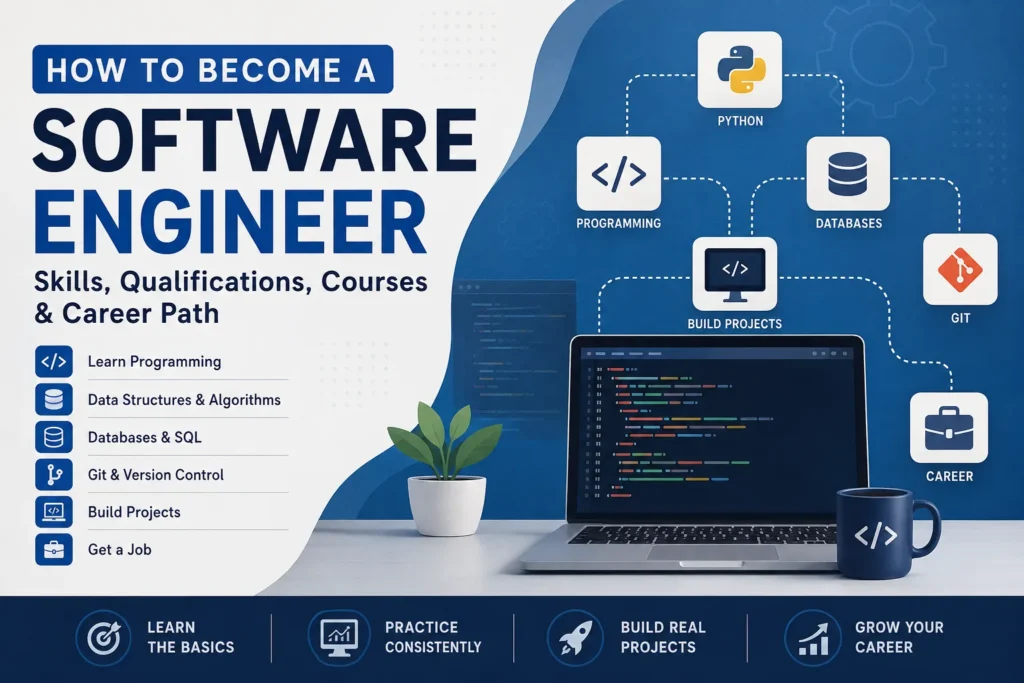
How to Become a Software Engineer: Skills, Qualifications, Courses & Career Path
A Software Engineer designs, develops, tests, maintains, and improves software applications and systems. It is one of the most popular technology careers, with opportunities across software companies, startups, banks, e-commerce, healthcare, education, and many other industries.
If you enjoy programming, problem-solving, technology, and building digital products, software engineering can be a strong career choice.
You don’t need to learn every programming language or technology at once. A better approach is to build strong programming fundamentals, choose a specialization, create practical projects, and gradually develop professional-level skills.
This guide explains how to become a Software Engineer, including qualifications, programming languages, technical skills, courses, projects, internships, salary, career paths, and how to get your first software engineering job.
What Does a Software Engineer Do?
A Software Engineer develops and maintains software that solves specific problems or provides useful services to users and organizations.
Depending on the role, responsibilities may include:
- Writing and maintaining code
- Designing software systems
- Developing applications
- Testing software
- Debugging errors
- Working with databases
- Building APIs
- Reviewing code
- Improving application performance
- Fixing security and reliability issues
- Collaborating with designers, product managers, and other engineers
- Maintaining and improving existing software
For example, a Software Engineer working on an e-commerce platform might develop features for user accounts, product search, shopping carts, payments, order tracking, and backend services.
How to Become a Software Engineer
A practical path to becoming a Software Engineer looks like this:
Learn Programming → Understand Computer Science Fundamentals → Choose a Development Path → Learn Databases & APIs → Build Projects → Learn Git → Build a Portfolio → Get an Internship → Prepare for Interviews → Apply for Jobs
You don’t need to master everything before building your first project. Start writing code early and gradually increase the complexity of your projects.
Step 1: Learn a Programming Language
Programming is the foundation of software engineering.
Choose one language and learn it properly before trying to learn several languages simultaneously.
Popular choices include:
- Python
- Java
- JavaScript
- C++
- C#
The best choice depends on the type of software you want to build.
For Web Development
Start with:
HTML → CSS → JavaScript
Then learn a frontend framework such as React and a suitable backend technology.
For Backend Development
You can build backend applications using technologies such as:
- Java
- Python
- JavaScript / Node.js
- C#
For Competitive Programming & Strong Fundamentals
Languages such as C++ or Java are commonly used for learning data structures and algorithms and preparing for technical interviews.
The important thing is not which language you choose first. The goal is to understand programming logic, problem-solving, and software development fundamentals.
Step 2: Learn Data Structures and Algorithms
Data Structures and Algorithms are important parts of software engineering fundamentals and are frequently tested during technical interviews.
Start with:
- Arrays
- Strings
- Linked lists
- Stacks
- Queues
- Hash tables
- Trees
- Graphs
- Heaps
Then learn algorithms and concepts such as:
- Searching
- Sorting
- Recursion
- Traversal
- Dynamic programming
- Greedy algorithms
- Time complexity
- Space complexity
You don’t need to begin with the hardest problems. Start with simple problems and gradually increase the difficulty.
The goal is to learn how to think about problems efficiently, not simply memorize solutions.
Step 3: Learn Object-Oriented Programming
Object-Oriented Programming (OOP) is widely used in software development.
Important concepts include:
- Classes
- Objects
- Encapsulation
- Inheritance
- Polymorphism
- Abstraction
- Constructors
- Interfaces
Understanding OOP makes it easier to work with large codebases and languages such as Java, C++, C#, and Python.
Step 4: Learn Databases
Most software applications need to store and retrieve information.
Start by understanding relational databases and SQL.
Learn:
- Tables
- Rows and columns
- Primary keys
- Foreign keys
- Relationships
- SQL queries
- Joins
- Indexes
- Transactions
- Database normalization
Popular database technologies include:
- MySQL
- PostgreSQL
- Microsoft SQL Server
You can later explore NoSQL databases such as MongoDB when your projects require them.
Step 5: Learn Git and GitHub
Software engineers commonly use version control to track code changes and collaborate with other developers.
Learn basic Git commands and concepts such as:
- Repository
- Commit
- Branch
- Merge
- Pull request
- Clone
- Push
- Pull
- Conflict resolution
Create a GitHub profile and use it to store and document your projects.
A well-organized repository can also become part of your professional portfolio.
Step 6: Choose a Software Engineering Specialization
Once you understand programming fundamentals, choose a direction rather than trying to learn every technology.
Frontend Development
Focus on:
HTML → CSS → JavaScript → React / other frontend frameworks
Backend Development
Focus on:
Programming Language → APIs → Databases → Authentication → Backend Framework
Full-Stack Development
Learn both frontend and backend development and understand how the complete application works.
Mobile App Development
Choose a platform and learn the appropriate technologies for Android or iOS development.
Cloud / DevOps
Focus on:
- Linux
- Networking
- Cloud platforms
- Containers
- CI/CD
- Infrastructure
AI / Machine Learning Engineering
Build a foundation in software engineering first, then learn:
- Python
- Mathematics
- Machine learning
- Model deployment
- AI frameworks
Educational Qualification to Become a Software Engineer
There is no single degree required for every Software Engineer position. However, a bachelor’s degree in a technical or computer-related field can be helpful when applying for jobs.
Common educational backgrounds include:
- B.Tech / B.E. in Computer Science
- B.Tech / B.E. in Information Technology
- BCA
- B.Sc. in Computer Science
- B.Sc. in Information Technology
- Other engineering or technical degrees
What matters alongside your qualification is your ability to write code, solve problems, understand software fundamentals, and build practical applications.
Can You Become a Software Engineer After 12th?
Yes. Students can start preparing for a Software Engineering career immediately after Class 12.
A common pathway is:
Class 12 → Bachelor’s Degree → Programming → DSA → Development Skills → Projects → Internship → Software Engineer Job
You can also begin learning programming while completing your degree. Starting early gives you more time to practise coding and build projects.
Students interested in Mathematics, Computer Science, technology, and problem-solving may find this career particularly suitable.
Can You Become a Software Engineer Without a Degree?
Yes, it is possible to enter software development without a traditional computer science degree. However, some companies and job positions may specifically require a bachelor’s degree.
If you take a non-traditional route, focus on demonstrating your ability through:
- Strong programming skills
- Data Structures and Algorithms
- Practical software projects
- GitHub portfolio
- Problem-solving practice
- Internships or freelance work
- Technical interview preparation
Your projects should demonstrate that you can build functional, maintainable software, rather than simply following tutorials.
Essential Software Engineer Skills
A Software Engineer needs a combination of programming, computer science, development, and problem-solving skills.
Core Technical Skills
- Programming
- Data Structures and Algorithms
- Object-Oriented Programming
- Databases and SQL
- Git and version control
- APIs
- Debugging
- Software testing
- Basic computer networks
- Operating system fundamentals
Professional Skills
You should also be able to:
- Understand requirements
- Break large problems into smaller tasks
- Read and understand existing code
- Write maintainable code
- Debug problems systematically
- Communicate with team members
- Work collaboratively using version control
You don’t need to master every skill before applying for your first job. Build the fundamentals first and develop more advanced skills as you gain experience.
Best Courses to Become a Software Engineer
You don’t need to complete every software development course available. Choose courses that build your programming fundamentals and then focus on the development path you want to pursue.
A useful learning sequence is:
Programming Fundamentals → Data Structures & Algorithms → Databases → Git → Development → Projects
Course Areas to Learn
| Course Area |
What You Should Learn |
| Programming |
Syntax, logic, functions, loops, OOP and problem-solving |
| Data Structures & Algorithms |
Efficient problem-solving and coding interview fundamentals |
| Database & SQL |
Data storage, queries, relationships and transactions |
| Web Development |
Frontend, backend, APIs and application development |
| Software Engineering |
Testing, debugging, version control and software design |
| Cloud & Deployment |
Hosting applications, CI/CD and basic cloud concepts |
When choosing a course, prioritize practical coding, projects, exercises, debugging, and real development work rather than choosing a course only because it provides a certificate.
Software Engineering Project Ideas
Projects are one of the best ways to demonstrate your software development skills, especially when you have limited professional experience.
Start with manageable applications and gradually build more complex projects.
Beginner Projects
- To-Do List Application
- Calculator
- Expense Tracker
- Notes Application
- Quiz Application
- Personal Portfolio Website
Intermediate Projects
- E-commerce Website
- Job Portal
- Learning Management System
- Online Bookstore
- Chat Application
- Expense Management System
Advanced Projects
- Full-stack SaaS application
- Real-time collaboration platform
- Scalable e-commerce application
- Cloud-based application
- AI-powered software application
For each project, try to demonstrate more than just the user interface. Include features such as authentication, database integration, APIs, error handling, testing, and deployment as your skills improve.
How to Build a Software Engineer Portfolio
Your portfolio should demonstrate that you can build and maintain software.
Include:
- 3–5 strong projects
- GitHub repositories
- Live project links where possible
- Technologies used
- Short project descriptions
- Key features
- Your role in the project
- Screenshots or demonstrations
- Technical challenges and how you solved them
Keep your GitHub repositories organized with a clear README, meaningful commit history, and understandable code.
A few well-developed projects are generally more useful than a large number of unfinished tutorial projects.
How to Get a Software Engineer Job as a Fresher
Once you have a solid foundation, start preparing for entry-level positions.
Focus on These Areas
Programming: Be comfortable writing code in at least one language.
DSA: Practise common data structures, algorithms, and coding problems.
Projects: Be able to explain the architecture, technologies, and decisions behind your projects.
Git: Understand basic version control and collaborative development.
Technical Interviews: Practise programming, DSA, OOP, databases, operating systems, and computer networking fundamentals.
Common Entry-Level Roles
- Software Engineer
- Software Developer
- Junior Software Developer
- Backend Developer
- Frontend Developer
- Full-Stack Developer
- Application Developer
Internships can also be a useful way to gain professional development experience before applying for full-time positions.
Software Engineer Salary in India
Software Engineer salaries vary based on experience, technical skills, location, company, specialization, and job responsibilities. Entry-level compensation can differ significantly between employers, while experienced engineers can progress into senior and specialized roles.
Salary by Experience
| Experience |
Typical Career Stage |
| 0–1 year |
Fresher / Junior Software Engineer |
| 1–3 years |
Software Engineer |
| 3–5 years |
Senior Software Engineer |
| 5+ years |
Senior, Lead, Staff, or Engineering Manager |
These are career stages, not fixed salary ranges. Actual compensation depends on the employer and individual profile.
Factors That Affect Salary
Technical Skills
Strong skills in programming, DSA, databases, system design, cloud technologies, or a specific development stack can help you qualify for more advanced positions.
Specialization
Salary and opportunities can vary between areas such as:
- Frontend Development
- Backend Development
- Full-Stack Development
- Mobile Development
- Cloud Engineering
- DevOps
- AI/ML Engineering
- Cybersecurity
Experience
Professional experience working on real software systems generally becomes increasingly valuable as you progress.
Company and Industry
Technology companies, startups, financial institutions, e-commerce companies, consulting firms, and other organizations can have different compensation structures.
How to Increase Your Software Engineer Salary
Focus on becoming better at building reliable software and solving increasingly complex problems, rather than simply collecting programming languages.
A possible progression is:
Programming Fundamentals → DSA → Development → Databases → System Design → Cloud / Specialization → Leadership
As you gain experience, developing skills in system design, scalability, testing, architecture, cloud infrastructure, and technical leadership can help you move toward higher-level engineering roles.
Software Engineer vs Web Developer
Software Engineer and Web Developer roles can overlap, but they are not always identical.
| Factor |
Software Engineer |
Web Developer |
| Primary Focus |
Building and maintaining software systems |
Building and maintaining websites and web applications |
| Scope |
Can include web, mobile, desktop, cloud, and other systems |
Primarily web-based applications |
| Skills |
Programming, DSA, databases, system design, software engineering |
HTML, CSS, JavaScript, frameworks, APIs |
| System Design |
Often important for larger systems |
Depends on the role |
| Career Options |
Broad range of software engineering roles |
Primarily frontend, backend, or full-stack web development |
A Web Developer can work as a Software Engineer, particularly when developing complex web applications. The exact distinction depends on the company and job description.
How Long Does It Take to Become a Software Engineer?
There is no fixed timeline because it depends on your previous knowledge, learning pace, and the type of role you want.
A beginner can structure the learning process into these stages:
Stage 1: Programming Fundamentals
Learn one programming language and develop strong problem-solving skills.
Stage 2: Computer Science Fundamentals
Learn DSA, OOP, databases, operating systems, and networking basics.
Stage 3: Development
Choose a specialization such as frontend, backend, full-stack, mobile, or another software engineering path.
Stage 4: Projects
Build practical applications and learn how to use Git and deployment tools.
Stage 5: Career Preparation
Prepare your resume, portfolio, coding interviews, and technical interviews.
The actual time required depends on how consistently you study and practise. Focus on skill development rather than trying to complete the roadmap within an arbitrary number of months.
Software Engineer Career Path
A typical software engineering career can progress through several levels:
Junior Software Engineer → Software Engineer → Senior Software Engineer → Lead / Staff Engineer → Principal Engineer
Another possible direction is engineering management:
Software Engineer → Senior Engineer → Engineering Manager → Senior Engineering Manager / Director
Your path can vary depending on whether you prefer technical expertise, system architecture, project leadership, or people management.
Frequently Asked Questions About Becoming a Software Engineer
What qualification is required to become a Software Engineer?
A degree in Computer Science, Information Technology, Engineering, or a related field can be helpful, but requirements vary by employer. Practical programming skills and software development experience are also important.
Can I become a Software Engineer after 12th?
Yes. You can start learning programming after Class 12 and pursue a relevant degree or other learning pathway while building practical development skills.
Can I become a Software Engineer without a degree?
Yes, some developers enter the industry without a traditional computer science degree. A strong portfolio, programming skills, projects, and interview preparation can help demonstrate your ability.
Which programming language should I learn first?
Python, Java, C++, and JavaScript are all reasonable starting points. Choose one based on the type of development you want to pursue and learn its fundamentals thoroughly.
Is coding enough to become a Software Engineer?
No. Software engineering also involves data structures, algorithms, databases, version control, testing, debugging, software design, and understanding how applications work as complete systems.
Do Software Engineers need mathematics?
Advanced mathematics is not required for every Software Engineering role. However, logical reasoning and basic mathematical understanding are useful, particularly for algorithms and specialized fields.
Is DSA necessary for Software Engineering?
Data Structures and Algorithms are important for building strong problem-solving skills and are commonly included in technical interviews, although the importance varies between roles.
How long does it take to become a Software Engineer?
There is no fixed timeline. Your learning speed depends on your existing knowledge, study time, chosen specialization, and the level of technical skills you want to develop.
What projects should a beginner Software Engineer build?
Start with practical applications such as a to-do app, expense tracker, quiz application, portfolio website, e-commerce application, job portal, or chat application. Increase complexity as your skills improve.
What skills are most important for a Software Engineer?
Core skills include programming, problem-solving, DSA, OOP, databases, Git, debugging, testing, APIs, and software development fundamentals.