
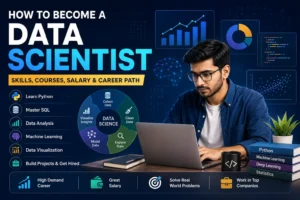
How to Become a Data Scientist: Skills, Qualifications, Courses & Career Path
A Data Scientist uses data, statistics, programming, and machine learning to solve complex problems and generate useful predictions and insights. It is a career that combines mathematics, programming, statistics, data analysis, and business understanding.
If you are interested in technology, problem-solving, mathematics, and working with large datasets, Data Science can be a strong career option.
You do not need to become an expert in every technology at the beginning. A structured approach is more effective: first build your foundations, then learn data analysis and machine learning, and finally apply your skills through practical projects.
This guide explains how to become a Data Scientist, including qualifications, essential skills, programming languages, courses, projects, portfolio building, career opportunities, salary, and the path to getting your first Data Science job.
What Does a Data Scientist Do?
A Data Scientist works with data to discover patterns, build predictive models, and solve complex business or technical problems.
Typical responsibilities can include:
- Collecting and preparing data
- Cleaning datasets
- Performing exploratory data analysis
- Applying statistical methods
- Building machine learning models
- Evaluating model performance
- Creating data visualizations
- Working with large datasets
- Communicating analytical findings
- Helping organizations make data-driven decisions
For example, an e-commerce company could use Data Science to predict which customers are likely to purchase a particular product.
A Data Scientist might analyse historical customer behaviour, identify relevant patterns, build a predictive model, and evaluate how accurately it performs.
How to Become a Data Scientist
A practical Data Science career path can be divided into several stages:
Learn Mathematics & Statistics → Learn Python → Learn SQL → Learn Data Analysis → Learn Machine Learning → Build Projects → Create a Portfolio → Prepare for Interviews → Apply for Jobs
You don’t need to master all of these skills simultaneously.
Build your foundation first and gradually move toward more advanced topics.
Step 1: Build a Strong Foundation in Mathematics
Mathematics plays a more important role in Data Science than it does in many entry-level Data Analyst roles.
Start with concepts such as:
- Algebra
- Functions
- Probability
- Statistics
- Vectors
- Matrices
- Basic calculus
You don’t necessarily need advanced mathematics before beginning. However, understanding the mathematical ideas behind algorithms becomes increasingly useful as you move into machine learning and advanced Data Science.
Step 2: Learn Python
Python is one of the most important programming languages for Data Science.
Start by learning:
- Variables
- Data types
- Conditional statements
- Loops
- Functions
- Lists and dictionaries
- File handling
- Object-oriented programming basics
After learning Python fundamentals, move into libraries commonly used for data work.
Important Python Libraries
| Library | Common Use |
|---|---|
| NumPy | Numerical computing |
| Pandas | Data manipulation and analysis |
| Matplotlib | Data visualization |
| Seaborn | Statistical visualization |
| Scikit-learn | Machine learning |
Don’t learn libraries only by memorizing syntax. Use them while working on actual datasets.
Step 3: Learn SQL
SQL is an important skill because data is often stored in relational databases.
Learn how to:
- Retrieve data
- Filter records
- Sort results
- Group data
- Aggregate values
- Join tables
- Use subqueries
- Work with common table expressions
- Use window functions
SQL is useful even if your primary programming language is Python because many Data Science workflows begin with retrieving and preparing data from databases.
Step 4: Learn Statistics
Statistics forms a major foundation of Data Science.
Important areas include:
- Mean, median and mode
- Variance
- Standard deviation
- Probability
- Probability distributions
- Sampling
- Correlation
- Regression
- Hypothesis testing
- Confidence intervals
Statistics helps you understand data properly and evaluate whether patterns or relationships are meaningful.
Step 5: Learn Data Analysis
Before jumping deeply into machine learning, learn how to analyse datasets.
You should be able to:
- Load a dataset
- Understand its structure
- Identify missing values
- Clean the data
- Explore relationships
- Visualize important patterns
- Identify anomalies
- Draw conclusions
Python libraries such as Pandas, NumPy, Matplotlib, and Seaborn can be used for this stage.
The ability to understand and prepare data is extremely important because machine learning models are only as useful as the data and methodology behind them.
Step 6: Learn Machine Learning
Machine learning is one of the major areas that differentiates Data Science from basic data analysis.
Start with supervised learning concepts such as:
- Linear regression
- Logistic regression
- Decision trees
- Random forests
- Classification
- Regression
Then learn concepts such as:
- Clustering
- Feature engineering
- Model evaluation
- Cross-validation
- Hyperparameter tuning
You should understand why and when a particular model is appropriate, rather than simply knowing how to run it through a Python library.
Deep Learning for Data Science
After learning the fundamentals of machine learning, you can move into deep learning. It is not necessary for every entry-level Data Scientist role, but it becomes important for areas such as computer vision, natural language processing, recommendation systems, and other advanced applications.
Important Deep Learning Concepts
Start with:
- Neural networks
- Activation functions
- Forward and backward propagation
- Loss functions
- Optimizers
- Training and validation
- Overfitting and regularization
- Convolutional Neural Networks (CNNs)
- Recurrent Neural Networks (RNNs)
- Transformers
You can later explore frameworks such as TensorFlow and PyTorch.
Don’t rush into deep learning before understanding statistics, Python, data analysis, and machine learning fundamentals.
Educational Qualification to Become a Data Scientist
There is no single degree that guarantees a Data Scientist career. However, a strong academic foundation in computer science, mathematics, statistics, engineering, economics, or a related quantitative field can be useful.
Common educational backgrounds include:
- B.Tech / B.E.
- B.Sc. in Mathematics
- B.Sc. in Statistics
- B.Sc. in Computer Science
- B.Sc. in Data Science
- BCA
- Mathematics or Statistics-related degrees
- Economics
- Other quantitative disciplines
A postgraduate qualification such as an M.Tech, M.Sc., MBA in Analytics, or specialized Data Science program can also be useful for some career paths.
However, your practical skills remain important. A degree alone does not demonstrate that you can build and evaluate Data Science solutions.
Can You Become a Data Scientist After 12th?
Yes. You can start preparing for a Data Science career after Class 12.
A practical pathway is:
Class 12 → Bachelor’s Degree → Mathematics & Statistics → Python → SQL → Data Analysis → Machine Learning → Projects → Internship → Data Science Job
Students interested in Mathematics, Computer Science, Statistics, and problem-solving may find it useful to begin learning programming and basic statistics early.
You don’t need to wait until graduation to start learning Python or working with datasets.
Can You Become a Data Scientist Without a Degree?
It is possible to develop Data Science skills without a traditional degree, although some employers may require a bachelor’s or master’s qualification.
If you’re taking a non-traditional route, you’ll need to demonstrate your capabilities through:
- Strong programming skills
- Statistics knowledge
- Machine learning projects
- Practical datasets
- A strong portfolio
- GitHub or other project documentation
- Internships or relevant work experience
- Technical interview preparation
The more advanced the role, the more important it becomes to demonstrate a strong understanding of mathematics, statistics, machine learning, and the underlying methods you use.
Essential Data Scientist Skills
A Data Scientist needs a combination of technical, mathematical, analytical, and communication skills.
Technical Skills
- Python
- SQL
- Statistics
- Probability
- Data cleaning
- Data visualization
- Machine learning
- Feature engineering
- Model evaluation
- Git and version control
Advanced Skills
Depending on the role, you may also need:
- Deep learning
- Natural language processing
- Computer vision
- Big data technologies
- Cloud platforms
- MLOps
- Model deployment
Soft Skills
Technical ability isn’t enough. Data Scientists also need to:
- Understand business problems
- Ask useful questions
- Explain technical results
- Communicate findings clearly
- Work with different teams
- Evaluate whether a model actually solves the intended problem
The strongest candidates combine technical knowledge with practical problem-solving ability.
Best Courses to Become a Data Scientist
There is no single course that is required to become a Data Scientist. The right course depends on your current knowledge, career goals, and how much time you can dedicate to learning.
A good Data Science course should cover more than just machine learning. Ideally, it should take you through Python, statistics, SQL, data analysis, machine learning, projects, and model evaluation.
Course Areas to Learn
| Course Area | What You Should Learn |
|---|---|
| Python for Data Science | Programming fundamentals, Pandas, NumPy and data handling |
| Statistics | Probability, distributions, hypothesis testing and regression |
| SQL | Database querying, joins, aggregation and advanced queries |
| Data Analysis | Cleaning, exploration and interpretation of datasets |
| Machine Learning | Regression, classification, clustering and model evaluation |
| Deep Learning | Neural networks and advanced machine learning |
| Data Visualization | Charts, dashboards and communicating insights |
| Projects | Applying your skills to real-world datasets |
What to Look for in a Data Science Course
Before choosing a course, check whether it provides:
- Hands-on exercises
- Real datasets
- Python programming practice
- SQL practice
- Statistics fundamentals
- Machine learning projects
- Model evaluation
- Portfolio projects
- Interview preparation
A certificate alone does not demonstrate that you can perform Data Science work. Practical projects and strong fundamentals are more important when building your skills.
How to Build Data Science Projects
Projects are essential because they allow you to apply concepts outside of tutorials.
A good project should solve a specific problem rather than simply demonstrate that you can run a machine learning algorithm.
Example Project Structure
Problem → Data Collection → Data Cleaning → Exploratory Analysis → Feature Engineering → Model Building → Evaluation → Insights
For example, you could build a model that predicts whether a customer is likely to leave a service.
Your project could include:
- Understanding the business problem
- Exploring the dataset
- Cleaning missing or incorrect data
- Identifying useful features
- Visualizing important patterns
- Training different models
- Comparing model performance
- Selecting an appropriate model
- Explaining the results
Data Science Project Ideas for Beginners
1. Customer Churn Prediction
Use customer information and historical behaviour to predict the likelihood of customers leaving a service.
2. House Price Prediction
Build a regression model to estimate property prices using features such as location, size, number of rooms, and other available variables.
3. Customer Segmentation
Use clustering techniques to group customers according to similarities in their behaviour.
4. Sales Forecasting
Analyse historical sales data and build a model to estimate future sales.
5. Spam Detection
Build a classification model that identifies whether a message or email is likely to be spam.
6. Recommendation System
Create a basic system that recommends products, movies, or other content based on user behaviour or similarities.
Start with projects that match your current skill level. As your knowledge improves, move toward more complex problems.
How to Build a Data Science Portfolio
Your portfolio should demonstrate that you understand the complete Data Science workflow, not just individual algorithms.
For every project, explain:
Problem
What problem are you trying to solve?
Dataset
Where did the data come from and what information does it contain?
Data Preparation
How did you clean and prepare the data?
Analysis
What patterns did you discover?
Model
Which model did you use and why?
Evaluation
How did you measure its performance?
Results
What did the model or analysis reveal?
Conclusion
What could someone do with the results?
A portfolio containing 3–5 strong, well-documented projects can be more useful than a large collection of unfinished tutorial projects.