

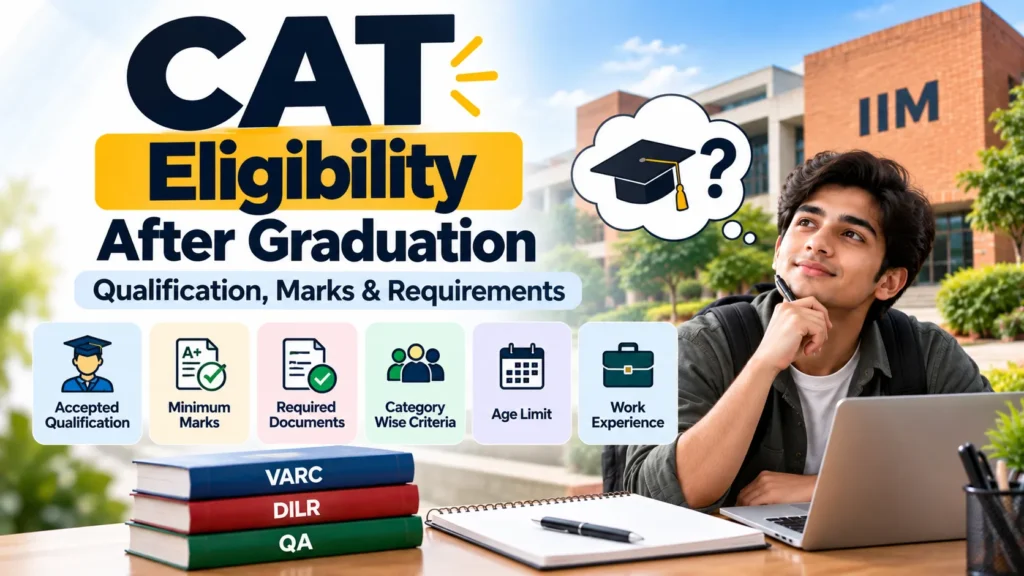
If you have completed your graduation and are planning to appear for the Common Admission Test (CAT), the first thing to check is whether your academic qualification and graduation marks meet the eligibility requirements.
For CAT 2026, candidates who have completed a recognised bachelor’s degree can apply if they meet the prescribed minimum percentage requirements. General, EWS and NC-OBC candidates need at least 50% marks or equivalent CGPA, while SC, ST and PwBD candidates need at least 45%. Professional degree holders such as CA, CS, CMA/ICWA and FIAI may also be eligible under the prescribed conditions.
However, CAT eligibility and IIM admission are not the same thing. Meeting the minimum eligibility requirement allows you to apply for CAT, but each IIM has its own shortlisting and admission criteria.
In this guide, we explain CAT eligibility after graduation, minimum marks, accepted qualifications, CGPA conversion, age requirements and other important conditions.
CAT Eligibility After Graduation: Quick Answer
Yes, graduates can apply for CAT if they satisfy the educational qualification and minimum marks requirements.
For CAT 2026, the basic requirement is:
| Eligibility Factor | Requirement |
|---|---|
| Educational Qualification | Bachelor’s degree or accepted equivalent/professional qualification |
| General Category | Minimum 50% or equivalent CGPA |
| EWS Category | Minimum 50% or equivalent CGPA |
| NC-OBC Category | Minimum 50% or equivalent CGPA |
| SC Category | Minimum 45% or equivalent CGPA |
| ST Category | Minimum 45% or equivalent CGPA |
| PwBD Category | Minimum 45% or equivalent CGPA |
| Work Experience | Not mandatory for appearing in CAT |
| Age Limit | No upper age limit |
| Final-Year Students | Eligible under prescribed conditions |
The current CAT 2026 eligibility information confirms the 50%/45% graduation requirement and allows final-year candidates to apply as well.
If you want the complete eligibility rules, see our [CAT Eligibility] guide.
What Qualification Is Required for CAT After Graduation?
The minimum educational qualification for CAT is generally a bachelor’s degree from a recognised university or institution.
This means graduates from different academic backgrounds can pursue CAT. Your graduation stream does not have to be management-related.
For example, candidates with degrees in:
- Engineering
- Commerce
- Arts
- Science
- Computer Applications
- Law
- Medicine
- Economics
- Mathematics
- Management
can apply if they satisfy the prescribed eligibility conditions.
The important factor is not whether your degree is specifically related to an MBA. The key requirement is having an accepted bachelor’s degree with the required marks or equivalent CGPA.
Minimum Graduation Marks Required for CAT
The minimum graduation percentage is one of the most important parts of CAT eligibility.
For CAT 2026, the requirement is:
General, EWS and NC-OBC Candidates
Candidates belonging to General, EWS and NC-OBC categories need at least 50% marks or equivalent CGPA in their bachelor’s degree.
SC, ST and PwBD Candidates
Candidates belonging to SC, ST and PwBD categories need at least 45% marks or equivalent CGPA.
Therefore, a simple eligibility check would look like this:
General/EWS/NC-OBC → 50% or equivalent CGPA
SC/ST/PwBD → 45% or equivalent CGPA
Remember that the exact CAT notification for the examination you are applying for should always be treated as the final authority.
Does Graduation Percentage Mean Aggregate Marks?
Generally, CAT eligibility is based on the percentage or equivalent CGPA obtained in the bachelor’s degree according to the applicable university/institution rules.
If your university provides an official percentage, use that percentage when determining your eligibility.
If your university awards CGPA instead of percentage, the conversion should follow the procedure prescribed by your university or institution. The CAT eligibility rules state that where an institution does not have its own CGPA-to-percentage conversion scheme, the equivalence can be established using the prescribed CGPA conversion method.
Example
Suppose your university gives you:
CGPA = 7.2
You should first check whether your university provides an official formula for converting 7.2 CGPA into percentage.
Do not automatically assume that every university uses the same formula.
This is particularly important if your percentage is close to the CAT eligibility threshold.
What If You Have 49% in Graduation?
This is an important situation for candidates who have completed graduation but fall slightly below the minimum requirement.
For a candidate in a category where the applicable CAT minimum is 50%, 49% would not satisfy a 50% minimum requirement.
You should not assume that CAT will automatically round 49% up to 50%.
Instead, check the official percentage calculation and conversion method followed by your university.
For example, if your university officially converts your CGPA into a percentage and the resulting percentage is 50% or above, that official conversion may be relevant to determining eligibility.
If your university’s official percentage remains below the applicable minimum, you should not treat yourself as eligible simply because the difference is small.
Does CAT Accept CGPA Instead of Percentage?
Yes, CAT eligibility rules allow an equivalent CGPA where applicable.
The important point is that the CGPA should be interpreted according to the conversion procedure of your university or institution.
The official CAT eligibility information states that if grades or CGPA are awarded, conversion into percentage should follow the procedure certified by the university or institution.
So, before filling out the CAT application form, check:
- Your final CGPA.
- Your university’s conversion formula.
- Whether your university issues a percentage-equivalence certificate.
- The minimum percentage applicable to your category.
- The instructions in the latest CAT notification.
Can You Apply for CAT After Completing Any Bachelor’s Degree?
In general, yes.
CAT is not restricted to candidates who have completed BBA, B.Com or other management-related degrees.
A graduate from a recognised institution can apply if the qualification and marks requirements are satisfied.
For example:
B.Tech + required percentage → Eligible
B.Com + required percentage → Eligible
B.Sc + required percentage → Eligible
BA + required percentage → Eligible
BCA + required percentage → Eligible
The important consideration is whether the qualification is recognised and meets the requirements specified in the CAT notification.
Are Professional Degree Holders Eligible for CAT?
Certain professional qualifications are also accepted under CAT eligibility rules.
The CAT 2026 eligibility information includes professional qualifications such as:
- CA
- CS
- ICWA/CMA
- Fellow of the Institute of Actuaries of India (FIAI)
subject to the prescribed requirements.
If you hold a professional qualification rather than a conventional bachelor’s degree, check the latest CAT notification carefully before applying.
Is There an Age Limit After Graduation?
There is no upper age limit for CAT 2026.
Therefore, completing graduation several years ago does not by itself prevent you from appearing for CAT, provided you satisfy the applicable educational eligibility requirements.
This makes CAT accessible to different groups of candidates, including:
- Recent graduates
- Working professionals
- Candidates with several years of work experience
- Candidates changing careers
- Candidates preparing for an MBA after a career break
Is Work Experience Required After Graduation?
No. Work experience is not required simply to appear for CAT.
A candidate who has recently completed graduation can apply without having worked anywhere.
Similarly, a working professional can also apply.
However, work experience can be considered as one of the factors in the selection or shortlisting process of individual IIMs. Therefore, CAT eligibility should not be confused with the admission criteria of a particular IIM.
CAT Eligibility vs IIM Admission Eligibility
This is one of the most important distinctions candidates should understand.
CAT Eligibility
CAT eligibility determines whether you can apply for and appear in the examination.
For CAT 2026, the basic graduation requirement is:
50% for General/EWS/NC-OBC
45% for SC/ST/PwBD
subject to the official eligibility conditions.
IIM Admission
After the examination, individual IIMs use their own admission and shortlisting criteria.
These can consider factors such as:
- CAT percentile
- Sectional performance
- Graduation marks
- Class 10 and 12 academic performance
- Work experience
- Academic background
- Diversity factors
- Personal interview performance
- Other institute-specific criteria
Therefore:
Being eligible for CAT does not guarantee an IIM call or admission.
The official CAT information also makes clear that satisfying the minimum eligibility criteria does not automatically ensure shortlisting by an IIM.
Does a Low Graduation Percentage Affect IIM Admission?
There are two separate questions here.
1. Can you appear for CAT?
If you satisfy the minimum CAT eligibility requirement, you can apply.
2. Can you get into an IIM?
That depends on the specific IIM’s selection criteria.
For example, two candidates could both satisfy CAT’s minimum eligibility requirement but have different academic profiles. Their chances of receiving shortlists can therefore be different.
This is why candidates should not stop at checking whether they are technically eligible for CAT.
You should also research the admission criteria of the IIMs you want to target.
What If You Completed Graduation Several Years Ago?
You can still consider CAT if you meet the applicable eligibility requirements.
For example, suppose you completed your bachelor’s degree in:
2022
and now want to pursue an MBA.
The fact that you graduated in 2022 does not automatically make you ineligible.
Similarly, a candidate who completed graduation in 2020 or earlier may also be able to apply, subject to the current CAT eligibility rules.
Your next step should be to evaluate your:
- Graduation marks
- Academic background
- Work experience
- CAT preparation level
- Target percentile
- Preferred IIMs and MBA programmes
What Documents Should Graduates Keep Ready?
Before completing your CAT application, keep your academic documents organised.
Depending on your circumstances, these may include:
- Graduation marksheets
- Degree certificate
- University percentage/CGPA details
- CGPA conversion certificate, if applicable
- Category certificate, if applicable
- PwBD certificate, if applicable
- Professional qualification documents, if applicable
- Other documents requested in the current CAT application
The exact documents and upload requirements can change between examination cycles, so always follow the instructions in the latest CAT application guide.
Can You Apply If Your Graduation Result Is Awaiting?
Yes, CAT rules have historically allowed candidates who have completed their degree requirements but are awaiting results, subject to the conditions specified in the applicable CAT notification.
Final-year candidates are also permitted to apply under the prescribed conditions.
If selected, such candidates may be admitted provisionally and may need to provide certification from their university or institution confirming completion of the degree requirements.
The exact documentation and submission deadlines are important and can vary by admission cycle, so candidates should check the current CAT and IIM instructions.
For a dedicated explanation, see [CAT Eligibility for Final-Year Students]
What Should You Do After Checking CAT Eligibility?
Once you confirm that you meet the eligibility requirements, the next step is preparation.
Start by understanding the complete [CAT Syllabus] and [CAT Exam Pattern].
Then create a preparation plan covering:
- VARC fundamentals
- Reading comprehension
- DILR sets
- Quantitative Aptitude
- Topic-wise practice
- Previous year questions
- Sectional tests
- Full-length mocks
- Mock analysis
- Revision
You can also follow our [CAT Preparation Strategy] for a structured approach.
If you are completely new to CAT, start with our [CAT Exam for Beginners] guide.
CAT Eligibility After Graduation: Quick Checklist
Before applying, ask yourself these questions:
- Have I completed a recognised bachelor’s degree or accepted equivalent qualification?
- Do I meet the minimum graduation percentage for my category?
- If I have CGPA, do I know my university’s conversion method?
- Do I have the required academic documents?
- If I belong to a reserved category, are my certificates valid?
- Have I checked the latest CAT notification?
- Have I checked the admission criteria of my target IIMs?
- Have I started preparing for VARC, DILR and QA?
If the answer to these questions is yes, you can move on to the application and preparation stages.
Frequently Asked Questions
Is graduation compulsory for CAT?
A bachelor’s degree or an accepted equivalent qualification is generally required, subject to the specific conditions in the current CAT notification. Final-year candidates may also apply under the prescribed rules.
What percentage is required in graduation for CAT?
For CAT 2026, the minimum is 50% for General, EWS and NC-OBC candidates and 45% for SC, ST and PwBD candidates, or the applicable equivalent CGPA.
Can I apply for CAT after graduation?
Yes. Graduates who meet the prescribed educational qualification and minimum marks requirements can apply.
Is there an age limit for CAT?
There is no upper age limit for CAT 2026.
Is work experience compulsory for CAT?
No. Work experience is not compulsory for appearing in CAT.
Can B.Tech students apply for CAT?
Yes. Engineering graduates can apply if they satisfy the applicable CAT eligibility requirements.
Can B.Com students apply for CAT?
Yes. B.Com graduates can apply if they meet the required eligibility conditions.
Does 50% graduation marks guarantee an IIM admission?
No. Meeting the minimum CAT eligibility requirement only makes you eligible to apply. IIMs have their own shortlisting and admission criteria.
What if my CGPA is given instead of percentage?
Use the CGPA-to-percentage conversion procedure prescribed by your university. If your university has an official conversion formula, follow that procedure.
Final Takeaway
CAT eligibility after graduation is straightforward: you generally need an accepted bachelor’s degree and the minimum qualifying marks specified for your category. For CAT 2026, the requirement is 50% for General, EWS and NC-OBC candidates and 45% for SC, ST and PwBD candidates, or the applicable equivalent CGPA.
But remember that CAT eligibility is only the first step. Your CAT percentile, academic profile, work experience and other factors can influence IIM shortlisting and admission.
If you are eligible, the next priority should be understanding the CAT syllabus, exam pattern and preparation strategy rather than worrying only about the minimum percentage.
Stay Updated with CareerMint
Get the latest updates on competitive exams, government jobs, results, notifications, scholarships, career opportunities, and preparation tips.
Follow CareerMint on all our platforms for daily updates:
Instagram – Exam updates & quick career tips
Facebook – Latest jobs, exams & opportunities
YouTube – Preparation guides & career content
Telegram – Instant exam & government job alerts
WhatsApp – Important updates delivered directly
LinkedIn – Career opportunities & professional updates
Follow CareerMint today and never miss an important career or exam update!