
Table of Contents
Government Jobs After Diploma in India 2026
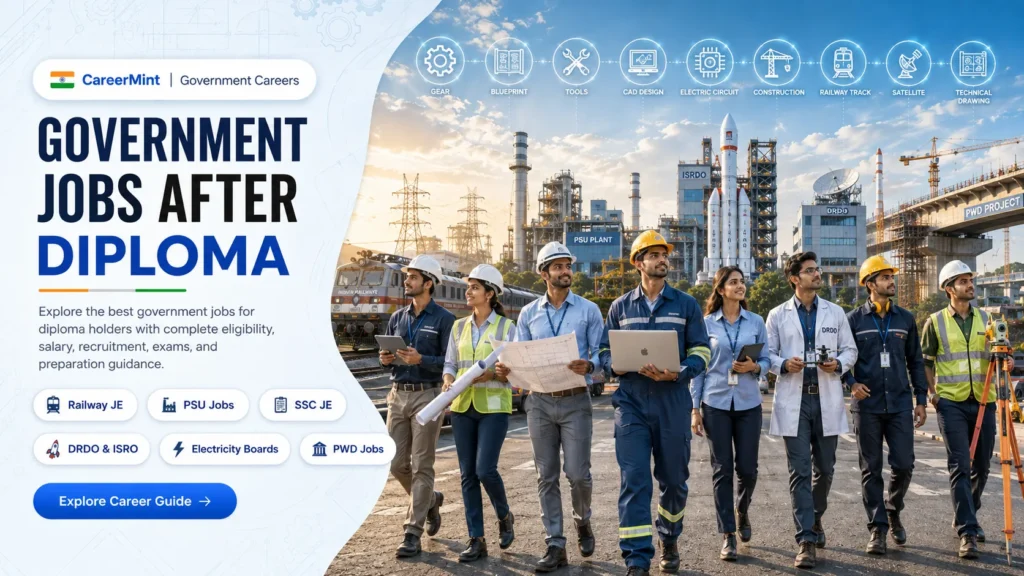
A diploma qualification opens the door to numerous government job opportunities in engineering, technical services, public sector undertakings (PSUs), railways, defence organizations, state government departments, and infrastructure projects. Diploma holders are highly sought after for technical and supervisory roles that offer competitive salaries, career growth, and long-term job security.
Whether you hold a Diploma in Mechanical, Civil, Electrical, Electronics, Computer Science, Automobile, Mining, or any other engineering discipline, various Central and State Government organizations conduct recruitment throughout the year for technical positions. This guide covers the best government jobs after diploma, eligibility criteria, salary, recruitment process, preparation tips, and career opportunities to help you choose the right government career.
Quick Highlights
| Particular | Details |
|---|---|
| Minimum Qualification | Diploma from a recognized institution |
| Eligible Diploma Streams | Mechanical, Civil, Electrical, Electronics, Computer Science, Automobile, Mining, Chemical, IT and other technical disciplines |
| Popular Government Sectors | Railways, PSUs, State Government, Defence, SSC, Electricity Boards, PWD, DRDO, ISRO |
| Popular Exams | RRB JE, SSC JE, GATE (PSUs), State JE Recruitment, DRDO, ISRO Technician, BHEL, ONGC, IOCL |
| Age Limit | Generally 18–32 years (varies by recruitment) |
| Starting Salary | ₹25,000–₹60,000+ per month |
| Selection Process | Written Exam, Skill Test (where applicable), Document Verification & Medical Examination |
| Recruiting Organizations | SSC, RRB, DRDO, ISRO, BHEL, ONGC, IOCL, NTPC, State PSCs, Electricity Boards |
| Job Benefits | Job Security, Technical Career Growth, Government Allowances, Promotions, Pension Benefits (where applicable) |
Why Choose Government Jobs After Diploma?
A diploma provides specialized technical knowledge, making candidates eligible for a wide range of government jobs in engineering, construction, manufacturing, transportation, defence, research, and public utilities. Compared to general qualifications, diploma holders often qualify for technical posts with higher starting salaries and faster career progression.
Government organizations recruit diploma holders for positions such as Junior Engineer (JE), Technician, Supervisor, Technical Assistant, Apprentice, and Executive Trainee, offering structured promotions, attractive allowances, and opportunities to work on major infrastructure and technology projects across India.
Benefits of Government Jobs After Diploma
- Technical Career Opportunities – Access specialized engineering and technical positions across government departments.
- Higher Salary Potential – Technical roles often provide better starting salaries than many general recruitment positions.
- Strong Career Growth – Regular promotions, departmental examinations, and opportunities for higher technical roles.
- Recruitment Across Multiple Sectors – Opportunities in Railways, PSUs, Defence, ISRO, DRDO, PWD, Electricity Boards, and State Government departments.
- Excellent Employee Benefits – Government allowances, medical facilities, paid leave, retirement benefits, and job stability.
- Work on National Projects – Contribute to infrastructure development, transportation, defence technology, energy, and public utilities.
- High Demand for Technical Skills – Engineering diploma holders are regularly recruited by Central and State Government organizations.
Government Jobs by Department
Diploma holders are primarily recruited for technical, engineering, maintenance, supervisory, and operational roles across Central and State Government organizations. These departments require candidates with practical knowledge and technical skills to support infrastructure development, manufacturing, transportation, defence, energy, and public services.
The table below compares the major government departments that regularly recruit diploma holders.
| Department | Popular Job Roles | Recruitment Agency | Starting Salary | Selection Process | Career Growth |
|---|---|---|---|---|---|
| Indian Railways | Junior Engineer (JE), Depot Material Superintendent, Chemical & Metallurgical Assistant | Railway Recruitment Board (RRB) | ₹35,400–₹44,900 | CBT-I, CBT-II, DV, Medical | Excellent |
| SSC | Junior Engineer (Civil, Electrical, Mechanical) | Staff Selection Commission (SSC) | ₹35,400–₹44,900 | Paper I, Paper II, DV | Excellent |
| Public Sector Undertakings (PSUs) | Junior Engineer, Technician, Diploma Engineer Trainee, Management Trainee | BHEL, NTPC, ONGC, IOCL, GAIL, SAIL, HPCL | ₹35,000–₹60,000+ | Written Exam / GATE / Interview | Excellent |
| Electricity Boards & Power Corporations | Junior Engineer, Assistant Engineer (Post-wise), Technician | State Electricity Boards, Power Grid, NTPC | ₹35,400–₹56,100 | Written Exam, DV | Excellent |
| Public Works Department (PWD) | Junior Engineer, Site Supervisor, Technical Assistant | State PWD, CPWD | ₹35,400–₹44,900 | Written Exam, Interview (Post-wise) | Good |
| DRDO & ISRO | Technician, Technical Assistant, Diploma Apprentice | DRDO, ISRO | ₹35,000–₹56,100 | Written Exam, Skill Test, Interview (Post-wise) | Excellent |
| Defence Organizations | Technical Assistant, Technician, Tradesman (Post-wise) | Indian Army, Navy, Air Force, Ordnance Factories | ₹25,500–₹44,900 | Written Exam, Skill Test, Medical | Good |
| State Government Engineering Departments | Junior Engineer, Technical Officer, Supervisor | State PSCs & Recruitment Boards | ₹35,400–₹44,900 | Written Exam, Interview (Post-wise) | Good |
| Municipal & Urban Development Departments | Junior Engineer, Civil Supervisor, Technical Assistant | Municipal Corporations, Urban Development Authorities | ₹35,400–₹44,900 | Written Exam, DV | Good |
| Water Resources & Irrigation Departments | Junior Engineer, Site Engineer, Technical Assistant | State Irrigation Departments | ₹35,400–₹44,900 | Written Exam, DV | Good |
Which Department Should You Choose?
| If You Want… | Recommended Department |
|---|---|
| Highest Salary | PSUs, ISRO, Power Sector |
| Best Technical Career | Railways, SSC JE, PSUs |
| Research & Innovation | ISRO, DRDO |
| Infrastructure Projects | PWD, Irrigation Department |
| Stable Government Job | Railways, Electricity Boards, State Engineering Departments |
| Fast Career Growth | PSUs, Railways, ISRO |
| Core Engineering Work | SSC JE, RRB JE, PWD |
| Field & Site Experience | Irrigation, Municipal Departments, PWD |
Popular Government Jobs After Diploma
A diploma qualification makes candidates eligible for a wide range of technical government jobs in engineering, infrastructure, manufacturing, research, defence, transportation, and public utilities. Central and State Government organizations regularly recruit diploma holders for positions such as Junior Engineer (JE), Technician, Diploma Engineer Trainee (DET), Technical Assistant, Supervisor, and Apprentice.
The table below highlights some of the most popular government jobs available after completing a diploma.
| Job Profile | Department | Recruitment Agency | Qualification | Age Limit | Starting Salary | Selection Process |
|---|---|---|---|---|---|---|
| Junior Engineer (JE) | Central Government | SSC JE | Diploma in Civil, Mechanical or Electrical Engineering | 18–32 Years | ₹35,400–₹44,900 | Paper I, Paper II, DV |
| Junior Engineer (JE) | Indian Railways | Railway Recruitment Board (RRB) | Relevant Engineering Diploma | 18–36 Years | ₹35,400–₹44,900 | CBT-I, CBT-II, DV, Medical |
| Diploma Engineer Trainee (DET) | Public Sector Undertakings | BHEL, NTPC, ONGC, GAIL, SAIL, IOCL | Engineering Diploma | As Notified | ₹35,000–₹60,000+ | Written Exam / Interview |
| Technical Assistant | Research Organizations | DRDO, ISRO | Engineering Diploma | As Notified | ₹35,400–₹56,100 | Written Exam, Skill Test, Interview |
| Junior Engineer | Electricity Boards | State Electricity Boards, Power Corporations | Engineering Diploma | As Notified | ₹35,400–₹56,100 | Written Exam, DV |
| Junior Engineer | Public Works Department | CPWD, State PWD | Diploma in Civil/Electrical Engineering | As Notified | ₹35,400–₹44,900 | Written Exam, Interview (Post-wise) |
| Technical Assistant | State Government | State Engineering Departments | Engineering Diploma | As Notified | ₹35,400–₹44,900 | Written Exam, DV |
| Technician | Defence Organizations | Indian Army, Navy, Air Force, Ordnance Factories | Diploma / Technical Qualification | As Notified | ₹25,500–₹44,900 | Written Exam, Skill Test, Medical |
| Diploma Apprentice | PSUs & Government Organizations | Various Central & State Organizations | Engineering Diploma | As Notified | Stipend Based | Merit / Written Test |
| Junior Engineer | Municipal & Urban Development | Municipal Corporations, Development Authorities | Engineering Diploma | As Notified | ₹35,400–₹44,900 | Written Exam, DV |
Note: Eligibility criteria, age limits, and recruitment methods vary by organization. Always refer to the latest official notification before applying.
Highest Paying Government Jobs After Diploma
Diploma holders can secure well-paying technical government jobs that offer excellent career growth, regular promotions, and attractive allowances.
| Rank | Job Profile | Department | Approx. Starting Salary |
|---|---|---|---|
| 1 | Diploma Engineer Trainee (DET) | PSUs | ₹50,000–₹60,000+ |
| 2 | Technical Assistant | ISRO / DRDO | ₹35,400–₹56,100 |
| 3 | Junior Engineer (SSC JE) | Central Government | ₹35,400–₹44,900 |
| 4 | Junior Engineer (RRB JE) | Indian Railways | ₹35,400–₹44,900 |
| 5 | Junior Engineer | Electricity Boards | ₹35,400–₹56,100 |
| 6 | Junior Engineer | CPWD / State PWD | ₹35,400–₹44,900 |
| 7 | Technical Assistant | State Government | ₹35,400–₹44,900 |
| 8 | Technician | Defence Organizations | ₹25,500–₹44,900 |
| 9 | Diploma Apprentice | PSUs | Stipend + Training Benefits |
| 10 | Municipal Junior Engineer | Urban Development Departments | ₹35,400–₹44,900 |
Eligibility Criteria for Government Jobs After Diploma
Candidates applying for government jobs after completing a diploma must fulfill the eligibility criteria specified by the respective recruiting organization. While an engineering diploma is the minimum qualification for most technical positions, factors such as age limit, nationality, diploma specialization, medical fitness, and experience (for selected posts) may also be considered during recruitment.
Before applying, candidates should carefully read the official notification to ensure they meet all the required eligibility conditions.
Eligibility Overview
| Eligibility Criteria | Details |
|---|---|
| Educational Qualification | Diploma in Engineering or Technology from a recognized institution or university. |
| Eligible Diploma Streams | Civil, Mechanical, Electrical, Electronics, Computer Science, Automobile, Mining, Chemical, Information Technology, Instrumentation, and other relevant branches. |
| Age Limit | Generally 18–32 years, depending on the recruitment and category. |
| Nationality | Candidate must be an Indian citizen or satisfy the nationality conditions mentioned in the official notification. |
| Physical Standards | Required for selected Defence, Railway, and technical field positions where physical fitness is essential. |
| Medical Fitness | Candidates must meet the medical standards prescribed for the respective post. |
| Experience | Most diploma-level government jobs are open to freshers. Some specialized technical posts may require relevant work experience. |
| Computer Knowledge | Basic computer skills are desirable for many engineering and administrative technical positions. |
Category-wise Age Relaxation
Reserved category candidates are eligible for age relaxation as per Government of India regulations.
| Category | Age Relaxation |
|---|---|
| SC / ST | 5 Years |
| OBC (Non-Creamy Layer) | 3 Years |
| PwBD (General) | Up to 10 Years |
| PwBD (OBC) | Up to 13 Years |
| PwBD (SC/ST) | Up to 15 Years |
| Ex-Servicemen | As per Government Rules |
| Other Reserved Categories | As specified in the official recruitment notification |
Selection Process for Government Jobs After Diploma
The selection process for government jobs after a diploma varies depending on the recruiting organization and job role. Most technical recruitments assess candidates through a written examination, while some organizations also conduct skill tests, interviews, or document verification. For technical and engineering positions, candidates are evaluated on both their general aptitude and technical knowledge related to their diploma specialization.
General Selection Process
| Stage | Description |
|---|---|
| 1. Official Notification | The recruiting organization releases a notification with details about vacancies, eligibility, syllabus, important dates, and application guidelines. |
| 2. Online Application | Eligible candidates submit the online application along with the required documents before the closing date. |
| 3. Written Examination | Most organizations conduct a Computer-Based Test (CBT) or Offline Examination covering technical subjects, reasoning, mathematics, general awareness, and English. |
| 4. Technical / Skill Test | Some recruitments include practical or trade-specific tests to evaluate technical knowledge and hands-on skills. |
| 5. Interview (Where Applicable) | Conducted for selected PSU, DRDO, ISRO, and technical officer recruitments to assess technical competency and communication skills. |
| 6. Document Verification | Candidates must verify their diploma certificates, educational records, identity proof, category certificates, and other required documents. |
| 7. Medical Examination | Medical fitness is required for Railway, Defence, PSU, and several technical field positions. |
| 8. Final Merit List | Final selection is based on performance in the applicable recruitment stages and successful completion of document verification and medical examination. |
Selection Process by Department
| Department | Written Exam | Technical Test | Interview | Medical |
|---|---|---|---|---|
| Indian Railways (RRB JE) | ✅ | ❌ | ❌ | ✅ |
| SSC JE | ✅ | Paper II (Technical) | ❌ | ❌ |
| PSUs (BHEL, NTPC, ONGC, IOCL, etc.) | Written / GATE | Post-wise | ✅ | Post-wise |
| Electricity Boards | ✅ | Post-wise | Post-wise | Post-wise |
| CPWD / State PWD | ✅ | Post-wise | Post-wise | Post-wise |
| DRDO / ISRO | ✅ | Skill Test (Post-wise) | Post-wise | ✅ |
| Defence Organizations | ✅ | Skill Test | Post-wise | ✅ |
| State Engineering Departments | ✅ | Post-wise | Post-wise | Post-wise |
| Municipal & Urban Development | ✅ | Post-wise | Post-wise | Post-wise |
Common Subjects Asked in Diploma-Level Government Exams
Many technical government examinations have a similar syllabus. Preparing these core subjects allows candidates to apply for multiple technical recruitments.
| Subject | Commonly Asked In |
|---|---|
| Technical Subject | SSC JE, RRB JE, PSU Recruitments, State JE Exams |
| Engineering Mathematics | SSC JE, RRB JE, State Engineering Recruitments |
| General Intelligence & Reasoning | SSC, Railways, PSU, State Government Exams |
| General Awareness | Almost all government examinations |
| English Language | SSC JE, Railways, PSU Recruitments |
| Computer Awareness | Selected PSU and State Government recruitments |
How to Prepare for Government Jobs After Diploma
Preparing for government jobs after a diploma requires a combination of technical knowledge, aptitude skills, and consistent practice. Since many diploma-level government examinations have a similar syllabus, candidates can prepare for multiple recruitments simultaneously. A well-planned study schedule, regular revision, and solving previous year papers can significantly improve your chances of selection.
Whether you’re preparing for SSC JE, RRB JE, PSU recruitments, State Junior Engineer examinations, DRDO, ISRO, or Electricity Board recruitments, focusing on both technical and non-technical subjects is essential.
Preparation Strategy
| Preparation Area | What You Should Do |
|---|---|
| Understand the Exam Pattern | Read the official notification to understand the syllabus, exam pattern, marking scheme, and selection process. |
| Strengthen Technical Concepts | Focus on core engineering subjects related to your diploma specialization such as Civil, Mechanical, Electrical, Electronics, or Computer Science. |
| Create a Study Plan | Allocate daily study time for technical subjects, aptitude, reasoning, English, and General Awareness. |
| Practice Previous Year Papers | Solve previous years’ question papers to understand the difficulty level and frequently asked technical topics. |
| Take Mock Tests | Attempt regular mock tests to improve speed, accuracy, and time management. |
| Stay Updated with Current Affairs | Read current affairs related to science, technology, infrastructure, economy, and government initiatives. |
| Improve Computer Skills | Learn MS Office, basic computer concepts, and digital tools required for technical and administrative roles. |
| Revise Regularly | Schedule weekly and monthly revision sessions to strengthen concepts and improve retention. |
Important Subjects to Focus On
| Subject | Key Topics |
|---|---|
| Technical Subject | Core concepts from your diploma branch (Civil, Mechanical, Electrical, Electronics, Computer Science, etc.) |
| Engineering Mathematics | Algebra, Trigonometry, Statistics, Mensuration, Basic Calculations |
| Reasoning Ability | Coding-Decoding, Series, Analogy, Blood Relations, Direction Sense, Logical Reasoning |
| English Language | Grammar, Vocabulary, Reading Comprehension, Error Detection |
| General Awareness | Current Affairs, Indian Polity, History, Geography, Science, Government Schemes |
| Computer Awareness | Computer Fundamentals, MS Office, Internet, Operating Systems, Cyber Security Basics |
Best Preparation Resources
| Resource | Purpose |
|---|---|
| Official Syllabus & Notification | Understand the latest eligibility, syllabus, and exam pattern. |
| Previous Year Question Papers | Analyze important topics and exam trends. |
| Mock Tests | Improve speed, accuracy, and confidence before the examination. |
| Standard Technical Books | Build strong concepts in your engineering discipline. |
| Current Affairs Resources | Prepare for the General Awareness section. |
| Online Practice Platforms | Daily quizzes, technical tests, and performance analysis. |
Explore More Government Career Guides
A diploma qualification is an excellent starting point for a technical government career, but it’s not the only pathway. Depending on your educational background, specialization, and future goals, you can explore various government career opportunities across engineering, technical services, public sector undertakings, defence, railways, and administrative departments. Browse our detailed career guides to find the right government job based on your qualifications.
| Career Guide | Description |
|---|---|
| Government Jobs After 10th | Explore entry-level government jobs in Railways, SSC, India Post, Defence, Police, and State Government departments. |
| Government Jobs After 12th | Discover government careers in SSC, Railways, Banking, Defence, Police, India Post, and State Government organizations. |
| Government Jobs After Graduation | Find officer-level opportunities through UPSC, SSC CGL, Banking, Railways, PSUs, Insurance, and State PSC examinations. |
| Government Jobs After ITI | Explore technical government jobs for ITI-qualified candidates in Railways, PSUs, Defence, Electricity Boards, and manufacturing organizations. |
| Latest Government Jobs | Stay updated with the latest government recruitment notifications, vacancies, application dates, and exam schedules. |
| Government Exam Calendar | Check upcoming government examinations, important dates, admit cards, results, and recruitment timelines in one place. |
Build a Successful Technical Government Career
A diploma qualification provides excellent opportunities to build a rewarding career in engineering and technical government services. Before applying, compare different departments based on eligibility, salary, job responsibilities, promotion opportunities, and long-term career growth. Selecting the right recruitment based on your diploma specialization and career goals will help you prepare more effectively and improve your chances of selection. CareerMint provides detailed career guides, recruitment updates, preparation resources, and exam information to help you achieve your government career goals.
Frequently Asked Questions (FAQs)
1. Which are the best government jobs after a diploma?
Some of the most popular government jobs for diploma holders include:
- SSC Junior Engineer (JE)
- RRB Junior Engineer (JE)
- Diploma Engineer Trainee (PSUs)
- Technical Assistant (DRDO)
- Technical Assistant (ISRO)
- Junior Engineer (Electricity Boards)
- Junior Engineer (PWD)
- State Junior Engineer Recruitments
- Technician in Defence Organizations
- Diploma Apprentices in PSUs
The right job depends on your diploma specialization, career goals, and interests.
2. Can I get a government job immediately after completing a diploma?
Yes. Diploma holders can apply for various Central and State Government recruitments immediately after completing their diploma, provided they satisfy the eligibility criteria mentioned in the official notification.
3. Which government exam is best after a diploma?
Some of the most popular examinations for diploma holders are:
- SSC Junior Engineer (JE)
- RRB Junior Engineer (JE)
- GATE (For PSU Recruitments)
- State Junior Engineer Recruitments
- DRDO Recruitment
- ISRO Technical Recruitment
- Electricity Board JE Recruitment
Choose the examination based on your diploma specialization and career objectives.
4. Which government job offers the highest salary after a diploma?
Some of the highest-paying government jobs for diploma holders include Diploma Engineer Trainee (PSUs), Technical Assistant in ISRO and DRDO, SSC JE, RRB JE, and Junior Engineer positions in Electricity Boards. These jobs provide competitive salaries, government allowances, and excellent promotion opportunities.
5. Which diploma branches are eligible for government jobs?
Government organizations recruit candidates from various diploma disciplines, including:
- Civil Engineering
- Mechanical Engineering
- Electrical Engineering
- Electronics & Communication Engineering
- Computer Science Engineering
- Information Technology
- Automobile Engineering
- Chemical Engineering
- Mining Engineering
- Instrumentation Engineering
Eligibility depends on the specific recruitment notification.
6. Is GATE compulsory for government jobs after a diploma?
No. Most diploma-level government recruitments such as SSC JE, RRB JE, State JE, PWD, and Electricity Board recruitments do not require GATE. However, some PSU recruitments may use GATE scores or conduct separate selection processes.
7. Can diploma holders apply for SSC JE?
Yes. Diploma holders in the required engineering disciplines such as Civil, Mechanical, and Electrical Engineering are eligible for SSC Junior Engineer (JE), subject to the eligibility conditions mentioned in the official notification.
8. Can diploma holders apply for RRB Junior Engineer (JE)?
Yes. Railway Recruitment Board (RRB) regularly recruits diploma holders for Junior Engineer and other technical positions. Candidates must possess the prescribed engineering diploma and meet the age and eligibility requirements.
9. What is the age limit for government jobs after a diploma?
The minimum age is generally 18 years, while the upper age limit usually ranges from 30 to 32 years, depending on the recruitment. Reserved category candidates receive age relaxation as per Government rules.
10. Is work experience required after completing a diploma?
No. Most government jobs for diploma holders are open to freshers. However, certain technical and specialist positions may require relevant work experience or apprenticeship training.
11. Which government departments recruit diploma holders every year?
Major recruiters include:
- Staff Selection Commission (SSC)
- Railway Recruitment Board (RRB)
- Public Sector Undertakings (PSUs)
- DRDO
- ISRO
- CPWD
- State PWD
- Electricity Boards
- State Public Service Commissions
- Defence Organizations
12. How should I prepare for government jobs after a diploma?
Start by selecting the recruitment that matches your diploma branch. Understand the syllabus, strengthen your technical subjects, practice previous year papers, take mock tests, revise regularly, and stay updated with current affairs and recruitment notifications.
13. Can I prepare for multiple government exams together?
Yes. Technical examinations such as SSC JE, RRB JE, State Junior Engineer, Electricity Board JE, and many PSU recruitments have similar engineering concepts and aptitude sections. A structured preparation plan can help you target multiple examinations simultaneously.
14. Which government job is best for diploma holders?
There is no single “best” government job. However, SSC JE, RRB JE, PSU Diploma Engineer Trainee, DRDO Technical Assistant, ISRO Technical Assistant, and State Junior Engineer are among the most preferred options because of their salary, career growth, and technical work profile.
15. Where can I find the latest government job notifications for diploma holders?
You can check the official websites of SSC, RRB, DRDO, ISRO, BHEL, NTPC, ONGC, IOCL, State Public Service Commissions, Electricity Boards, and other government organizations for the latest recruitment notifications. CareerMint also provides updated information on vacancies, eligibility, exam dates, and preparation resources.
Related Guides
| Guide | What You’ll Learn |
|---|---|
| Government Jobs | Explore all government job opportunities based on qualification, department, and eligibility. |
| Government Jobs After 12th | Discover the best government career options available after completing Class 12. |
| Government Jobs After ITI | Explore technical government jobs available for ITI certificate holders. |
| Government Jobs After Graduation | Learn about higher-level government jobs you can pursue after earning a bachelor’s degree. |
| Government Jobs After post Graduation | Learn about advanced government positions requiring postgraduate qualifications. |