

Understanding the CAT marking scheme is essential for candidates preparing for CAT 2027. Knowing how marks are awarded, how negative marking works and how different question types are scored can help you make better decisions during the examination.
The Common Admission Test (CAT) uses a scoring system that rewards correct answers and penalizes incorrect multiple-choice responses. Candidates should therefore focus not only on solving questions but also on accuracy, time management and question selection.
Although previous CAT examinations provide a useful reference, candidates should verify the final rules in the official CAT 2027 notification when it is released.
CAT Marking Scheme 2027: Quick Overview
The established CAT marking pattern used in recent examinations is summarized below.
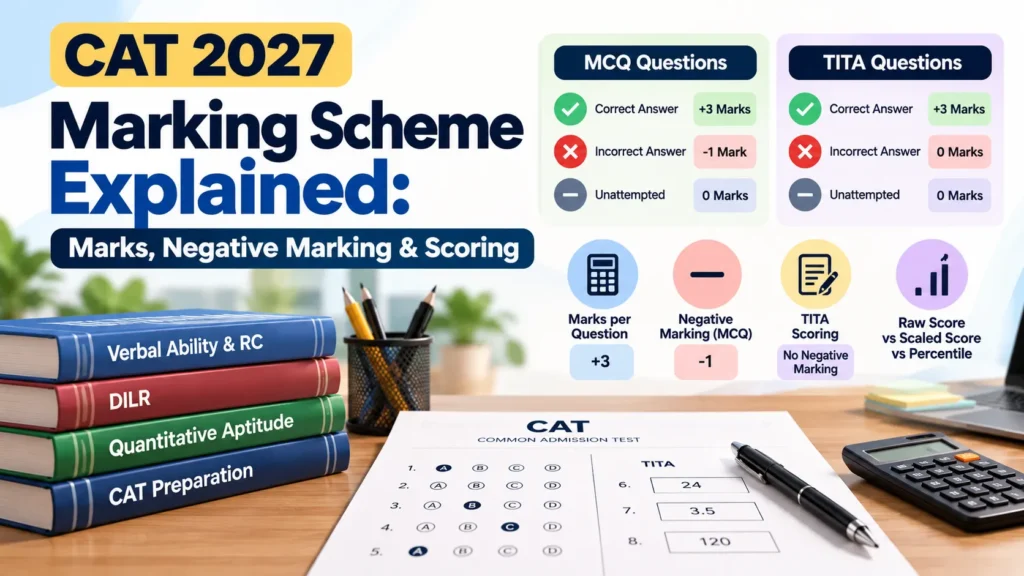
| Response type | Correct answer | Incorrect answer | Unattempted |
|---|---|---|---|
| Multiple-Choice Question (MCQ) | +3 marks | -1 mark | 0 marks |
| Type In The Answer (TITA) | +3 marks | 0 marks | 0 marks |
Important: This table reflects the established recent CAT marking pattern. Confirm the final CAT 2027 rules against the official notification before relying on them for the examination.
1. How Many Marks Does Each CAT Question Carry?
Under the established marking pattern, a correct answer earns three marks.
For example:
- 1 correct answer earns 3 marks.
- 5 correct answers earn 15 marks.
- 10 correct answers earn 30 marks.
- 20 correct answers earn 60 marks.
However, your final score depends on incorrect answers as well as correct answers. Negative marking can reduce the marks earned from correct responses.
2. What Is Negative Marking in CAT?
Negative marking means that marks are deducted for incorrect answers. In CAT, the established rule applies a penalty of one mark for an incorrect MCQ.
For example, suppose a candidate answers five MCQs incorrectly. The total deduction would be:
5 × 1 = 5 marks.
If the candidate answers ten MCQs correctly and five incorrectly, the score from those questions would be:
- Marks from correct answers: 10 × 3 = 30
- Marks deducted for incorrect answers: 5 × 1 = 5
- Net score: 30 − 5 = 25 marks
This is why accuracy matters. Attempting more questions does not automatically produce a higher score.
3. Is There Negative Marking for TITA Questions?
TITA stands for Type In The Answer. These questions require candidates to enter their answers rather than select from the available multiple-choice options.
Under the established CAT marking pattern:
- A correct TITA answer earns 3 marks.
- An incorrect TITA answer receives no negative penalty.
- An unattempted TITA question earns zero marks.
This makes TITA questions different from MCQs, where incorrect answers carry a penalty.
However, candidates should still solve TITA questions carefully. No negative marking does not mean every question will be easy or worth spending unlimited time on.
4. How to Calculate Your CAT Score
Your raw score can be calculated by adding the marks for correct responses and subtracting the applicable penalties for incorrect MCQs.
Under the established marking pattern, the formula is:
Raw Score = (Correct MCQs × 3) + (Correct TITA × 3) − (Incorrect MCQs × 1)
Incorrect TITA responses and unattempted questions contribute zero under this pattern.
Example of CAT Score Calculation
Suppose a candidate records the following responses:
| Response | Number of questions | Marks per question | Total |
|---|---|---|---|
| Correct MCQs | 18 | +3 | +54 |
| Incorrect MCQs | 6 | -1 | -6 |
| Correct TITA | 5 | +3 | +15 |
| Incorrect TITA | 3 | 0 | 0 |
| Unattempted | 8 | 0 | 0 |
The raw score would be:
54 − 6 + 15 = 63 marks
This example illustrates the calculation method. It is not a prediction of the score required for a particular percentile.
5. What Is the Difference Between Raw Score, Scaled Score and Percentile?
These three terms are related but have different meanings.
Raw Score
The raw score is calculated from your correct and incorrect responses using the applicable marking rules.
Scaled Score
When CAT is conducted in multiple sessions, the examination authority may use a normalization process to account for differences between test sessions. The resulting scaled score can differ from the raw score.
The exact process and applicable rules should be checked in the official CAT 2027 documentation.
Percentile
Your percentile represents your relative performance compared with other candidates. For example, a 90 percentile generally indicates performance equal to or better than approximately 90% of the comparison group, subject to the examination’s percentile calculation method.
Remember: A score of 90 marks does not mean a 90 percentile. The relationship between marks and percentile varies by examination difficulty, candidate performance and the relevant scoring process.
6. Does CAT Have Section-Wise Scoring?
CAT evaluates candidates across three sections:
- Verbal Ability and Reading Comprehension (VARC)
- Data Interpretation and Logical Reasoning (DILR)
- Quantitative Aptitude (QA)
Each section contributes to the overall CAT score. Section-wise scores and percentiles may also matter during MBA admission shortlisting, depending on the policies of individual institutes.
For section-specific preparation, explore the CAT syllabus and the CAT exam pattern.
7. How to Avoid Losing Marks in CAT
Understanding the marking scheme is useful only when you apply it during practice and the actual examination.
Prioritize accuracy
Practise solving questions correctly before focusing on speed. Review mistakes to identify whether they resulted from weak concepts, calculation errors or misreading.
Choose MCQs carefully
An incorrect MCQ can reduce your score by one mark under the established pattern. Avoid selecting an answer randomly without considering the available information.
When you can eliminate options or narrow down possibilities, use your reasoning to decide whether an attempt is worthwhile.
Use TITA questions strategically
TITA questions have no options to eliminate, so they require you to calculate or derive the answer. Since the established pattern has no negative penalty for an incorrect TITA response, a reasoned attempt can be worthwhile when you have made meaningful progress.
Still, do not spend excessive time on a single question.
Manage your time
CAT has section-wise time constraints. Practise timed sectional tests to learn when to continue, when to move on and how to avoid spending too long on a difficult problem.
Analyse mock tests
After each mock test, record your correct answers, incorrect MCQs, time spent and missed opportunities. This helps you improve your accuracy and question selection.
8. Common Mistakes Candidates Make About CAT Scoring
Avoid these misunderstandings:
- Assuming every incorrect answer receives the same penalty regardless of question type.
- Confusing raw scores with scaled scores.
- Treating percentile as a direct percentage of marks.
- Attempting every MCQ without considering accuracy.
- Spending too much time on questions that are unlikely to be solved.
- Assuming the marking rules or paper structure cannot change in CAT 2027.
Always use the official examination notification as the final reference for the applicable year’s rules.
Frequently Asked Questions
How many marks are awarded for a correct CAT answer?
Under the established recent CAT marking pattern, each correct answer earns three marks. Confirm the CAT 2027 notification for the final applicable rules.
How much negative marking is there in CAT?
The established pattern deducts one mark for an incorrect MCQ. TITA questions do not carry a negative penalty under that pattern.
Are unattempted questions penalized in CAT?
No marks are awarded or deducted for unattempted questions under the established recent marking pattern.
How is the CAT raw score calculated?
The raw score is calculated by adding three marks for each correct response and subtracting one mark for each incorrect MCQ under the established pattern. Incorrect TITA responses and unattempted questions contribute zero.
Is CAT percentile the same as CAT score?
No. The score represents marks obtained under the scoring rules, while the percentile reflects relative performance compared with other candidates.
Does CAT 2027 have the same marking scheme as previous years?
The established recent pattern is +3 for correct answers, -1 for incorrect MCQs and zero penalty for incorrect TITA answers. However, CAT 2027 candidates should confirm the final rules in the official notification rather than assume that every detail will remain unchanged.
Conclusion
Understanding the CAT marking scheme helps candidates make informed decisions about accuracy, question selection and time management. Under the established recent pattern, correct answers earn three marks, incorrect MCQs lose one mark and TITA questions have no negative penalty.
For CAT 2027, combine this understanding with regular practice, previous-year papers and mock-test analysis. Check the official notification when it is released to confirm the final marking rules.
Start with the CareerMint CAT exam guide for an overview of eligibility, syllabus, exam pattern and preparation resources.
Stay Updated with CareerMint
Get the latest updates on competitive exams, government jobs, results, notifications, scholarships, career opportunities, and preparation tips.
Follow CareerMint on all our platforms for daily updates:
Instagram – Exam updates & quick career tips
Facebook – Latest jobs, exams & opportunities
YouTube – Preparation guides & career content
Telegram – Instant exam & government job alerts
WhatsApp – Important updates delivered directly
LinkedIn – Career opportunities & professional updates
Follow CareerMint today and never miss an important career or exam update!