
The Quantitative Aptitude (QA) section is an important part of the Common Admission Test (CAT), which is taken by candidates seeking admission to MBA and other management programmes. It evaluates mathematical understanding, logical problem-solving ability and the application of concepts under time constraints.
For CAT 2027 aspirants, understanding the CAT Quantitative Aptitude topics is the first step toward building an effective preparation strategy. A clear topic-wise plan helps candidates identify what to study, which concepts to practise first and how to improve accuracy.
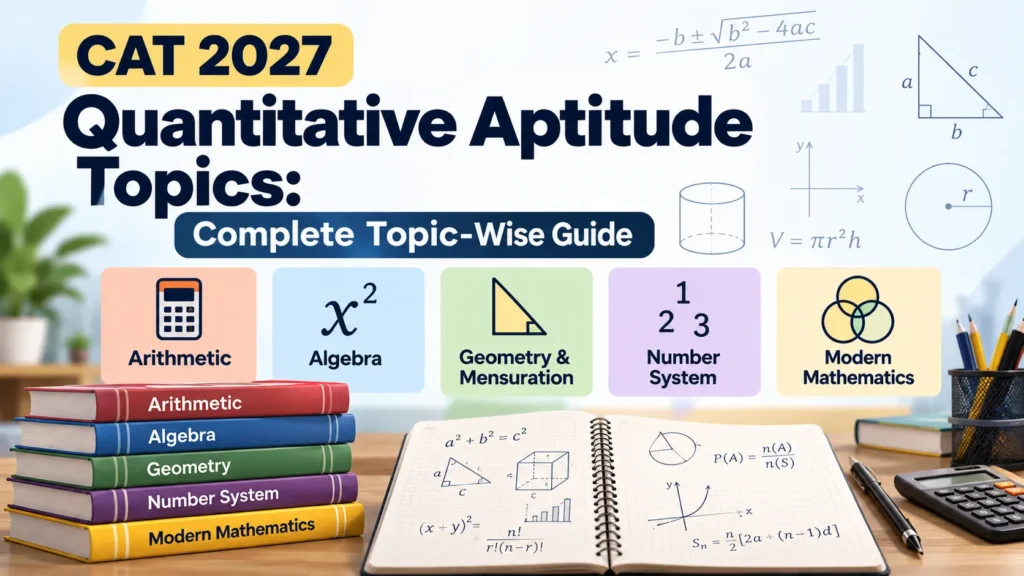
The QA section covers several areas of mathematics, including Arithmetic, Algebra, Geometry, Number System and Modern Mathematics. The exact topic-wise distribution for CAT 2027 is not known in advance, so candidates should prepare systematically rather than depend entirely on predictions.
CAT Quantitative Aptitude Topics 2027: Complete List
The following table organizes the major Quant topics and their important subtopics.
| Main topic | Important subtopics |
|---|---|
| Arithmetic | Percentages, Profit and Loss, Ratio and Proportion, Averages, Time and Work, Time-Speed-Distance, Mixtures and Alligation |
| Algebra | Linear Equations, Quadratic Equations, Inequalities, Functions, Logarithms, Sequences and Series |
| Geometry and Mensuration | Triangles, Circles, Quadrilaterals, Polygons, Coordinate Geometry, Areas and Volumes |
| Number System | Integers, Divisibility, Factors, Multiples, Remainders, HCF and LCM |
| Modern Mathematics | Permutations and Combinations, Probability, Set Theory |
This is a practical topic-wise preparation list, not a verbatim official CAT 2027 syllabus. Use the latest official examination notification when it becomes available.
1. Arithmetic
Arithmetic is a useful starting point for CAT Quantitative Aptitude preparation. It focuses on numerical relationships and real-world mathematical problems.
Important Arithmetic topics
Percentages
- Percentage increase and decrease
- Successive percentage changes
- Percentage comparisons
- Applications of percentages
Profit and Loss
- Cost price and selling price
- Profit and loss percentages
- Discounts
- Marked price and successive discounts
Ratio and Proportion
- Basic ratios
- Proportional relationships
- Direct and inverse proportion
- Division of quantities in a given ratio
Averages
- Simple and weighted averages
- Changes in average values
- Combined averages
Time and Work
- Work rates and efficiency
- Combined work
- Work completed in a given period
- Pipes and cisterns
Time-Speed-Distance
- Relative speed
- Trains
- Boats and streams
- Average speed
Mixtures and Alligation
- Mixture concentration
- Replacement problems
- Mixing quantities at different prices or concentrations
Preparation tip: Begin with percentages, ratios and averages. These concepts also support problem-solving in several other Arithmetic topics.
2. Algebra
Algebra tests your ability to understand equations, manipulate expressions and solve mathematical relationships.
Important Algebra topics
Linear Equations
- Equations with one or more variables
- Simultaneous equations
- Applications of linear equations
Quadratic Equations
- Factorization
- Roots and their properties
- Discriminant
- Relationships between roots and coefficients
Inequalities
- Linear inequalities
- Quadratic inequalities
- Intervals and solution ranges
Functions
- Domain and range
- Function evaluation
- Composite functions
- Graph interpretation
Logarithms
- Logarithmic identities
- Change of base
- Logarithmic equations
Sequences and Series
- Arithmetic Progression (AP)
- Geometric Progression (GP)
- General sequence patterns
- Sum of terms
Preparation tip: Understand algebraic identities and equation-solving methods before moving to complex questions. Practise different solution methods where appropriate, but prioritize accuracy over memorizing shortcuts.
3. Geometry and Mensuration
Geometry involves shapes, their properties and the relationships between their measurements. Mensuration focuses on calculating areas, perimeters, surface areas and volumes.
Important Geometry topics
Triangles
- Types and properties of triangles
- Angle relationships
- Similarity and congruence
- Area and perimeter
- Pythagorean theorem
Circles
- Radius and diameter
- Chords and tangents
- Angles in circles
- Circumference and area
Quadrilaterals and Polygons
- Squares and rectangles
- Parallelograms
- Rhombuses and trapeziums
- Interior and exterior angles of polygons
Coordinate Geometry
- Distance between points
- Midpoint
- Slope of a line
- Basic coordinate relationships
Important Mensuration topics
- Area of two-dimensional shapes
- Perimeter and circumference
- Surface area of three-dimensional shapes
- Volume of common solids
- Combined-shape problems
Preparation tip: Maintain a formula sheet and revise geometric properties regularly. Learn to draw clear diagrams and identify relationships before applying formulas.
4. Number System
Number System questions focus on the properties of integers and the relationships between numbers.
Important Number System topics
Integers and Number Properties
- Positive and negative integers
- Even and odd numbers
- Prime and composite numbers
- Consecutive integers
Divisibility
- Divisibility rules
- Factors and multiples
- Prime factorization
HCF and LCM
- Highest Common Factor
- Least Common Multiple
- Applications involving repeated events and common multiples
Remainders
- Division algorithm
- Remainder properties
- Cyclic patterns in powers
Other areas
- Unit digits
- Factorials and their properties
- Basic numerical patterns
Preparation tip: Focus on understanding why divisibility and remainder rules work. Practise problems that require logical reasoning instead of relying only on lengthy calculations.
5. Modern Mathematics
Modern Mathematics includes counting methods, probability and set-based problems. Candidates should understand the basic principles before attempting more complicated questions.
Important Modern Mathematics topics
Permutations and Combinations
- Fundamental counting principle
- Arrangements of objects
- Selection of objects
- Arrangements with restrictions
Probability
- Basic probability
- Favourable and total outcomes
- Complementary events
- Simple conditional situations
Set Theory
- Union and intersection
- Venn diagrams
- Number of elements in sets
- Problems involving overlapping groups
Preparation tip: Start with basic counting principles before attempting advanced arrangement questions. In Probability, carefully identify the possible outcomes and any conditions given in the question.
Which CAT Quantitative Aptitude Topics Should You Study First?
If you are beginning CAT 2027 preparation, use the following order as a starting point.
| Priority | Topic | Recommended approach |
|---|---|---|
| 1 | Arithmetic | Build fundamentals and practise standard applications |
| 2 | Algebra | Strengthen equation-solving and expression manipulation |
| 3 | Geometry and Mensuration | Learn properties, formulas and diagram-based reasoning |
| 4 | Number System | Practise divisibility, factors and remainders |
| 5 | Modern Mathematics | Develop counting and probability concepts |
This order is a suggested study sequence, not an official ranking of question frequency. Your personal priorities should also depend on your diagnostic test results and progress.
How to Prepare CAT Quantitative Aptitude Topics Effectively
Step 1: Learn the fundamentals
Choose one topic at a time. Understand the concepts, formulas and standard problem types before attempting difficult questions.
Step 2: Practise topic-wise questions
Start with basic questions, move to moderate difficulty and then solve more challenging problems. This helps you identify gaps in your understanding.
Step 3: Solve previous-year questions
CAT previous-year questions help you understand how mathematical concepts are applied in the examination.
Explore CAT Previous Year Question Papers to practise actual questions and review your performance.
Step 4: Take sectional tests
Once you have covered a reasonable number of topics, attempt timed QA sectional tests. Track accuracy, time spent and the types of questions that cause difficulty.
Step 5: Analyse mistakes
Classify mistakes into categories such as conceptual errors, calculation errors, misreading and inefficient methods. Revisit the relevant concepts and solve similar questions again.
Step 6: Revise regularly
Keep a notebook of formulas, useful methods and questions you previously answered incorrectly. Regular revision helps retain concepts and improve solving speed.
For a broader study plan, read the CAT Preparation Strategy.
Common Mistakes to Avoid During CAT QA Preparation
- Studying formulas without understanding their applications.
- Ignoring weaker topics throughout preparation.
- Spending too much time on one difficult question.
- Practising only easy questions.
- Depending entirely on predicted topic-wise weightage.
- Taking mock tests without analysing the results.
- Neglecting revision after completing a topic.
A balanced preparation plan should develop conceptual understanding, accuracy, question selection and time management together.
Frequently Asked Questions
What are the main CAT Quantitative Aptitude topics for 2027?
The major preparation areas are Arithmetic, Algebra, Geometry and Mensuration, Number System, and Modern Mathematics. The exact topic-wise distribution for CAT 2027 cannot be guaranteed in advance.
Which CAT Quant topic should beginners study first?
Arithmetic is a practical starting point for many beginners. Percentages, ratios, averages, profit and loss, and time and work provide a useful foundation for further preparation.
Is the CAT QA topic list the same every year?
The broad mathematical areas are useful for preparation across CAT editions, but question types, difficulty and topic distribution can change. Check the official CAT 2027 notification for any published examination information.
Can I prepare for CAT QA without coaching?
Yes. You can prepare using structured concept lessons, practice questions, previous-year papers, sectional tests and mock exams. A consistent schedule and regular error analysis are essential.
How should I revise CAT Quantitative Aptitude topics?
Revise formulas and core concepts, solve previously incorrect questions, practise mixed-topic sets and use timed tests to check whether you can apply concepts accurately.
Conclusion
Understanding the CAT Quantitative Aptitude topics gives you a clear starting point for CAT 2027 preparation. Begin with fundamental concepts, practise each major topic systematically and use previous-year questions to understand how concepts are tested.
Rather than trying to predict the exact questions, focus on building a strong foundation across Arithmetic, Algebra, Geometry, Number System and Modern Mathematics. Regular revision and mock-test analysis can help you identify weaknesses and improve your performance.
For more exam information, explore the CareerMint CAT guide and the CAT syllabus guide
Stay Updated with CareerMint
Get the latest updates on competitive exams, government jobs, results, notifications, scholarships, career opportunities, and preparation tips.
Follow CareerMint on all our platforms for daily updates:
Instagram – Exam updates & quick career tips
Facebook – Latest jobs, exams & opportunities
YouTube – Preparation guides & career content
Telegram – Instant exam & government job alerts
WhatsApp – Important updates delivered directly
LinkedIn – Career opportunities & professional updates
Follow CareerMint today and never miss an important career or exam update!