

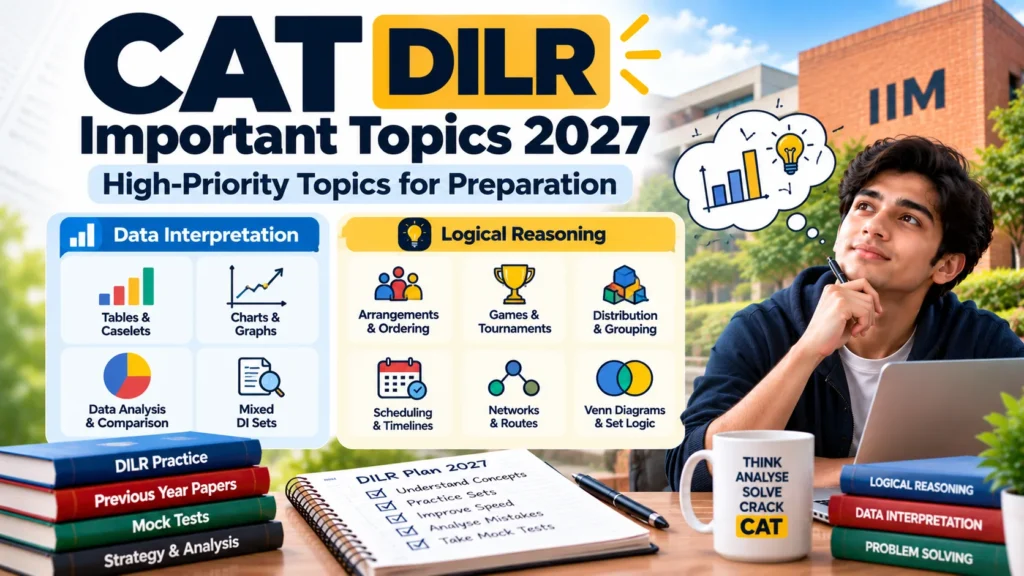
The CAT DILR (Data Interpretation and Logical Reasoning) section is often considered one of the most unpredictable parts of the CAT exam. Unlike Quantitative Ability, where individual mathematical topics can be tracked more easily, DILR is primarily presented through sets, and one set can combine multiple concepts.
For CAT 2027, the best preparation strategy is therefore not to memorize a fixed list of “most expected” questions. Instead, you should master the recurring DILR set types, develop logical deduction skills, improve calculation speed, and most importantly learn how to select the right sets during the exam.
Recent CAT papers support this approach. Analysis of CAT 2021–2025 shows recurring formats such as arrangements, games and tournaments, tables, graphs, rankings, distribution, networks, scheduling and hybrid DI-LR sets, while the exact mix changes from year to year.
Important: IIMs do not publish a guaranteed chapter-wise DILR weightage for CAT 2027. The priorities in this article are based on previous CAT trends and should be used as a preparation framework, not as a prediction of the CAT 2027 paper.
CAT DILR Important Topics 2027 at a Glance
If you’re wondering which DILR topics to prepare first, use this priority structure:
| DILR Topic | Priority | Key Skills |
|---|---|---|
| Arrangements & Ordering | Very High | Sequencing, positioning, conditions |
| Tables & Caselets | High | Data extraction, comparison, calculation |
| Games & Tournaments | High | Ranking, points, outcomes |
| Graphs & Charts | High | Data interpretation, comparison |
| Distribution & Grouping | High | Allocation, constraints, combinations |
| Scheduling & Timelines | High | Ordering, time-based conditions |
| Ranking & Selection | High | Relative positions, conditions |
| Networks & Routes | Medium-High | Paths, connections, optimization |
| Venn Diagrams / Set Logic | Medium | Overlapping groups, deductions |
| Hybrid DI-LR Sets | Very High | Calculation + logical reasoning |
The important thing to notice is that hybrid sets deserve special attention. Recent CAT papers increasingly combine numerical information with logical conditions rather than presenting every set as purely DI or purely LR.
What Is DILR in CAT?
DILR stands for:
Data Interpretation and Logical Reasoning
It combines two broad abilities.
Data Interpretation
DI requires you to understand and analyse information presented through:
- Tables
- Bar graphs
- Line graphs
- Charts
- Caselets
- Numerical data
- Ratios
- Percentages
- Comparisons
Logical Reasoning
LR requires you to use conditions and deductions to solve problems involving:
- Arrangements
- Rankings
- Distribution
- Scheduling
- Games
- Tournaments
- Networks
- Selection
- Grouping
- Sequencing
However, CAT increasingly combines the two.
A set might provide numerical data and then ask you to apply several logical conditions to reach the answer.
That is why DILR preparation should not be divided into completely separate DI and LR silos.
Why Is CAT DILR Considered Difficult?
DILR is not necessarily difficult because every question requires advanced mathematics.
The bigger challenge is deciding which set to solve and how to structure the information.
You may encounter a set that initially looks easy but takes 15 minutes because of complicated conditions.
Another set may look unfamiliar but become straightforward once you identify the underlying structure.
Recent CAT analyses have repeatedly highlighted set selection as an important DILR skill because the section can contain sets with significantly different levels of difficulty.
Therefore, CAT DILR preparation should develop three abilities:
Recognise → Select → Solve
1. Arrangements and Ordering
Priority: Very High
Arrangement-based sets are among the most important DILR areas to practise.
They can involve:
- People
- Objects
- Positions
- Teams
- Departments
- Schedules
- Rankings
- Seating
- Ordering
Recent CAT papers have repeatedly included arrangement and ordering-based sets.
Common Types
Linear Arrangement
Entities are arranged in a straight line.
Example:
A, B, C, D and E are sitting in five positions.
Additional conditions determine their positions.
Circular Arrangement
Entities are arranged around a circle or table.
Ranking and Ordering
Candidates need to determine relative positions based on multiple conditions.
Scheduling
Events or people need to be placed according to time or sequence.
What You Should Learn
Practise converting written conditions into:
- Tables
- Grids
- Position charts
- Diagrams
Don’t try to solve complex arrangement sets entirely in your head.
2. Tables and Caselets
Priority: High
Tables and caselet-based sets are important parts of Data Interpretation.
Information may be presented through a table or a paragraph rather than a conventional graph.
You may need to calculate:
- Percentages
- Ratios
- Averages
- Differences
- Growth
- Comparisons
- Weighted values
Recent CAT papers have continued to use table and caselet-based information, although the exact format changes between years.
Preparation Focus
Learn to quickly identify:
What information is given?
↓
What information is relevant?
↓
What needs to be calculated?
↓
Which comparison is required?
This prevents you from wasting time calculating information that the question never asks for.
3. Games and Tournaments
Priority: High
Games and tournament sets have appeared repeatedly in CAT papers.
These sets can involve:
- Teams
- Matches
- Wins
- Losses
- Draws
- Points
- Rankings
- Performance
- Possible outcomes
Recent five-year CAT analysis identifies games and tournaments as one of the recurring DILR formats.
How to Prepare
Learn to create a structured table such as:
| Team | Matches | Wins | Losses | Points |
|---|---|---|---|---|
| A | – | – | – | – |
| B | – | – | – | – |
| C | – | – | – | – |
Then gradually introduce the conditions given in the set.
4. Graphs and Charts
Priority: High
Graph-based DI has been an important recurring format.
You should be comfortable with:
- Bar graphs
- Line graphs
- Pie charts
- Mixed graphs
- Multi-variable charts
- Unusual graphical representations
Recent CAT analysis shows graph-based questions appearing across multiple slots, including line and bar graph formats.
Skills to Practise
You should become comfortable with:
- Reading scales
- Comparing values
- Calculating percentage changes
- Finding ratios
- Identifying trends
- Extracting information quickly
Don’t spend too much time performing calculations before understanding what the graph actually represents.
5. Distribution and Grouping
Priority: High
Distribution problems require you to allocate people, objects, resources or values according to specific conditions.
Examples can involve:
- Students in groups
- Objects in boxes
- People assigned to departments
- Products distributed across locations
- Teams formed under constraints
The difficulty usually comes from managing multiple conditions simultaneously.
Important Skills
Practise:
- Allocation
- Group formation
- Constraints
- Maximum/minimum conditions
- Possibility checking
- Case formation
Distribution-based reasoning has appeared in multiple recent CAT DILR analyses.
6. Scheduling and Timelines
Priority: High
Scheduling sets require you to place activities, people or events according to time-related conditions.
For example:
- A happens before B
- C cannot happen immediately after D
- E must happen between F and G
- A meeting occurs on Monday or Wednesday
- Certain events cannot occur on the same day
Best Method
Create a timeline:
Monday → Tuesday → Wednesday → Thursday → Friday
Then place the known conditions.
This reduces the cognitive load and makes contradictions easier to identify.
7. Ranking and Selection
Priority: High
Ranking sets can involve:
- Competition rankings
- Employee ratings
- Team positions
- Scores
- Relative rankings
- Selection criteria
These problems may require you to determine:
- Who ranks first?
- How many positions are possible?
- Which candidates can be selected?
- What is the minimum or maximum possible rank?
Recent CAT DILR trend analysis shows ranking and promotion-style reasoning appearing repeatedly.
8. Networks and Routes
Priority: Medium-High
Network-based questions involve connections between different points.
You may need to determine:
- Possible routes
- Shortest paths
- Number of connections
- Movement patterns
- Reachability
- Restrictions
Recent CAT papers have included networks and route-based logical reasoning sets.
Preparation Tip
Draw the network instead of trying to visualize it mentally.
For example:
A → B → C
A → D → C
Then add restrictions and possible routes.
9. Venn Diagrams and Set-Based Logic
Priority: Medium
Venn diagram questions involve overlapping groups.
For example:
- Students studying different subjects
- People using different products
- Employees belonging to multiple categories
You should understand:
- Union
- Intersection
- Exclusive groups
- Overlapping groups
- Complementary groups
Venn and binary-logic style sets have appeared in recent CAT DILR papers, although their frequency varies.
10. Hybrid DI-LR Sets
Priority: Very High
This is one of the most important areas for CAT 2027 preparation.
A hybrid set may contain:
Data + Conditions + Logical deductions + Calculations
For example, a set could provide sales information for several companies and then give conditions about rankings, growth, employees or investments.
You may need to combine:
- Percentages
- Ratios
- Tables
- Ranking
- Logical deductions
Recent CAT 2025 analysis found a substantial share of questions in mixed DI-LR caselets, alongside pure LR and pure DI questions.
This means you should practise mixed sets, not only textbook-style DI and LR separately.
CAT DILR Important Topics: What Should Beginners Study First?
If you’re starting CAT 2027 preparation from scratch, don’t immediately jump into extremely difficult sets.
Follow a progression.
Stage 1 – Basic DI
Start with:
- Tables
- Percentages
- Ratios
- Averages
- Basic graphs
Stage 2 – Basic LR
Then learn:
- Ordering
- Ranking
- Simple arrangements
- Selection
Stage 3 – Intermediate Sets
Move to:
- Distribution
- Scheduling
- Games
- Tournaments
- Caselets
Stage 4 – Advanced Sets
Then practise:
- Complex arrangements
- Networks
- Hybrid DI-LR
- Multi-condition puzzles
Stage 5 – CAT Level Sets
Finally, solve actual previous-year CAT sets under time pressure.
CAT DILR Preparation Strategy for 2027
The biggest mistake is treating DILR as a section where you simply need to “finish the syllabus.”
DILR requires set-solving practice.
A better preparation cycle is:
Understand → Practise → Time → Analyse → Repeat
Step 1: Learn the Basic Structures
Understand how different sets work.
For example:
- How to construct an arrangement table
- How to interpret a graph
- How to represent a tournament
- How to create cases
- How to represent a network
Step 2: Solve Untimed Sets
Initially, don’t worry too much about speed.
Your goal is to learn the reasoning process.
Step 3: Introduce Time Limits
Once you understand the basics, start tracking:
- Reading time
- Setup time
- Calculation time
- Answering time
Step 4: Practise Set Selection
This is critical.
Before solving a set, spend a short amount of time understanding:
- How much information is given?
- How many conditions exist?
- Does the structure look familiar?
- Can you identify an entry point?
- Does the set appear calculation-heavy?
- Can you see a possible path toward the answer?
Then decide whether to attempt it.
How to Improve DILR Set Selection
During mock tests, don’t immediately start solving the first set you see.
Instead:
Scan
Look through all available sets.
Categorise
Mark them mentally:
Easy → Moderate → Difficult
Select
Start with the set where:
- You understand the information quickly
- The conditions are manageable
- You can identify a clear starting point
- The potential return is high
This is particularly important because recent DILR papers have contained sets with varying difficulty levels.
How Many DILR Sets Should You Solve?
There is no magic number.
Instead of setting a goal such as:
“I will solve 1,000 DILR sets.”
track your quality of practice.
For every set, record:
| Metric | Track |
|---|---|
| Set Type | Arrangement / DI / Game / etc. |
| Difficulty | Easy / Medium / Difficult |
| Time Taken | Minutes |
| Questions Solved | Number |
| Correct | Number |
| Mistakes | Number |
| Main Error | Concept / Calculation / Logic / Time |
| Set Selection | Good / Bad |
This will show you where your actual weakness lies.
Common CAT DILR Preparation Mistakes
1. Studying Only DI
Don’t assume DILR means graphs and tables.
Recent CAT trends show strong representation of Logical Reasoning and mixed DI-LR sets.
2. Solving Every Set
In the actual exam, your goal is not to solve every set.
Your goal is to maximize your score within the available time.
3. Ignoring Set Selection
A candidate can know how to solve DILR but still score poorly by spending too much time on the wrong set.
4. Practising Without a Timer
Untimed practice is useful initially.
But eventually you need timed practice because DILR is a time-management challenge.
5. Not Analysing Unsolved Sets
An unsolved set is still useful.
Ask:
Why couldn’t I solve it?
Maybe:
- You didn’t understand the setup.
- You chose the wrong representation.
- You missed a condition.
- Your calculation was slow.
- The set was simply unsuitable for you.
Each reason requires a different solution.
CAT DILR Previous Year Papers
Previous-year questions are one of the best resources for understanding how DILR actually appears in CAT.
Use them to identify:
- Repeated set structures
- Difficulty levels
- New formats
- Hybrid sets
- Calculation requirements
- Logical reasoning patterns
- Time-consuming sets
You can use the [CAT Previous Year Question Papers] page as the main resource.
Don’t simply solve PYQs.
Analyse them.
CAT DILR and the Exam Pattern
The exact CAT 2027 DILR structure should not be assumed before the official notification.
Recent CAT history shows that the section structure has changed. For example, DILR had 20 questions across four sets in 2021–2023, while the 2024 and 2025 papers moved to 22 questions across five sets.
This is another reason why your preparation should focus on skills rather than memorising one expected exam format.
For the broader examination structure, see our [CAT Exam Pattern] guide.
CAT DILR Important Topics 2027: Priority List
If you need a simple list to save for your preparation:
Very High Priority
- Arrangements
- Ordering
- Hybrid DI-LR sets
- Complex puzzles
High Priority
- Tables
- Graphs
- Games & Tournaments
- Distribution
- Scheduling
- Ranking
- Selection
Medium-High Priority
- Networks
- Routes
- Caselets
- Venn Diagrams
- Binary logic
Supporting Practice
- Unfamiliar mixed sets
- Calculation-heavy DI
- New-format reasoning sets
Remember: priority does not mean guaranteed weightage.
CAT DILR Important Topics vs CAT DILR Weightage
These are two different concepts.
Our [CAT Topic-Wise Weightage] guide explains historical patterns across CAT.
This article answers:
Which DILR topics should I prioritize during preparation?
The main [CAT Syllabus] page should remain the broader resource covering the overall CAT syllabus.
This separation is useful because DILR is especially difficult to represent through a fixed chapter-wise syllabus.
Frequently Asked Questions
Which DILR topics are most important for CAT 2027?
Start with arrangements, tables, graphs, games and tournaments, distribution, scheduling, ranking and hybrid DI-LR sets. Recent CAT papers show these formats recurring across different years.
Is DILR difficult in CAT?
It can be challenging because sets can vary significantly in difficulty and often require several deductions. Set selection and time management are therefore as important as solving ability.
Which should I study first: DI or LR?
Start with basic DI and basic LR together. Then move toward hybrid sets because CAT increasingly combines numerical data with logical conditions.
Are graphs important for CAT DILR?
Yes. Graph-based DI has appeared repeatedly in recent CAT papers, including bar and line graph formats.
Are arrangements important for CAT DILR?
Yes. Arrangement and ordering-based sets have repeatedly appeared across recent CAT papers.
Should I skip difficult DILR topics?
No. But don’t spend disproportionate time mastering one difficult set type. First build competence across the major recurring formats.
How can I improve DILR set selection?
Practise scanning several sets before choosing one. After every mock, record which sets you selected, which ones you rejected and whether your selection was efficient.
Stay Updated with CareerMint
Get the latest updates on competitive exams, government jobs, results, notifications, scholarships, career opportunities, and preparation tips.
Follow CareerMint on all our platforms for daily updates:
Instagram – Exam updates & quick career tips
Facebook – Latest jobs, exams & opportunities
YouTube – Preparation guides & career content
Telegram – Instant exam & government job alerts
WhatsApp – Important updates delivered directly
LinkedIn – Career opportunities & professional updates
Follow CareerMint today and never miss an important career or exam update!