
The CAT VARC (Verbal Ability and Reading Comprehension) section tests how effectively you can understand written information, identify arguments, interpret ideas and arrange information logically.
For CAT 2027, VARC preparation should not be treated as a vocabulary-heavy section. The biggest priority should be Reading Comprehension, followed by the major Verbal Ability question types.
IIMs do not publish a fixed chapter-wise CAT syllabus or guaranteed topic-wise weightage. Therefore, the topics below are based on recurring CAT question types and previous-paper trends. The final CAT 2027 notification and question paper should be treated as the authority for any changes.
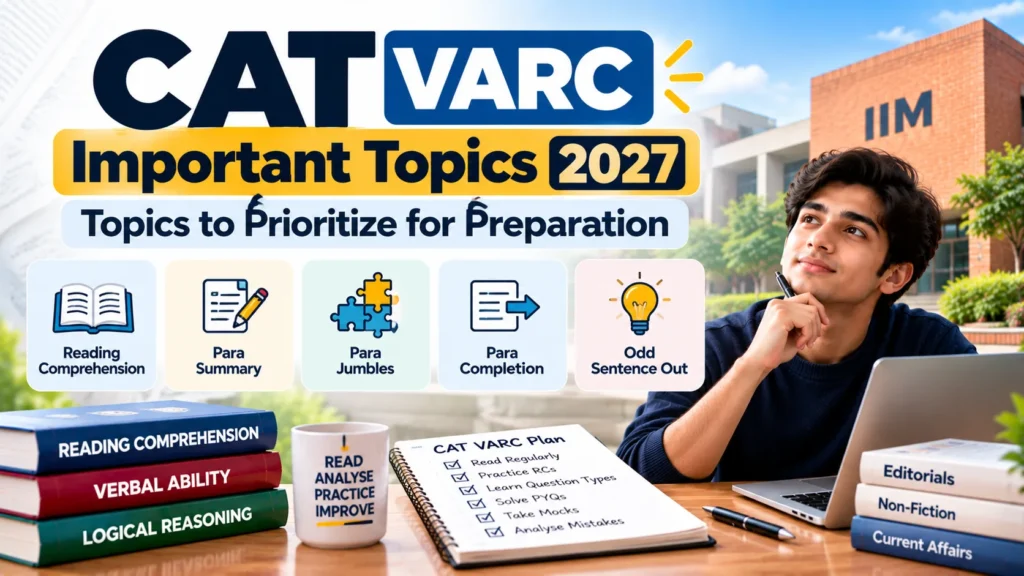
CAT VARC Important Topics 2027 at a Glance
| VARC Topic | Priority | What to Focus On |
|---|---|---|
| Reading Comprehension | Very High | Main idea, inference, tone, author’s argument |
| Para Summary | High | Central idea, scope, elimination |
| Para Jumbles | High | Logical sequence, sentence relationships |
| Para Completion | High | Continuity, argument and logical flow |
| Odd Sentence Out | Medium | Paragraph structure and sentence relevance |
| Vocabulary in Context | Supporting | Meaning from context |
| Critical Reading | Very High | Inference, assumptions, author’s intent |
The most important point is that Reading Comprehension should form the foundation of your VARC preparation.
What Is VARC in CAT?
VARC stands for Verbal Ability and Reading Comprehension.
It is one of the three sections of the CAT examination:
- VARC
- DILR
- QA
VARC primarily evaluates your ability to:
- Read and understand passages
- Identify the central idea
- Draw logical conclusions
- Understand an author’s argument
- Interpret tone and intent
- Identify relationships between sentences
- Summarize information
- Arrange ideas logically
Unlike traditional English examinations, CAT does not simply test whether you know a large number of grammar rules or vocabulary words.
The ability to understand and reason from written information is much more important.
CAT VARC Important Topics: What Should You Prepare First?
If you are preparing for CAT 2027, a practical priority order is:
Priority 1 — Reading Comprehension
Start with:
- Main idea
- Inference
- Author’s purpose
- Tone
- Argument structure
- Passage summary
- Supporting ideas
Priority 2 — Para Summary
Learn how to identify the central argument without getting distracted by examples or secondary details.
Priority 3 — Para Jumbles
Develop your ability to identify logical relationships between sentences.
Priority 4 — Para Completion
Understand how an argument or paragraph logically continues.
Priority 5 — Odd Sentence Out
Practise identifying the sentence that does not belong to the logical structure of a paragraph.
This doesn’t mean you should completely ignore lower-priority areas. It simply gives you a better order for allocating preparation time.
1. Reading Comprehension
Priority: Very High
Reading Comprehension is the most important area of CAT VARC preparation.
A significant portion of VARC has historically consisted of RC-based questions, making it essential for candidates targeting a strong VARC score.
CAT passages can come from a wide range of subjects, including:
- Philosophy
- Economics
- History
- Psychology
- Sociology
- Science
- Technology
- Environment
- Business
- Culture
- Literature
You generally don’t need prior knowledge of the subject.
The test is primarily about whether you can understand the information presented in the passage.
Important Reading Comprehension Skills
Instead of simply solving hundreds of passages, develop these specific skills.
1. Identifying the Main Idea
Ask:
What is the passage primarily trying to communicate?
The correct answer usually represents the central argument rather than one isolated point.
2. Understanding the Author’s Argument
Identify:
- What the author believes
- What evidence is provided
- What problem is being discussed
- What conclusion is reached
This becomes especially important in inference-based questions.
3. Drawing Inferences
CAT frequently tests whether you can logically derive something from the passage.
An inference should be supported by the information given.
Don’t select an answer simply because it sounds reasonable in the real world.
4. Understanding Tone
The author may be:
- Critical
- Analytical
- Neutral
- Supportive
- Skeptical
- Concerned
- Optimistic
- Pessimistic
- Sarcastic
Understanding tone helps eliminate incorrect options.
5. Identifying the Author’s Purpose
Ask:
Why did the author write this passage?
The purpose could be to:
- Explain
- Criticize
- Compare
- Evaluate
- Challenge
- Describe
- Argue
- Present a perspective
6. Understanding Paragraph Structure
Don’t read every paragraph as an independent block.
Try to understand the relationship:
Introduction → Argument → Evidence → Counterargument → Conclusion
Not every passage will follow this exact structure, but recognizing the movement of ideas makes difficult RCs easier.
How to Prepare Reading Comprehension for CAT 2027
A strong RC preparation routine can follow this sequence:
Read → Understand → Solve → Analyse → Repeat
Don’t focus only on the number of passages solved.
After every passage, ask:
- Why was my answer correct?
- Why were the other options wrong?
- Did I misunderstand the passage?
- Did I miss an inference?
- Did I fall for an extreme option?
- Did I rely on outside knowledge?
This analysis is often more valuable than simply solving another passage.
2. Para Summary
Priority: High
Para Summary questions test whether you can identify the central idea of a paragraph.
You are usually given a paragraph followed by answer choices.
Your job is to select the option that best captures the paragraph’s overall meaning.
Focus on:
- Main argument
- Central idea
- Scope
- Author’s position
- Supporting details
- Examples
- Conclusion
How to Solve Para Summary Questions
First, read the paragraph without looking at the options.
Ask yourself:
“If I had to explain this paragraph in one sentence, what would I say?”
Then compare your understanding with the options.
Be careful with options that:
- Focus on only one example
- Are too broad
- Are too narrow
- Introduce a new idea
- Reverse the author’s argument
- Use extreme language
3. Para Jumbles
Priority: High
Para Jumbles require you to arrange sentences into a logical sequence.
For example:
A → C → B → D
You need to determine the correct order.
The challenge is understanding how the sentences relate to each other.
Important Para Jumble Clues
Pronouns
Words such as:
- He
- They
- It
- This
- These
usually refer to something introduced earlier.
Connectors
Watch for words such as:
- However
- Therefore
- Moreover
- Consequently
- In contrast
- For example
- Similarly
These can provide important clues about sentence relationships.
Cause and Effect
One sentence may introduce a cause while another explains the result.
Example and Explanation
A general statement often comes before a specific example.
Introduction and Conclusion
A paragraph generally requires an introductory idea before supporting arguments.
Likewise, a concluding statement often comes after the discussion.
4. Para Completion
Priority: High
Para Completion questions test whether you can determine how an incomplete paragraph should logically continue.
You need to understand:
- The central idea
- The direction of the argument
- The author’s tone
- The relationship between ideas
- What information logically follows
Don’t choose an answer merely because it sounds grammatically correct.
The answer must fit the logic and purpose of the paragraph.
5. Odd Sentence Out
Priority: Medium
In an Odd Sentence Out question, several sentences belong to the same logical paragraph while one sentence does not.
Your objective is to identify the sentence that breaks the flow.
Look for:
- Common topic
- Logical relationships
- Pronoun references
- Cause and effect
- Chronological sequence
- Contrasting ideas
- Sudden topic changes
The odd sentence may still be related to the general subject.
The important question is whether it belongs to the same logical structure.
CAT VARC Topics: Reading Skills You Must Develop
Apart from individual question types, CAT 2027 aspirants should develop broader reading skills.
Critical Reading
Learn to identify:
- Arguments
- Assumptions
- Conclusions
- Evidence
- Counterarguments
- Examples
- Author’s position
Inference
Don’t confuse an inference with an assumption.
An inference must be logically supported by the passage.
Tone
Train yourself to recognize subtle differences between:
- Critical vs hostile
- Skeptical vs negative
- Neutral vs supportive
- Analytical vs descriptive
Vocabulary in Context
You don’t necessarily need to memorize thousands of words.
Instead, learn how to understand unfamiliar words using:
- Surrounding sentences
- Examples
- Contrast
- Context
- Author’s argument
This is particularly useful when reading difficult CAT passages.
How Much Time Should You Give VARC for CAT 2027?
There is no single ideal number of hours for every student.
Your time allocation should depend on your current level.
For a beginner, a practical daily routine could include:
Reading
30–45 minutes
Read quality material from different subjects.
RC Practice
30–45 minutes
Solve and analyse passages.
Verbal Ability
20–30 minutes
Practise Para Summary, Para Jumbles, Para Completion and other relevant question types.
Analysis
15–20 minutes
Review mistakes and identify patterns.
The goal is consistency rather than studying VARC for several hours once a week.
What Should You Read for CAT VARC?
Because CAT passages can cover diverse subjects, your reading should also be diverse.
You can read material related to:
- Science
- Economics
- History
- Philosophy
- Psychology
- Technology
- Environment
- Culture
- Business
- Society
The objective isn’t to memorize facts.
The objective is to become comfortable reading complex arguments and unfamiliar subjects.
Common CAT VARC Preparation Mistakes
1. Focusing Only on Vocabulary
A large vocabulary can help, but CAT VARC is not simply a vocabulary test.
Understanding the argument is more important.
2. Reading Without Analysis
Reading articles every day is useful, but you should occasionally ask:
- What was the author’s main argument?
- What evidence was used?
- What was the author’s tone?
- What conclusion was reached?
This converts passive reading into active reading practice.
3. Solving RCs Without Reviewing Mistakes
Simply solving 10 passages doesn’t guarantee improvement.
Analyse why you selected the wrong option.
4. Using Outside Knowledge
CAT RC questions should generally be answered based on the passage.
An option may be factually true in the real world but still be incorrect if the passage does not support it.
5. Spending Too Long on One Question
CAT is a time-limited examination.
Learning when to move on is an important part of preparation.
CAT VARC Preparation Strategy for 2027
A simple progression can look like this:
Stage 1 — Build Reading Habit
Read every day.
Focus on comprehension rather than speed.
Stage 2 — Learn Question Types
Understand:
- RC
- Para Summary
- Para Jumbles
- Para Completion
- Odd Sentence Out
Stage 3 — Topic-Wise Practice
Practise individual question types separately.
Stage 4 — Mixed VARC Practice
Combine RC and VA questions.
Stage 5 — Timed Sectional Tests
Start solving complete VARC sections within the prescribed time.
Stage 6 — Mock Tests
Move towards full CAT mocks.
Stage 7 — Analyse
Your mock analysis should identify:
Accuracy + Speed + Question Selection
This is where your VARC performance can improve substantially.
For the broader preparation plan, see our [CAT Preparation Strategy 2027]
CAT VARC Important Topics: Priority Table
| Priority | Topics |
|---|---|
| Very High | Reading Comprehension |
| High | Para Summary |
| High | Para Jumbles |
| High | Para Completion |
| Medium | Odd Sentence Out |
| Supporting Skill | Vocabulary in Context |
| Supporting Skill | Critical Reading |
| Supporting Skill | Inference & Tone |
Remember that these are preparation priorities, not an official CAT 2027 weightage table.
Should You Prepare VARC Topics Separately?
Initially, yes.
For example, spend a few days understanding how Para Summary questions work.
Then practise them independently.
But after building the basics, move toward mixed practice.
CAT doesn’t tell you:
“This is an RC question. Now use your RC strategy.”
You need to identify the question type yourself and decide how to approach it.
How Previous Year Papers Help With CAT VARC
Previous year papers are extremely useful for understanding the actual style of CAT questions.
Use them to analyse:
- Passage difficulty
- Question types
- Answer choices
- Inference patterns
- Tone-based questions
- Para Summary questions
- Para Jumbles
- Time required
You can find the relevant resources on our [CAT Previous Year Question Papers] page.
Frequently Asked Questions
What are the most important VARC topics for CAT 2027?
Reading Comprehension is the highest priority, followed by Para Summary, Para Jumbles and Para Completion. Odd Sentence Out and other verbal areas should also be covered.
Is Reading Comprehension important for CAT 2027?
Yes. RC has historically formed a substantial portion of VARC and should be a major part of your preparation.
Is vocabulary important for CAT VARC?
Vocabulary is useful, but CAT VARC preparation should focus more heavily on comprehension, inference, reasoning and understanding arguments.
How many RC passages should I solve for CAT 2027?
There is no fixed number that guarantees improvement. Consistent practice combined with detailed analysis is more useful than chasing a particular passage count.
Which VARC topic should beginners study first?
Start with Reading Comprehension fundamentals, then gradually add Para Summary, Para Jumbles and Para Completion.
Can I prepare CAT VARC without reading newspapers?
Yes. Newspapers can be useful for developing reading habits, but they are not the only source of reading practice. Use a variety of quality reading material.
Is CAT VARC difficult?
The difficulty depends on the candidate. Students who are comfortable reading complex arguments and making logical inferences generally have an advantage.
Stay Updated with CareerMint
Get the latest updates on competitive exams, government jobs, results, notifications, scholarships, career opportunities, and preparation tips.
Follow CareerMint on all our platforms for daily updates:
Instagram – Exam updates & quick career tips
Facebook – Latest jobs, exams & opportunities
YouTube – Preparation guides & career content
Telegram – Instant exam & government job alerts
WhatsApp – Important updates delivered directly
LinkedIn – Career opportunities & professional updates
Follow CareerMint today and never miss an important career or exam update!