

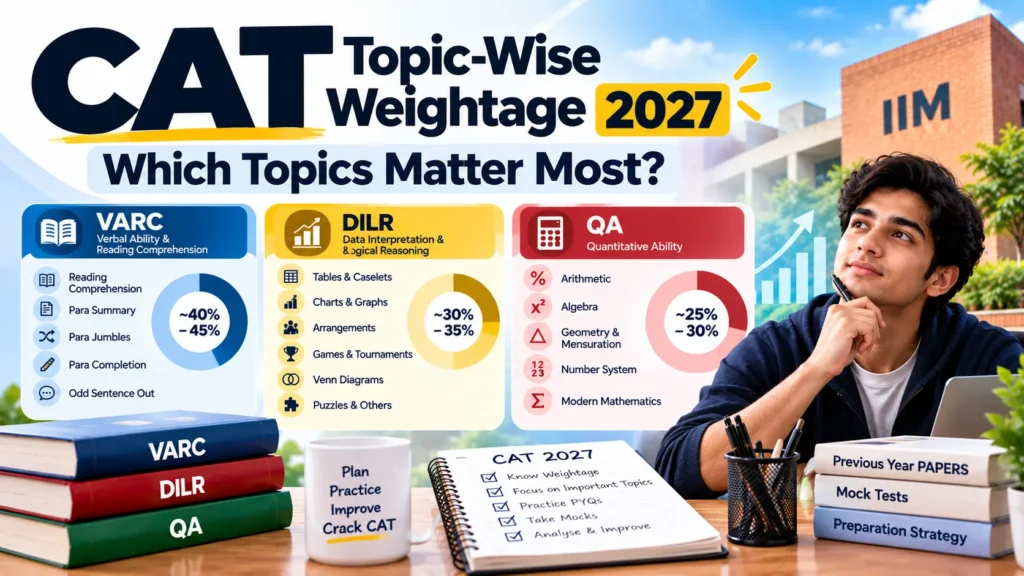
Knowing the CAT topic-wise weightage can help you decide where to spend more preparation time. However, there is one important point every CAT 2027 aspirant should understand: IIMs do not publish a fixed chapter-wise weightage for CAT. The distribution of questions can change between years and even across slots.
Therefore, the best way to estimate topic importance is to study previous CAT papers and identify recurring patterns.
Recent CAT analyses show a consistent trend: Reading Comprehension dominates VARC, Arithmetic and Algebra dominate QA, while DILR can vary considerably depending on the sets selected in a particular year.
This guide uses previous-paper trends to help CAT 2027 aspirants understand which topics generally matter most, what to prepare first, and how to use weightage without making the mistake of completely skipping low-frequency topics.
CAT Topic-Wise Weightage 2027: Quick Overview
Based on recent CAT trends, the broad priority can be understood as follows:
| Section | High-Priority Topics | Overall Priority |
|---|---|---|
| VARC | Reading Comprehension | Very High |
| VARC | Para Summary, Para Jumbles, Para Completion | High |
| DILR | Arrangements, Graphs, Tables, Caselets, Games & Tournaments | High |
| DILR | Puzzles, Venn Diagrams, Distribution | Medium-High |
| QA | Arithmetic | Very High |
| QA | Algebra | Very High |
| QA | Geometry & Mensuration | High |
| QA | Number System | Medium-High |
| QA | Modern Mathematics | Medium |
These are trend-based priorities, not guaranteed CAT 2027 weightages.
The actual CAT 2027 distribution will only be known after the examination is conducted.
Is CAT Topic-Wise Weightage Official?
No.
IIM does not provide candidates with a guaranteed chapter-wise question distribution such as:
Arithmetic = 40%
Algebra = 30%
Geometry = 15%
Such numbers are estimates derived from previous papers.
This distinction is important because CAT is designed to test problem-solving ability, and the distribution of questions can change.
For example, recent papers show that Arithmetic has remained highly important in QA, while the exact number of Arithmetic and Algebra questions has varied across slots.
Therefore, use topic-wise weightage to prioritize preparation, not to predict the exact CAT 2027 paper.
CAT VARC Topic-Wise Weightage
VARC stands for Verbal Ability and Reading Comprehension.
Among all VARC topics, Reading Comprehension has consistently carried the largest share of the section.
Recent CAT analyses show RC accounting for roughly two-thirds of VARC in several years. For example, CAT 2024 had 16 of 24 VARC questions from Reading Comprehension, or about 66.7%.
Recent VARC Trend
| Topic | Approx. Share in Recent Papers | Priority |
|---|---|---|
| Reading Comprehension | ~65–70% | Very High |
| Para Summary | ~10–13% | High |
| Para Jumbles | ~10–15% in years when included prominently | High |
| Para Completion | ~10–13% in recent papers | High |
| Odd Sentence Out | ~4–8% | Medium |
| Other Verbal Ability | Variable | Medium |
These percentages should be treated as historical ranges, not a prediction for CAT 2027.
1. Reading Comprehension
Priority: Very High
If you want to prioritize one VARC topic, Reading Comprehension should be at the top of your list.
Recent CAT papers have consistently allocated a large portion of VARC to RC.
CAT passages can cover subjects such as:
- Economics
- Philosophy
- History
- Science
- Technology
- Society
- Psychology
- Environment
- Culture
- Literature
The important skills are not memorizing information about these subjects.
You need to develop the ability to:
- Identify the main idea
- Understand the author’s argument
- Draw logical inferences
- Identify tone
- Understand paragraph structure
- Distinguish assumptions from conclusions
- Eliminate incorrect answer choices
CAT 2027 Preparation Priority
Spend regular time reading and solving RC passages rather than trying to memorize large vocabulary lists.
2. Para Summary
Priority: High
Para Summary questions ask you to identify the option that best captures the central idea of a paragraph.
The challenge is usually distinguishing the main argument from supporting details.
When preparing, focus on:
- Main idea
- Author’s conclusion
- Scope of the paragraph
- Supporting versus central information
- Elimination of extreme options
Recent CAT papers have repeatedly included Para Summary questions.
3. Para Jumbles
Priority: High
Para Jumbles test your ability to arrange sentences into a logical sequence.
Important clues include:
- Pronouns
- Connecting words
- Cause and effect
- Chronology
- Examples
- Contrasts
- Repeated ideas
- Introduction and conclusion
The exact format of these questions can vary from year to year, so practice should focus on logical sequencing, not memorizing patterns.
4. Para Completion
Priority: High
Para Completion questions require you to identify the sentence or idea that logically continues a paragraph.
Focus on:
- The author’s argument
- Logical progression
- Tone
- Context
- Relationship between preceding and following ideas
Recent CAT papers have included Para Completion as a meaningful part of VARC.
CAT DILR Topic-Wise Weightage
DILR stands for Data Interpretation and Logical Reasoning.
This section is more difficult to predict than QA and VARC because CAT often presents DILR as sets, and the structure of those sets can change considerably.
Recent papers have included sets involving:
- Graphs
- Tables
- Arrangements
- Games and tournaments
- Distribution
- Networks
- Venn diagrams
- Rankings
- Scheduling
- Caselets
For this reason, DILR preparation should focus less on predicting an exact percentage and more on developing set-solving ability.
DILR Topic Priority for CAT 2027
| DILR Area | Priority |
|---|---|
| Arrangements | Very High |
| Tables & Caselets | High |
| Graphs & Charts | High |
| Games & Tournaments | High |
| Distribution | High |
| Puzzles | High |
| Venn Diagrams | Medium-High |
| Networks/Routes | Medium |
| Ranking & Scheduling | Medium-High |
| Data Sufficiency | Medium |
Recent CAT analyses show significant variation in DILR set types between years and slots, which is why candidates should avoid relying on a single expected weightage table.
5. Arrangements
Priority: Very High
Arrangement sets can involve:
- People
- Objects
- Positions
- Groups
- Schedules
- Rankings
- Multiple conditions
These questions reward candidates who can organize information systematically.
Use:
- Tables
- Grids
- Diagrams
- Position charts
rather than trying to keep every condition in your head.
6. Tables and Caselets
Priority: High
Tables and caselets require you to extract information and perform calculations or logical deductions.
You may encounter:
- Percentages
- Ratios
- Averages
- Comparisons
- Growth
- Missing values
- Multiple variables
The key skill is converting the information into a structure that makes the set easier to solve.
7. Graphs and Charts
Priority: High
Graphs can include:
- Bar graphs
- Line graphs
- Pie charts
- Combination charts
- Unusual graphical representations
Recent CAT papers have included several graph-based DILR sets, although the exact distribution changes by year and slot.
8. Games and Tournaments
Priority: High
Games and tournament sets can involve:
- Teams
- Matches
- Points
- Wins and losses
- Rankings
- Groups
- Constraints
These sets are excellent for developing logical deduction skills.
CAT QA Topic-Wise Weightage
Quantitative Ability is where topic-wise trends can be particularly useful.
Recent CAT papers show that Arithmetic and Algebra consistently occupy a large portion of QA.
In CAT 2025, for example, an analysis of all three slots found:
- Arithmetic: 10, 8 and 9 questions
- Algebra: 7, 7 and 6 questions
- Geometry & Mensuration: 3, 3 and 4 questions
- Number System: 1, 2 and 2 questions
- Modern Mathematics: 1, 2 and 1 questions
Thus, Arithmetic and Algebra together accounted for roughly 68–77% of QA questions across the three 2025 slots, depending on the slot.
That makes these two areas extremely important for CAT 2027 preparation.
QA Topic-Wise Priority for CAT 2027
| QA Topic | Historical Importance | Priority |
|---|---|---|
| Arithmetic | Very High | ⭐⭐⭐⭐⭐ |
| Algebra | Very High | ⭐⭐⭐⭐⭐ |
| Geometry & Mensuration | High | ⭐⭐⭐⭐ |
| Number System | Medium-High | ⭐⭐⭐ |
| Modern Mathematics | Medium | ⭐⭐⭐ |
Again, these priorities are based on historical trends rather than an official CAT 2027 prediction.
9. Arithmetic
Priority: Very High
Arithmetic should be one of the first areas you complete during CAT 2027 preparation.
Important areas include:
- Percentages
- Ratio and Proportion
- Averages
- Profit and Loss
- Simple and Compound Interest
- Time and Work
- Time, Speed and Distance
- Mixtures and Alligation
- Partnership
Recent analyses consistently identify Arithmetic as one of the strongest contributors to QA.
10. Algebra
Priority: Very High
Important Algebra topics include:
- Linear equations
- Quadratic equations
- Inequalities
- Functions
- Algebraic expressions
- Sequences and series
- Progressions
- Logarithms
- Surds and indices
- Modulus
Algebra has also consistently appeared as one of the largest QA topic groups in recent CAT papers.
11. Geometry and Mensuration
Priority: High
Focus on:
- Triangles
- Circles
- Quadrilaterals
- Polygons
- Lines and angles
- Coordinate geometry
- Areas
- Volumes
- Mensuration
Geometry generally has a smaller share than Arithmetic and Algebra, but the number of questions can still be significant.
12. Number System
Priority: Medium-High
Important areas include:
- Divisibility
- Factors
- Multiples
- HCF
- LCM
- Remainders
- Unit digits
- Number properties
The number of Number System questions can vary considerably between CAT papers, so it should be covered but does not necessarily need to be your first QA topic.
13. Modern Mathematics
Priority: Medium
This area can include:
- Permutation and Combination
- Probability
- Set Theory
- Sequences
- Progressions
Although its historical share is generally smaller than Arithmetic and Algebra, smaller weightage does not mean zero importance.
A single question can matter significantly when you are targeting a high percentile.
CAT 2027: Which Topics Should You Prepare First?
If you’re starting preparation from scratch, a practical priority order would be:
VARC
1. Reading Comprehension
2. Para Summary
3. Para Jumbles / Para Completion
4. Other verbal ability topics
DILR
1. Arrangements
2. Tables & Caselets
3. Graphs
4. Games & Tournaments
5. Distribution & Puzzles
6. Other set types
QA
1. Arithmetic
2. Algebra
3. Geometry
4. Number System
5. Modern Mathematics
This prioritization is based on recurring historical patterns and should not be interpreted as a guaranteed CAT 2027 question distribution.
Can You Prepare CAT by Following Weightage Alone?
No.
This is one of the biggest mistakes CAT aspirants make.
Suppose Arithmetic historically contributes a large portion of QA.
That doesn’t mean you should study only Arithmetic.
CAT can change the distribution.
For example, Number System may have fewer questions in one year and more questions in another.
Similarly, DILR can completely change its set composition.
Therefore:
Use weightage to prioritize topics, not to eliminate topics.
How to Use CAT Topic-Wise Weightage Correctly
A good strategy is to divide topics into three levels.
Tier 1 — High Priority
Spend the most preparation time here.
VARC: Reading Comprehension
DILR: Arrangements, Graphs, Tables, Caselets, Games
QA: Arithmetic, Algebra
Tier 2 — Important
Study after building your Tier 1 foundation.
VARC: Para Summary, Para Jumbles, Para Completion
DILR: Distribution, Puzzles, Venn Diagrams, Networks
QA: Geometry, Number System
Tier 3 — Complete Before Exam
Do not ignore these topics.
QA: Modern Mathematics and remaining areas
DILR: Less frequent set types
VARC: Other verbal question types
How Previous Year Papers Help With Weightage
The most reliable way to understand topic trends is to study actual CAT papers.
Don’t just solve them for marks.
Track:
- Topic
- Question type
- Difficulty
- Time taken
- Accuracy
- Repeated concepts
- Set structure
- Your mistakes
Use the [CAT Previous Year Question Papers] page as the starting point.
After solving several papers, you will begin to see which concepts repeatedly appear.
Should You Skip Low-Weightage Topics?
No.
A low historical frequency does not mean a topic cannot appear in CAT 2027.
For example, if a topic historically contributes only a few questions, completely ignoring it could cost valuable marks.
Instead:
High-weightage topic → Deep preparation
Medium-weightage topic → Strong preparation
Low-weightage topic → Basic-to-moderate preparation
This is much safer than completely skipping chapters.
CAT 2027 Topic-Wise Weightage: Quick Strategy
If your preparation time is limited, use this approach:
| Section | Start With | Then Move To |
|---|---|---|
| VARC | Reading Comprehension | Para Summary, Jumbles, Completion |
| DILR | Arrangements & Basic DI | Graphs, Tables, Puzzles, Games |
| QA | Arithmetic | Algebra → Geometry → Number System → Modern Maths |
Once the fundamentals are complete, shift your focus toward:
PYQs → Sectional Tests → Mocks → Analysis → Revision
You can follow the complete [CAT Preparation Strategy 2027] for a structured preparation plan.
Frequently Asked Questions
What is the highest-weightage topic in CAT?
There is no permanently fixed highest-weightage topic because CAT’s distribution changes. However, Reading Comprehension in VARC and Arithmetic/Algebra in QA have consistently been among the most important areas in recent papers.
What is the CAT QA topic-wise weightage?
Recent CAT papers show Arithmetic and Algebra as the dominant QA areas, followed by Geometry & Mensuration, Number System and Modern Mathematics. In CAT 2025, Arithmetic and Algebra together formed the majority of QA questions across all three slots.
What is the CAT VARC topic-wise weightage?
Reading Comprehension has historically dominated VARC, often accounting for around two-thirds of the section. Other questions come from areas such as Para Summary, Para Jumbles, Para Completion and Odd Sentence Out.
What is the CAT DILR topic-wise weightage?
DILR has no reliable fixed topic distribution. The types of sets can change substantially across years and slots. Candidates should therefore prepare multiple types of DI and LR sets rather than relying on one expected weightage chart.
Can I skip low-weightage CAT topics?
It is not recommended. Weightage is based on historical trends, and CAT can change its question distribution. Use weightage to prioritize your preparation rather than completely eliminating topics.
Which QA topics should I study first for CAT 2027?
Start with Arithmetic and Algebra, then move to Geometry, Number System and Modern Mathematics. Recent CAT trends strongly support prioritizing Arithmetic and Algebra.
Is CAT 2027 topic-wise weightage officially released?
No fixed official chapter-wise weightage should be assumed. CAT topic distributions are generally inferred from previous examination papers.
Final Takeaway
The biggest lesson from CAT topic-wise analysis is that weightage is a preparation tool, not a prediction tool.
For CAT 2027, prioritize:
VARC
Reading Comprehension → Para Summary → Para Jumbles/Completion
DILR
Arrangements → Graphs/Tables → Games & Puzzles → Other Sets
QA
Arithmetic → Algebra → Geometry → Number System → Modern Mathematics
Recent CAT papers reinforce the importance of RC in VARC and Arithmetic + Algebra in QA, while DILR remains comparatively variable.
So, instead of asking “Which topics can I skip?”, a better question is:
“Which topics should I master first, and how much time should I allocate to the rest?”
That approach will make your CAT 2027 preparation much more resilient to changes in the actual paper.
Stay Updated with CareerMint
Get the latest updates on competitive exams, government jobs, results, notifications, scholarships, career opportunities, and preparation tips.
Follow CareerMint on all our platforms for daily updates:
Instagram – Exam updates & quick career tips
Facebook – Latest jobs, exams & opportunities
YouTube – Preparation guides & career content
Telegram – Instant exam & government job alerts
WhatsApp – Important updates delivered directly
LinkedIn – Career opportunities & professional updates
Follow CareerMint today and never miss an important career or exam update!



1 thought on “CAT Topic-Wise Weightage 2027: Which Topics Matter Most?”
Pingback: CAT DILR Important Topics 2027: High-Priority Topics