

Preparing for CAT can become overwhelming when you look at the entire syllabus at once. With three different sections VARC, DILR and QA many aspirants make the mistake of trying to study everything with equal priority.
A better approach is to understand the CAT important topics first and then organize your preparation around the areas that repeatedly appear in CAT papers.
For CAT 2027, the three sections are expected to remain Verbal Ability & Reading Comprehension (VARC), Data Interpretation & Logical Reasoning (DILR), and Quantitative Ability (QA). However, the official CAT 2027 notification will be the final authority on the exam structure and any changes. IIMs do not generally release a fixed chapter-wise syllabus, so the topic priorities in this guide are based on recurring patterns in previous CAT papers.
If you are preparing for CAT 2027, knowing what to study first can save considerable time and help you build your preparation systematically.
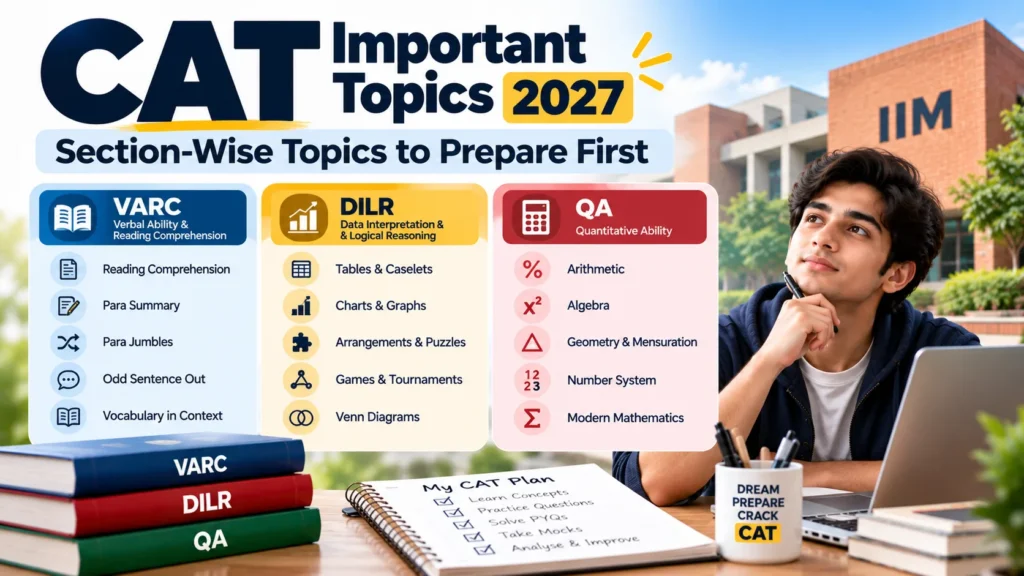
CAT Important Topics 2027 at a Glance
The major areas to focus on are:
| Section | Important Topic Areas | Priority |
|---|---|---|
| VARC | Reading Comprehension | Very High |
| VARC | Para Summary | High |
| VARC | Para Jumbles | High |
| VARC | Odd Sentence Out | Medium-High |
| DILR | Tables & Caselets | High |
| DILR | Charts & Graphs | High |
| DILR | Arrangements & Puzzles | Very High |
| DILR | Games & Tournaments | High |
| DILR | Venn Diagrams | Medium |
| QA | Arithmetic | Very High |
| QA | Algebra | Very High |
| QA | Geometry & Mensuration | High |
| QA | Number System | High |
| QA | Modern Mathematics | Medium |
Important: Priority does not mean that other topics can be completely ignored. CAT can combine concepts and change the distribution of questions from year to year.
CAT Important Topics: VARC
The Verbal Ability and Reading Comprehension (VARC) section tests your ability to understand, analyse and interpret written information.
For most students, Reading Comprehension should receive the highest priority because it represents a substantial part of the section.
Important VARC Topics
- Reading Comprehension
- Para Summary
- Para Jumbles
- Odd Sentence Out
- Sentence-based verbal reasoning
- Vocabulary in context
- Main idea and central argument
- Author’s tone and intent
- Inference-based questions
- Paragraph structure and logical flow
1. Reading Comprehension
Priority: Very High
Reading Comprehension is one of the most important areas to prepare for CAT.
Passages can cover a wide range of subjects, including:
- Philosophy
- Economics
- History
- Sociology
- Psychology
- Science
- Technology
- Environment
- Business
- Culture
- Literature
You do not need specialist knowledge of these subjects to solve RC questions.
The important skills are:
- Understanding the central idea
- Identifying the author’s argument
- Drawing logical inferences
- Understanding tone
- Identifying assumptions
- Distinguishing facts from opinions
- Understanding the purpose of a paragraph
- Eliminating incorrect options
What Should You Practise First?
Start with:
Main idea → Inference → Tone → Author’s purpose → Argument structure
Don’t make vocabulary memorisation the centre of your VARC preparation.
Instead, develop the ability to understand unfamiliar passages quickly.
2. Para Summary
Priority: High
Para Summary questions require you to identify the option that best represents the central idea of a paragraph.
The biggest mistake is selecting an option that mentions one important detail but fails to capture the entire paragraph.
While practising, ask:
“What is the author actually trying to say?”
rather than:
“Which option contains words from the passage?”
This distinction can significantly improve accuracy.
3. Para Jumbles
Priority: High
Para Jumbles test your ability to identify the logical sequence of sentences.
Important clues include:
- Pronouns
- Connectors
- Cause and effect
- Chronological order
- Examples
- Definitions
- Contrasting statements
- Introduction and conclusion
The goal is not simply to find sentences that “sound right.”
You need to understand the logical structure of the paragraph.
4. Odd Sentence Out
Priority: Medium-High
In these questions, several sentences form a coherent paragraph while one sentence does not fit the logical flow.
Focus on:
- Common theme
- Sentence relationships
- Pronoun references
- Continuity
- Cause-effect relationships
- Topic shifts
This topic is relatively straightforward to understand but requires consistent practice.
CAT Important Topics: DILR
The Data Interpretation and Logical Reasoning (DILR) section is different from traditional school-style subjects.
Instead of memorising a fixed list of formulas, you need to develop the ability to analyse information and solve unfamiliar sets.
This is also why DILR can be unpredictable.
Important DILR Areas
Data Interpretation
- Tables
- Bar graphs
- Line graphs
- Pie charts
- Caselets
- Mixed graphs
- Missing-data sets
- Percentage-based DI
- Ratio-based DI
Logical Reasoning
- Arrangements
- Seating arrangements
- Selection problems
- Distribution
- Games and tournaments
- Scheduling
- Venn diagrams
- Networks
- Routes
- Ranking
- Team formation
- Constraint-based puzzles
Previous CAT papers show that DILR can combine different concepts within a single set, so candidates should practise complete sets rather than only isolated question types.
5. Tables and Caselets
Priority: High
Tables and caselet-based DI require you to extract information from text or structured data.
You may need to calculate:
- Percentages
- Ratios
- Differences
- Averages
- Growth rates
- Comparisons
The important skill is converting the information into a usable structure.
6. Arrangements and Puzzles
Priority: Very High
Logical reasoning sets can involve:
- Seating
- Scheduling
- Assignments
- Ordering
- Selection
- Distribution
- Groups
- Multiple conditions
The challenge is usually not a difficult formula.
The challenge is handling several conditions simultaneously.
Practise using:
- Tables
- Grids
- Diagrams
- Flowcharts
- Logical deductions
7. Games and Tournaments
Priority: High
Games and tournament sets may involve:
- Matches
- Points
- Rankings
- Wins and losses
- Team comparisons
- Tournament conditions
These sets require careful interpretation and systematic elimination.
8. Venn Diagrams and Set-Based Problems
Priority: Medium
Venn diagrams can involve overlapping groups and conditions.
For example, a question might provide information about students who like:
- Finance
- Marketing
- Operations
and ask you to determine the number belonging to one or more groups.
The basic concepts are relatively simple, but CAT can combine them with additional conditions.
CAT Important Topics: QA
The Quantitative Ability (QA) section covers mathematical concepts, but CAT generally tests how well you can apply those concepts rather than simply recall formulas.
The most important QA areas for CAT 2027 preparation are:
- Arithmetic
- Algebra
- Geometry
- Number System
- Modern Mathematics
Among these, Arithmetic and Algebra should normally receive early priority.
9. Arithmetic
Priority: Very High
Arithmetic is one of the most important areas to build your QA foundation.
Focus on:
- Percentages
- Profit and Loss
- Ratio and Proportion
- Averages
- Mixtures and Alligation
- Time and Work
- Time, Speed and Distance
- Simple Interest
- Compound Interest
- Partnership
Start your QA preparation with Arithmetic if you are building your fundamentals from scratch.
10. Algebra
Priority: Very High
Important Algebra areas include:
- Linear equations
- Quadratic equations
- Inequalities
- Functions
- Algebraic expressions
- Sequences and series
- Progressions
- Modulus
- Surds and indices
Algebra becomes particularly important when questions require you to combine multiple concepts.
Build your fundamentals before attempting difficult CAT-level problems.
11. Geometry and Mensuration
Priority: High
Important topics include:
- Lines and angles
- Triangles
- Quadrilaterals
- Circles
- Polygons
- Coordinate geometry
- Areas
- Volumes
- Mensuration
You should understand properties and relationships instead of simply memorising formulas.
For example, knowing the properties of triangles can help you solve several different types of CAT questions.
12. Number System
Priority: High
Important areas include:
- Divisibility
- Factors
- Multiples
- HCF
- LCM
- Remainders
- Unit digits
- Number properties
- Bases
- Surds and indices
Number System questions can sometimes look complicated but become much easier once the underlying properties are clear.
13. Modern Mathematics
Priority: Medium
Important areas include:
- Permutation and Combination
- Probability
- Set Theory
- Sequences
- Progressions
These topics should not be ignored, but if you are just beginning your CAT 2027 preparation, it is generally more productive to first build strong foundations in Arithmetic and Algebra.
Which CAT Topics Should You Prepare First?
If you are starting CAT 2027 preparation from scratch, don’t attempt to complete every topic simultaneously.
A practical priority order would be:
VARC
1. Reading Comprehension
↓
2. Para Summary
↓
3. Para Jumbles
↓
4. Odd Sentence Out
DILR
1. Basic DI
↓
2. Tables & Caselets
↓
3. Arrangements
↓
4. Puzzles
↓
5. Games & Tournaments
↓
6. Other mixed sets
QA
1. Arithmetic
↓
2. Algebra
↓
3. Geometry
↓
4. Number System
↓
5. Modern Mathematics
This does not mean you should completely finish one section before touching another. CAT preparation works better when you maintain regular practice across all three sections.
CAT Important Topics vs CAT Syllabus
There is an important difference between the two.
CAT syllabus refers broadly to the areas tested in the examination.
CAT important topics refers to the areas you should prioritise based on recurring question patterns, your preparation level and the time available.
Since IIMs do not publish a fixed chapter-by-chapter syllabus, students should avoid treating any third-party “weightage” table as guaranteed. Recent CAT preparation sources similarly note that the detailed topic lists are derived from previous papers rather than an official IIM chapter-wise syllabus.
Should You Skip Low-Priority CAT Topics?
No.
Priority helps you decide what to study first. It does not mean you should permanently skip other topics.
For example, if Arithmetic is your weakest area, you should spend more time building it.
But once your fundamentals are strong, you should gradually cover the remaining areas.
CAT can test combinations of concepts, and the distribution can vary between papers.
How to Prepare CAT Important Topics in 2027
A good preparation cycle can follow this sequence:
Step 1: Learn the Concept
Understand the underlying concept instead of memorising shortcuts immediately.
Step 2: Solve Basic Questions
Build accuracy first.
Step 3: Move to CAT-Level Questions
Gradually increase difficulty.
Step 4: Solve Previous Year Questions
Use [CAT Previous Year Question Papers] to understand how concepts are actually tested.
Step 5: Take Sectional Tests
Once you have covered enough topics, start timed sectional practice.
Step 6: Analyse Your Mistakes
Don’t simply count your score.
Identify:
- Conceptual mistakes
- Calculation mistakes
- Time-management mistakes
- Wrong question selection
- Misinterpretation
Step 7: Take Full-Length Mocks
Mocks should become an important part of your preparation closer to the examination.
Best Strategy for CAT 2027 Beginners
If you’re beginning CAT preparation now, don’t start by collecting dozens of books and PDFs.
Start with the fundamentals.
First Priority
QA: Arithmetic + Algebra
VARC: Reading Comprehension
DILR: Basic sets + arrangements
Second Priority
Expand into:
- Geometry
- Number System
- Para Summary
- Para Jumbles
- Tables
- Caselets
- Puzzles
- Games and tournaments
Third Priority
Move towards:
- Previous year questions
- Sectional tests
- Full mocks
- Mock analysis
- Revision
You can also follow the complete [CAT Exam Preparation Roadmap] for a stage-by-stage preparation plan.
CAT Important Topics 2027: Quick Revision Table
| Section | Topic | Priority |
|---|---|---|
| VARC | Reading Comprehension | Very High |
| VARC | Para Summary | High |
| VARC | Para Jumbles | High |
| VARC | Odd Sentence Out | Medium-High |
| DILR | Tables & Caselets | High |
| DILR | Charts & Graphs | High |
| DILR | Arrangements | Very High |
| DILR | Puzzles | Very High |
| DILR | Games & Tournaments | High |
| DILR | Venn Diagrams | Medium |
| QA | Arithmetic | Very High |
| QA | Algebra | Very High |
| QA | Geometry | High |
| QA | Number System | High |
| QA | Modern Mathematics | Medium |
Frequently Asked Questions
What are the most important topics for CAT 2027?
The major priority areas are Reading Comprehension in VARC, arrangements and data sets in DILR, and Arithmetic and Algebra in QA. However, candidates should eventually cover all major areas because CAT can vary its question mix.
Which section should I prepare first for CAT 2027?
There is no universal answer. A practical approach is to begin with QA Arithmetic, VARC Reading Comprehension and basic DILR sets simultaneously.
Is CAT 2027 syllabus officially released?
A detailed chapter-wise syllabus is generally not published by IIMs. The topic lists used by aspirants are primarily derived from previous CAT papers and recurring question types.
Is Arithmetic important for CAT 2027?
Yes. Arithmetic is one of the most important QA areas and is a good starting point for candidates building their quantitative fundamentals.
Is Reading Comprehension important for CAT?
Yes. RC is a major component of VARC and should receive substantial preparation time.
Is DILR difficult?
DILR can be unpredictable because the difficulty and structure of sets can vary. Strong set selection and regular practice are therefore important.
Should I study every CAT topic?
Yes, eventually. However, prioritising high-value topics first can make your preparation more efficient.
Final Takeaway
If you’re preparing for CAT 2027, don’t approach preparation as simply “finishing the syllabus.”
Instead, identify the CAT important topics, build your fundamentals, practise actual CAT-style questions and then improve your speed and decision-making through sectional tests and mocks.
Your initial priority should be:
VARC → Reading Comprehension + Verbal Ability
DILR → DI sets + Arrangements + Puzzles
QA → Arithmetic + Algebra + Geometry
Then progressively cover the remaining topics.
Most importantly, treat the topic list as a preparation framework, not an official IIM syllabus. The final CAT 2027 notification should be checked when it is released for any changes to the examination structure or eligibility
Stay Updated with CareerMint
Get the latest updates on competitive exams, government jobs, results, notifications, scholarships, career opportunities, and preparation tips.
Follow CareerMint on all our platforms for daily updates:
Instagram – Exam updates & quick career tips
Facebook – Latest jobs, exams & opportunities
YouTube – Preparation guides & career content
Telegram – Instant exam & government job alerts
WhatsApp – Important updates delivered directly
LinkedIn – Career opportunities & professional updates
Follow CareerMint today and never miss an important career or exam update!