

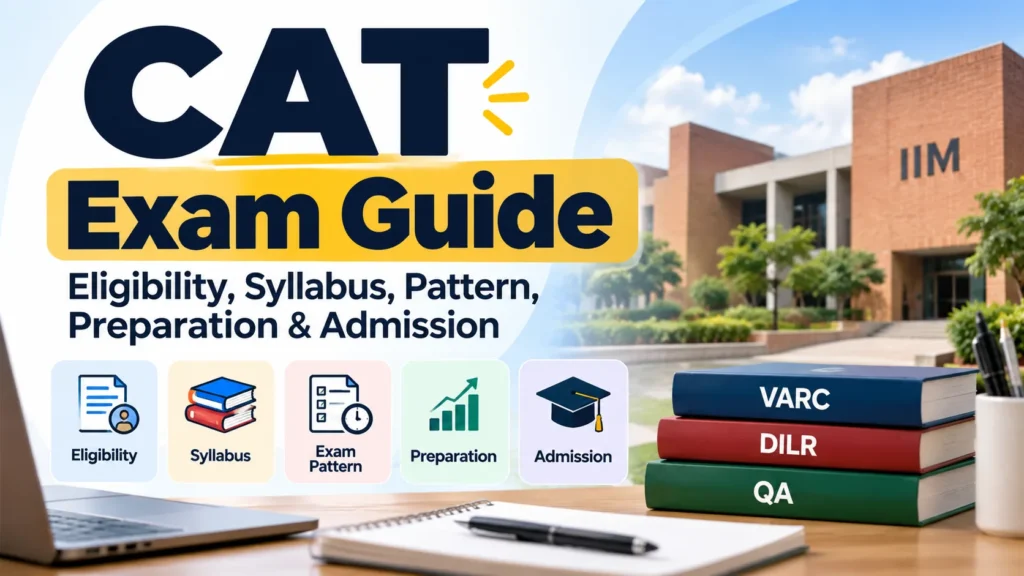
CAT Exam Guide: Complete Overview for MBA Aspirants
The CAT exam guide is the right place to start if you are planning to appear for the Common Admission Test and want to understand the complete journey from eligibility and syllabus to preparation and MBA admission.
The Common Admission Test, commonly known as CAT, is a computer-based management entrance examination conducted for admission to postgraduate management programmes offered by the Indian Institutes of Management (IIMs). CAT scores are also accepted by various other participating management institutes.
For a beginner, CAT can initially seem complicated because it involves several stages: understanding eligibility, completing registration, preparing for three sections, taking the examination, checking the result, and going through the individual admission processes of institutes.
This CAT exam guide brings these important areas together in one place so that you can understand what CAT involves and what you should do next.
Quick Overview: CAT preparation involves understanding the exam structure, studying the syllabus, developing fundamentals, solving questions, practising previous-year papers, taking mock tests, analysing performance, and preparing for the admission stage.
What Is the CAT Exam?
The Common Admission Test (CAT) is a national-level management entrance examination conducted by the IIMs.
CAT is primarily associated with admission to management programmes at IIMs, while CAT scores may also be used by other participating non-IIM institutions.
The exam tests a candidate’s aptitude in three broad areas:
- Verbal Ability and Reading Comprehension (VARC)
- Data Interpretation and Logical Reasoning (DILR)
- Quantitative Ability (QA)
The exact examination structure, number of questions, duration, registration dates and other details can change from one CAT edition to another. Therefore, candidates should always check the official CAT website and the latest notification before applying.
If you are completely new to CAT, you can also read our detailed [CAT guide for beginners] before starting your preparation.
CAT Eligibility Criteria
One of the first things you should check before preparing for CAT is whether you are eligible to apply.
Generally, CAT eligibility is based on your educational qualification and academic performance. Candidates who have completed a bachelor’s degree and eligible final-year candidates can apply, subject to the requirements specified in the relevant CAT notification.
In recent official CAT eligibility information, the minimum academic requirement has generally included a bachelor’s degree with at least 50% marks or equivalent CGPA for General/EWS/NC-OBC candidates and 45% for SC, ST and PwD candidates. Final-year students may also be eligible, subject to the applicable conditions. Always verify the requirements in the notification for the year you are applying.
Can Final-Year Students Apply for CAT?
Yes, eligible candidates in the final year of their bachelor’s degree can apply, subject to the conditions mentioned in the relevant CAT notification.
However, fulfilling the minimum eligibility criteria does not automatically guarantee admission or shortlisting. Individual IIMs can apply their own selection criteria and admission policies.
For a detailed breakdown, see our [CAT Eligibility] page.
CAT Exam Pattern
Understanding the exam pattern before preparation is important because CAT is not simply a test of knowledge. You also need to manage time, select questions carefully and maintain accuracy.
CAT has three major sections:
| Section | Full Form |
|---|---|
| VARC | Verbal Ability and Reading Comprehension |
| DILR | Data Interpretation and Logical Reasoning |
| QA | Quantitative Ability |
The exam is computer-based and consists of questions from these three areas.
The precise number of questions, duration, marking scheme and other examination details can change between editions. Therefore, do not rely on an old CAT pattern while preparing for your examination.
You can check the detailed [CAT Exam Pattern] page for section-wise information.
Why Should You Understand the Pattern First?
Knowing the structure helps you decide:
- How much time to allocate to each section
- Which topics require more preparation
- How to approach different question types
- When to start sectional tests
- How to analyse mock-test performance
For CAT preparation, knowing what to study is only one part of the process. Knowing how the examination tests you is equally important.
CAT Syllabus
The CAT syllabus is broadly divided into three sections: VARC, DILR and QA.
1. VARC
The VARC section primarily focuses on reading comprehension and verbal ability.
Important areas may include:
- Reading Comprehension
- Para Jumbles
- Para Summary
- Odd Sentence
- Sentence-based questions
- Vocabulary and contextual understanding
- Verbal reasoning
Reading regularly is particularly useful because CAT Reading Comprehension requires candidates to understand arguments, ideas, tone, structure and information presented in passages.
2. DILR
DILR combines data interpretation with logical reasoning.
Common areas include:
- Tables
- Charts
- Graphs
- Arrangements
- Games and tournaments
- Selection and distribution
- Networks
- Logical sets
- Data-based reasoning
The important skill here is not simply memorising formulas. You need to learn how to identify the structure of a set and determine whether it is worth attempting.
3. Quantitative Ability
QA covers mathematical concepts generally associated with areas such as:
- Arithmetic
- Algebra
- Geometry
- Number System
- Modern Mathematics
- Percentages
- Profit and Loss
- Ratio and Proportion
- Time, Speed and Distance
- Time and Work
You can explore the complete [CAT Syllabus] separately for a more detailed topic-wise breakdown.
How to Prepare for CAT
A good CAT preparation strategy should not begin with randomly solving difficult questions.
Instead, follow a structured process.
Step 1: Understand the Exam
Start by understanding:
- CAT eligibility
- Exam pattern
- Syllabus
- Sections
- Question types
- Marking system
- Preparation requirements
This gives you a clear picture of the examination before you begin studying.
Step 2: Assess Your Current Level
Before creating a long study schedule, identify your strengths and weaknesses.
For example:
VARC:
Can you understand long passages quickly?
DILR:
Can you identify patterns and solve logical sets?
QA:
Are your basic mathematical concepts strong?
This assessment helps you decide where to spend more time.
Step 3: Build Your Fundamentals
Do not immediately focus on advanced questions.
First strengthen the basics of important topics.
For QA, revise fundamental mathematical concepts.
For VARC, develop reading and comprehension ability.
For DILR, practise different types of logical and data-based sets.
Step 4: Practise Topic-Wise Questions
Once your fundamentals are clear, start solving questions topic by topic.
This allows you to identify:
- Frequently occurring mistakes
- Weak concepts
- Time-consuming question types
- Topics requiring additional revision
Step 5: Solve CAT Previous-Year Papers
Previous-year questions help you understand how concepts are actually tested.
Don’t simply solve them and check your score.
Analyse:
- Why you selected a particular question
- Whether your approach was correct
- How much time you spent
- Where you made mistakes
- Whether another method was faster
Our [CAT Previous Year Question Papers] page can be used as part of this stage.
Step 6: Take Sectional Tests
After developing sufficient topic-level preparation, introduce sectional tests.
Sectional tests help you practise:
- Time management
- Question selection
- Accuracy
- Section-specific strategy
Step 7: Start Full-Length Mock Tests
Mocks become increasingly important as you progress.
However, taking a mock test without analysing it limits its usefulness.
After every mock, review your performance and identify:
What went wrong?
Which questions should you have attempted?
Which questions should you have skipped?
Where did you lose time?
Which concepts need revision?
This process can help you gradually improve your performance.
CAT Preparation Timeline
There is no single preparation duration that works for every student.
Your preparation time depends on your current academic level, available study hours, familiarity with the syllabus and target score.
A simple approach is:
6+ Months
Focus on:
- Fundamentals
- Complete syllabus coverage
- Topic-wise practice
- Reading
- Previous-year questions
- Gradual mock-test practice
3–6 Months
Focus on:
- Completing important topics
- Intensive practice
- Sectional tests
- Previous-year questions
- Regular mocks
- Performance analysis
Less Than 3 Months
Focus heavily on:
- High-priority topics
- Revision
- Previous-year questions
- Sectional tests
- Mock tests
- Improving question selection and time management
For a detailed plan, follow our [CAT Preparation Strategy] guide.
CAT Registration and Application
CAT registration is conducted online through the official CAT website during the registration window announced for that examination year.
Candidates need to carefully enter their personal, academic and other required information and upload the documents specified in the application instructions.
Registration dates, fees, test cities and other application details can change each year.
For example, the official CAT 2025 announcement specified its own registration period, fee structure, test date and other details. These should not be assumed to apply to another CAT edition.
Therefore, when the next CAT notification is released, check the official notification before submitting your application.
What Happens After the CAT Exam?
Your CAT journey does not end when you submit the examination.
The broad process is:
CAT Exam → Result/Score → Institute Shortlisting → Selection Process → Final Admission
After CAT results are released, individual IIMs and other participating institutions may use CAT scores along with their own admission criteria.
The selection process can vary from one institution to another.
Factors considered by an institute may include:
- CAT performance
- Academic record
- Work experience
- Category
- Diversity-related criteria
- Written assessment
- Personal interview
- Other institute-specific components
The important point is that CAT score is not the only factor in every institute’s admission process. IIMs have their own admission policies and selection criteria.
CAT Exam vs MBA Admission
It is important to understand the difference.
CAT is the entrance examination.
MBA admission is the larger process that happens after the examination.
You may perform well in CAT, receive a shortlist and still need to complete further selection stages depending on the institute.
This is why your preparation should not stop at simply targeting a percentile. You should also understand the admission criteria of the institutes you want to join.
Common Mistakes CAT Aspirants Should Avoid
1. Starting Without Understanding the Syllabus
Don’t begin preparation randomly. Know what you need to study first.
2. Ignoring Fundamentals
Trying advanced questions without strong basics can waste time.
3. Taking Too Many Mocks Too Early
Mocks are useful, but they cannot replace concept building.
4. Not Analysing Mock Tests
A mock score alone doesn’t tell you how to improve.
5. Ignoring Previous-Year Questions
PYQs provide valuable insight into the way concepts are tested.
6. Focusing Only on One Section
CAT requires preparation across VARC, DILR and QA.
7. Studying Without a Plan
A consistent schedule is more useful than occasional long study sessions.
CAT Preparation Roadmap for Beginners
If you are starting from zero, follow this sequence:
Understand CAT → Check Eligibility → Understand Exam Pattern → Study the Syllabus → Assess Your Strengths & Weaknesses → Build Fundamentals → Topic-Wise Practice → Previous-Year Questions → Sectional Tests → Mock Tests → Mock Analysis → Revision → Final Exam Strategy
This gives beginners a clear path instead of trying to prepare for everything simultaneously.
CAT Exam Guide: Quick Checklist
Before beginning your preparation, make sure you have covered these areas:
- ✅ Check CAT eligibility
- ✅ Understand the exam pattern
- ✅ Study the syllabus
- ✅ Assess your current level
- ✅ Create a realistic study schedule
- ✅ Build fundamentals
- ✅ Practise topic-wise questions
- ✅ Solve previous-year questions
- ✅ Take sectional tests
- ✅ Attempt full-length mocks
- ✅ Analyse your mistakes
- ✅ Revise regularly
- ✅ Understand the admission process
Frequently Asked Questions
What is CAT?
CAT stands for Common Admission Test. It is a computer-based management entrance examination conducted by the IIMs and is used for admission to IIM programmes and by participating non-IIM institutions.
Who can apply for CAT?
Eligible graduates and eligible final-year bachelor’s degree candidates can apply, subject to the requirements specified in the relevant CAT notification. Always check the latest official eligibility criteria before applying.
Is CAT difficult for beginners?
CAT can be challenging, but beginners can prepare effectively with a structured approach. Understanding the syllabus, building fundamentals, practising consistently and analysing mock tests are important parts of preparation.
What are the three sections of CAT?
The three broad sections are VARC, DILR and QA.
How long should I prepare for CAT?
There is no fixed preparation duration. Many students prefer several months of structured preparation, while the appropriate timeline depends on their existing knowledge, available study time and target.
Is CAT enough for MBA admission?
No. CAT is an entrance examination. After the exam, individual institutions may conduct their own shortlisting and selection processes.
Should I solve CAT previous-year papers?
Yes. Previous-year questions can help you understand question types, difficulty and how concepts are tested. They should be combined with conceptual preparation, sectional practice and mock tests.
Final Takeaway
A successful CAT preparation journey begins with clarity.
First understand eligibility, syllabus and exam pattern. Then build your fundamentals, practise systematically, solve previous-year questions and gradually introduce sectional and full-length mock tests.
Most importantly, remember that the CAT examination and MBA admission are two connected but different stages. Your CAT preparation should therefore focus not only on solving questions but also on developing accuracy, time management, question selection and consistency.
If you are starting from scratch, use this CAT exam guide as your starting point and then move through the detailed CareerMint resources for [CAT Eligibility], [CAT Syllabus], [CAT Previous Year Question Papers] and [CAT Preparation Strategy].
Follow CareerMint on all our platforms for daily updates:
Instagram – Exam updates & quick career tips
Facebook – Latest jobs, exams & opportunities
YouTube – Preparation guides & career content
Telegram – Instant exam & government job alerts
WhatsApp – Important updates delivered directly
LinkedIn – Career opportunities & professional updates
Follow CareerMint today and never miss an important career or exam update!