


Starting your MBA preparation can feel confusing, especially if you are hearing about CAT for the first time. You may have questions about the exam, eligibility, syllabus, preparation strategy, previous papers, and what you should study first.
This CAT exam for beginners guide explains the complete journey in simple terms. Whether you are a college student, working professional, final-year graduate, or someone who has just decided to pursue an MBA, this guide will help you understand where to start.
The most important thing is not to begin with random books or mock tests. First, understand the CAT exam, its structure, syllabus, and preparation requirements. Once you have that foundation, you can build a practical study plan.
What Is the CAT Exam?
The Common Admission Test, commonly known as CAT, is a national-level management entrance examination used by the Indian Institutes of Management (IIMs) and accepted by numerous other business schools for admission to management programmes.
For a beginner, it is useful to think of CAT as a combination of three broad skills:
- Verbal and Reading Comprehension
- Data Interpretation and Logical Reasoning
- Quantitative Ability
The exam is not simply about memorising information. It tests your ability to understand information, solve problems, manage time, and make accurate decisions under pressure.
This is why a successful CAT exam for beginners strategy should focus on building fundamentals before moving to advanced questions and full-length mocks.
If you want an overview of the examination, eligibility, syllabus, preparation and other important information in one place, visit the main [CAT guide] on CareerMint.
Why Should Beginners Start CAT Preparation Early?
One of the biggest advantages a beginner can have is time.
CAT preparation involves several different skills, and they don’t necessarily improve at the same speed. A student may be comfortable with mathematics but struggle with reading comprehension. Another student may perform well in verbal ability but need more practice in logical reasoning.
Starting early gives you enough time to identify these differences.
A good beginner’s preparation generally follows this progression:
Understand → Learn → Practice → Analyse → Improve → Revise
Instead of trying to solve the hardest questions immediately, begin by understanding the concepts and question types.
Early preparation also gives you enough time to:
- Complete the syllabus
- Build fundamental concepts
- Develop reading habits
- Solve previous year questions
- Take sectional tests
- Take full-length mock tests
- Analyse mistakes
- Revise weak areas
CAT Eligibility for Beginners
Before starting serious preparation, check whether you meet the eligibility requirements for CAT.
Eligibility generally relates to your educational qualification and academic performance. Final-year undergraduate students may also be eligible under the conditions specified in the relevant CAT notification.
However, eligibility requirements can change between examination cycles. Therefore, beginners should always verify the latest requirements before applying.
For a detailed explanation, see the [CAT Eligibility] guide on CareerMint.
Understanding eligibility early is useful because it helps you determine whether you can apply in the current cycle or whether you should use the additional time to prepare for a future attempt.
Understand the CAT Exam Pattern First
A common mistake beginners make is starting preparation without understanding how the exam works.
Before selecting books or creating a timetable, understand:
- The sections in the examination
- Number and type of questions
- Sectional time limits
- Marking system
- Negative marking
- Question formats
- Overall test structure
Knowing the pattern helps you develop a realistic preparation strategy.
For example, simply knowing mathematics is not enough for the Quantitative Ability section. You also need to solve questions within the available time while maintaining accuracy.
You can understand the complete structure through CareerMint’s [CAT Exam Pattern] guide.
Understand the CAT Syllabus
Once you understand the exam pattern, the next step is to understand the syllabus.
The three broad CAT sections are:
1. Verbal Ability and Reading Comprehension
VARC tests your ability to understand written information, interpret passages and answer verbal questions.
Important areas can include:
- Reading comprehension
- Para jumbles
- Para summary
- Odd sentence
- Verbal reasoning
- Reading-based questions
2. Data Interpretation and Logical Reasoning
DILR requires you to interpret information and identify logical relationships.
Questions can involve:
- Tables
- Charts
- Graphs
- Arrangements
- Games and tournaments
- Distribution
- Scheduling
- Logical sets
3. Quantitative Ability
QA tests mathematical concepts and problem-solving ability.
Important areas generally include:
- Arithmetic
- Algebra
- Geometry
- Number system
- Modern mathematics
- Percentages
- Profit and loss
- Ratios
- Averages
- Time and work
- Time, speed and distance
For the detailed topic-wise breakdown, use the [CAT Syllabus](/cat/syllabus/) page.
Don’t try to memorise the entire syllabus
A beginner’s objective should not be to memorise a list of topics.
Instead, divide the syllabus into:
Strong → Average → Weak
Then allocate your preparation time accordingly.
How to Start CAT Preparation as a Beginner
For CAT exam for beginners, building strong fundamentals is more important than immediately attempting difficult questions.
Step 1: Understand Your Current Level
Before creating a study plan, determine your current strengths and weaknesses.
You can solve a few basic questions from each section to understand your starting point.
Ask yourself:
- How comfortable am I with mathematics?
- How well do I understand long passages?
- Can I solve logical sets?
- How quickly can I calculate?
- How good is my accuracy?
- How well do I manage time?
You don’t need to score highly at this stage.
The purpose is simply to understand where you stand.
Step 2: Build Your Fundamentals
For beginners, fundamentals should come before advanced-level questions.
In QA, for example, you should understand basic concepts such as percentages, ratios, averages and equations before attempting difficult questions.
For VARC, develop a consistent reading habit.
For DILR, start with manageable sets and gradually increase the difficulty.
Your goal during this stage is:
Accuracy first, speed later.
Speed naturally improves as you become familiar with concepts and question types.
Step 3: Create a Realistic Study Schedule
A study schedule should fit your daily routine.
A beginner who studies consistently for two hours every day can make better progress than someone who studies eight hours for two days and then stops for a week.
A simple schedule could look like:
| Activity | Approx. Time |
|---|---|
| Quantitative Ability | 45 minutes |
| VARC/Reading | 30 minutes |
| DILR | 30 minutes |
| Revision | 15 minutes |
You can adjust this according to your strengths and weaknesses.
If QA is your weakest section, you can increase its study time.
If you struggle with reading comprehension, spend additional time reading and solving RC passages.
Step 4: Develop a Reading Habit
Reading is particularly important for beginners preparing for the verbal section.
Don’t restrict yourself to CAT preparation material.
Read:
- Newspapers
- Editorials
- Essays
- Non-fiction
- Business articles
- Science and technology articles
- History and social science content
The objective isn’t just to read faster.
You should learn to identify:
- The main argument
- Author’s opinion
- Supporting ideas
- Tone
- Context
- Logical relationships
Over time, this can improve your comprehension and ability to handle unfamiliar passages.
Step 5: Start Solving Questions
After understanding the basics, start practising questions topic by topic.
Don’t immediately jump into full-length mock tests.
A better progression is:
Concept → Basic Questions → Moderate Questions → CAT-Level Questions → Mixed Practice → Mock Test
This approach lets you identify exactly where you are making mistakes.
When you get a question wrong, don’t simply check the answer and move on.
Ask:
Why did I get it wrong?
Was it because of:
- Lack of concept?
- Calculation error?
- Misreading?
- Wrong approach?
- Time pressure?
- Guessing?
Your mistakes can become one of the most useful sources of improvement.
Step 6: Use CAT Previous Year Question Papers
Once your fundamentals are reasonably strong, start solving previous year questions.
Previous year questions help you understand what the actual examination asks and how concepts are applied.
They can help you identify:
- Frequently tested concepts
- Question difficulty
- Question patterns
- Time requirements
- Common traps
- Your weak areas
Don’t treat previous papers as just another question bank.
Analyse them.
After completing a paper or a set of questions, record:
- Questions attempted
- Correct answers
- Incorrect answers
- Unattempted questions
- Time taken
- Reason for mistakes
CareerMint’s [CAT Previous Year Question Papers] resource can be used as part of this process.
Step 7: Start Taking Mock Tests
Mocks become more valuable after you have developed sufficient familiarity with the syllabus and question types.
A mock test should not simply be about your score.
After every mock, analyse:
Accuracy
How many attempted questions were correct?
Time management
Where did you spend too much time?
Sectional performance
Which section is strongest and which needs improvement?
Question selection
Did you spend too much time on difficult questions?
Mistakes
Were your mistakes conceptual or careless?
A student who takes fewer mocks but analyses them properly can learn more than someone who takes many mocks without reviewing mistakes.
CAT Preparation Strategy for Beginners
A simple preparation cycle can be divided into four stages.
Stage 1: Foundation
Focus on:
- Basic concepts
- Syllabus familiarity
- Reading habit
- Fundamental question types
Stage 2: Practice
Focus on:
- Topic-wise questions
- Previous year questions
- Accuracy
- Concept application
Stage 3: Testing
Focus on:
- Sectional tests
- Mixed practice
- Mock tests
- Time management
Stage 4: Revision
Focus on:
- Weak topics
- Mistake notebook
- Important formulas
- Previously attempted questions
- Mock analysis
For a more detailed year-specific approach, continue to the CareerMint [CAT 2027 Preparation Strategy] guide.
How Long Does CAT Preparation Take?
There is no single preparation duration that works for everyone.
Your required preparation time depends on:
- Current academic level
- Mathematics fundamentals
- Reading ability
- Available study hours
- Previous preparation
- Target percentile
- Consistency
A student with strong fundamentals may need less time than someone starting from scratch.
Rather than asking:
“How many months are enough?”
ask:
“How much of the syllabus have I mastered, and how consistently am I improving?”
That gives you a much more useful measure of progress.
Common Mistakes CAT Beginners Should Avoid
Many students following a CAT exam for beginners approach make the mistake of starting with mock tests before building their fundamentals.
1. Starting without understanding the syllabus
You need to know what you are preparing for.
2. Collecting too many books
More resources don’t automatically mean better preparation.
Choose useful resources and complete them properly.
3. Ignoring reading
Reading comprehension requires regular practice.
4. Focusing only on strengths
Your weak areas can significantly affect your overall performance.
5. Taking mocks too early
Mocks are valuable, but they are not a replacement for learning fundamentals.
6. Taking mocks without analysis
A mock test is only half the process.
Analysis is where much of the learning happens.
7. Ignoring previous year questions
PYQs help you understand actual question patterns and difficulty.
8. Chasing speed before accuracy
Fast wrong answers don’t improve your score.
First build accuracy, then work on speed.
A Simple CAT Beginner Roadmap
This CAT exam for beginners roadmap takes you from understanding the exam to developing a structured preparation strategy.
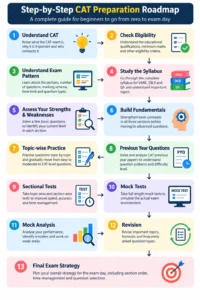
This gives you a clear direction instead of jumping between different preparation resources.
Frequently Asked Questions
Can a beginner prepare for CAT?
Yes. A beginner can prepare for CAT by first understanding the exam structure and syllabus, then building fundamentals, practising systematically and gradually moving toward previous year questions and mock tests.
When should a beginner start CAT preparation?
The earlier you start, the more time you have to build fundamentals and improve weak areas. However, the ideal starting point depends on your available time, academic background and target score.
Can I prepare for CAT without coaching?
Yes. Self-study can work if you have a structured plan, reliable resources, regular practice and a disciplined approach to analysing mistakes.
Should beginners start with mock tests?
Generally, beginners should first understand the syllabus and build basic concepts. Mocks become more useful once you have enough familiarity with the examination and its question types.
Are CAT previous year papers important?
Yes. Previous year papers help you understand actual question styles, difficulty and the way concepts are tested. They should be used alongside concept learning and mock-test practice.
Is CAT difficult for beginners?
CAT can seem challenging initially, but a structured CAT exam for beginners strategy can make preparation much easier. Start with the syllabus, understand the exam pattern, build fundamentals, and gradually move toward sectional tests and full-length mocks.
Final Takeaway
Preparing for CAT as a beginner doesn’t mean studying everything at once. The most effective approach is to understand the examination first, learn the syllabus, build your fundamentals, practise consistently and gradually introduce previous year questions and mock tests.
If you’re starting from zero, don’t worry about your initial score. Focus on building a strong foundation and improving one weakness at a time.
The complete CAT exam for beginners journey can be summarized in one simple process:
Understand → Learn → Practise → Analyse → Improve → Revise.
Once you have established this routine, your preparation becomes much more manageable and measurable.
For the next step, explore CareerMint’s CAT, CAT Eligibility, CAT Syllabus, CAT Exam Pattern, CAT Previous Year Question Papers, and CAT 2027 Preparation Strategy resources to continue your preparation.
Stay Updated with CareerMint
Get the latest updates on competitive exams, government jobs, results, notifications, scholarships, career opportunities, and preparation tips.
Follow CareerMint on all our platforms for daily updates:
Instagram – Exam updates & quick career tips
Facebook – Latest jobs, exams & opportunities
YouTube – Preparation guides & career content
Telegram – Instant exam & government job alerts
WhatsApp – Important updates delivered directly
LinkedIn – Career opportunities & professional updates
Follow CareerMint today and never miss an important career or exam update!


2 thoughts on “CAT Exam for Beginners: Complete Guide to the Common Admission Test 2027”
Pingback: CAT MBA Entrance Exam 2027: Eligibility, Syllabus, Pattern & Admission
Pingback: CAT Exam Preparation Roadmap: Beginner to Exam Day