
How to Prepare for JEE 2027: Complete JEE Preparation Strategy
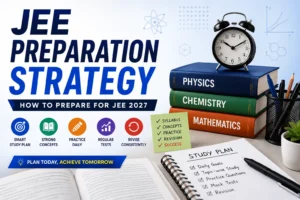
Preparing for JEE requires more than studying for long hours. A practical preparation strategy combines concept building, regular question practice, previous year papers, mock tests, and revision.
Whether you are preparing for JEE Main or JEE Advanced, the basic approach remains the same: understand the syllabus, build strong fundamentals in Physics, Chemistry and Mathematics, practise consistently, and track your mistakes.
This guide explains how to prepare for JEE 2027, including subject-wise preparation tips, a daily study plan, recommended books, revision strategies, and common mistakes to avoid.
JEE Preparation Strategy 2027 Highlights
| Particular | Details |
|---|---|
| Applicable For | JEE Main & JEE Advanced |
| Subjects | Physics, Chemistry & Mathematics |
| Preparation Focus | Concept Building, Practice & Revision |
| Recommended Resources | NCERT, Reference Books, Mock Tests & Previous Year Papers |
| Study Approach | Daily Study Plan with Regular Revision |
| Best For | Class 11, Class 12 & Droppers |
How to Prepare for JEE Effectively
A good JEE preparation plan should cover the complete syllabus while leaving enough time for practice and revision. Instead of trying to study everything at once, divide the syllabus into manageable topics and track your progress.
Step-by-Step JEE Preparation Strategy
| Step | What You Should Do |
|---|---|
| Understand the Syllabus | Go through the complete JEE syllabus before starting your preparation. |
| Create a Study Plan | Prepare a realistic daily and weekly timetable covering all three subjects. |
| Build Strong Concepts | Strengthen fundamentals using NCERT and standard reference books. |
| Practice Questions Daily | Solve topic-wise and mixed questions regularly. |
| Solve Previous Year Papers | Use PYQs to understand question patterns and practise under exam-like conditions. |
| Take Mock Tests | Attempt full-length tests to improve speed, accuracy and time management. |
| Revise Regularly | Revise formulas, concepts, short notes and previously attempted questions. |
A useful approach is to keep concept learning, practice and revision running together rather than waiting until the end of the syllabus to revise.
Subject-Wise JEE Preparation Strategy
Physics
Physics requires a combination of conceptual understanding and numerical problem-solving.
Focus on:
- Understanding the theory before attempting difficult questions.
- Building strong fundamentals in Mechanics, Electricity, Modern Physics and Optics.
- Solving numerical questions regularly.
- Maintaining a formula sheet for important equations.
- Reviewing mistakes made while solving questions and mock tests.
For JEE Advanced, gradually move from basic questions to multi-concept and application-based problems.
Chemistry
Chemistry requires a different approach for Physical, Organic and Inorganic Chemistry.
Physical Chemistry
- Understand the underlying concepts before memorising formulas.
- Practise numerical questions regularly.
- Learn how formulas are applied rather than only memorising them.
- Revise important equations and concepts frequently.
Organic Chemistry
- Understand reaction mechanisms instead of relying only on memorisation.
- Build a clear understanding of basic concepts before moving to complex reactions.
- Revise named reactions regularly.
- Practise reaction-based questions.
Inorganic Chemistry
- Read NCERT carefully.
- Make short notes for important facts and exceptions.
- Revise frequently because retention is important.
- Practise questions after completing each topic.
Mathematics
Mathematics improves mainly through regular problem-solving.
Focus on:
- Practising questions every day.
- Strengthening Algebra and Calculus.
- Revising important formulas and methods.
- Solving questions with different approaches where possible.
- Practising mixed-topic questions to improve problem-solving speed.
- Reviewing questions that took too much time or were answered incorrectly.
Daily JEE Study Plan
There is no fixed number of hours that works for every student. The important thing is to maintain a consistent schedule that gives enough time to all three subjects.
A sample study structure can look like this:
| Activity | Recommended Time |
|---|---|
| Physics | 2–3 Hours |
| Chemistry | 2–3 Hours |
| Mathematics | 2–3 Hours |
| Previous Year Questions | 1 Hour |
| Revision | 1 Hour |
| Mock Test / Analysis | 2–3 Tests per Week |
The exact schedule can be adjusted according to your school, college, coaching or other commitments.
Best Books for JEE Preparation
Start with NCERT textbooks to build your foundation and then use reference books for additional practice.
| Subject | Recommended Books |
|---|---|
| Physics | NCERT Physics, Concepts of Physics by H.C. Verma, D.C. Pandey Series |
| Chemistry | NCERT Chemistry, Physical Chemistry by O.P. Tandon, Organic Chemistry by M.S. Chauhan |
| Mathematics | NCERT Mathematics, R.D. Sharma, Problems Plus in IIT Mathematics by A. Das Gupta |
CareerMint Tip: Complete NCERT first before moving to multiple reference books. Using too many books at the same time can make it harder to complete the syllabus and revise properly.
How to Use Previous Year Papers for JEE Preparation
Previous year question papers are useful for understanding how concepts are tested in the actual examination.
When solving PYQs, pay attention to:
- Question types
- Important topics
- Difficulty level
- Time taken per question
- Repeated concepts
- Mistakes and weak areas
Start with chapter-wise PYQs while completing the syllabus. Once you have covered most topics, move towards solving complete papers under exam conditions.
See our JEE Previous Year Question Papers for year-wise practice.
Mock Tests and JEE Preparation
Mock tests become particularly useful after you have developed a reasonable understanding of the syllabus.
After every mock test, do more than check your score. Analyse:
- Questions you got wrong.
- Questions you guessed incorrectly.
- Questions that took too much time.
- Topics where you repeatedly make mistakes.
- Questions you could have solved with a better approach.
This analysis helps turn mock tests into a preparation tool rather than just a measure of performance.
For the syllabus you need to cover before attempting full-length tests, see the JEE Syllabus.
JEE Revision Strategy
Revision should not be left for the final weeks.
A simple revision cycle can include:
- Daily: Revise formulas, difficult concepts and mistakes from the day’s study.
- Weekly: Review the topics completed during the week.
- Monthly: Revisit important chapters and solve mixed questions.
- Before the exam: Focus on short notes, formulas, PYQs, mock tests and frequently repeated mistakes.
Keep a separate mistake notebook containing questions you repeatedly get wrong. Revisiting these questions can be more useful than repeatedly solving questions you already know how to answer.
Common Mistakes to Avoid During JEE Preparation
| Mistake | Better Approach |
|---|---|
| Ignoring NCERT | Build your foundation with NCERT before moving to advanced books. |
| Studying Without a Plan | Follow a realistic daily and weekly timetable. |
| Skipping Mock Tests | Take regular mock tests and analyse your performance. |
| Not Solving Previous Year Papers | Practise PYQs to understand question patterns and important concepts. |
| Ignoring Weak Subjects | Identify weak areas and give them additional practice time. |
| Lack of Revision | Revise formulas, concepts and short notes regularly. |
| Using Too Many Books | Complete your primary resources before adding more material. |
| Focusing Only on Study Hours | Measure preparation through completed topics, questions solved, revision and test performance. |
JEE Preparation for Class 11, Class 12 and Droppers
Class 11 Students
Class 11 provides more time to build fundamentals. Focus on understanding concepts properly rather than rushing through chapters.
Try to:
- Complete topics consistently.
- Practise questions after every chapter.
- Revise older topics regularly.
- Avoid creating a large backlog.
Class 12 Students
Class 12 students need to balance board preparation with JEE preparation.
A practical approach is to:
- Follow the JEE syllabus alongside school studies.
- Keep revising Class 11 topics.
- Practise PYQs regularly.
- Start full-length mock tests after covering sufficient syllabus.
Droppers
Droppers can dedicate more time specifically to JEE preparation, but the available time should be used systematically.
Focus on:
- Identifying weak chapters from your previous attempt.
- Revising important concepts.
- Solving more exam-level questions.
- Taking regular mock tests.
- Analysing mistakes instead of simply increasing the number of tests.
Related JEE Resources
Continue your preparation with these CareerMint guides:
| Guide | What You’ll Learn |
|---|---|
| JEE Overview | Complete information about JEE Main, JEE Advanced and the admission process. |
| JEE Main | Eligibility, exam pattern, application process, colleges and admission details. |
| JEE Advanced | IIT admission, eligibility, exam structure and preparation information. |
| JEE Syllabus | Physics, Chemistry and Mathematics topics for JEE. |
| JEE Previous Year Question Papers | Previous papers and practice resources for JEE Main and Advanced. |
Frequently Asked Questions
1. How should I start preparing for JEE?
Start by understanding the JEE syllabus, making a realistic study plan and strengthening your fundamentals with NCERT. Then gradually increase the level of question practice.
2. How many hours should I study for JEE every day?
There is no fixed number of hours suitable for every student. Focus on maintaining a consistent routine that includes concept learning, question practice, revision and tests.
3. Can I crack JEE without coaching?
Yes. Self-study can be used for JEE preparation with good books, quality learning resources, previous year papers and regular mock tests. The important part is following a structured study plan.
4. Which books are best for JEE preparation?
Commonly recommended resources include:
- Physics: NCERT, H.C. Verma, D.C. Pandey
- Chemistry: NCERT, O.P. Tandon, M.S. Chauhan
- Mathematics: NCERT, R.D. Sharma, A. Das Gupta
5. Is NCERT enough for JEE?
NCERT provides an important foundation, particularly for Chemistry and basic concepts. However, JEE preparation also requires problem-solving practice and questions at the appropriate examination level.
6. When should I start preparing for JEE?
Many students start in Class 11 because it provides more preparation time. However, students beginning in Class 12 or preparing as droppers can also follow a structured preparation plan.
7. How important are previous year question papers?
PYQs are an important part of JEE preparation. They help you understand question patterns, important concepts, difficulty levels and time management.
You can practise them through our JEE Previous Year Question Papers page.
8. Should I take mock tests regularly?
Yes. Mock tests can help improve speed, accuracy and time management. Their value increases when you analyse your mistakes after every test.
9. Which subject is the toughest in JEE?
This varies from student to student. Instead of assuming that one subject is universally difficult, identify your weaker areas and give them additional practice.
10. How should I revise for JEE?
Regular revision should include:
- Formula revision
- Short notes
- Previous year questions
- Mock tests
- Mistake analysis
- Revision of difficult concepts
11. What are the biggest mistakes students make during JEE preparation?
Common mistakes include skipping revision, avoiding PYQs, not taking mock tests, studying without a plan and spending too much time collecting study material instead of using it.
12. Is solving mock tests more important than studying theory?
Both have different purposes. Theory builds conceptual understanding, while mock tests help you apply that knowledge under time constraints. A balanced preparation plan should include both.
13. How can I improve my JEE score?
Focus on completing the syllabus, practising questions regularly, solving PYQs, taking mock tests, revising consistently and analysing your mistakes.
14. Can I prepare for JEE in one year?
Yes. One year can be used for JEE preparation with a structured plan, consistent practice and regular revision. The available time should be divided between completing the syllabus, practising questions and testing your preparation.