

IFS Officer: Complete Guide to Becoming an Indian Foreign Service Officer
The Indian Foreign Service (IFS) is one of the most prestigious and sought-after careers offered through the Union Public Service Commission (UPSC) Civil Services Examination. IFS officers represent India on the global stage by managing diplomatic relations, promoting India’s interests abroad, negotiating international agreements, protecting Indian citizens overseas, and strengthening ties with foreign governments and international organizations.
Unlike many other civil services that primarily serve within India, IFS officers build careers that combine diplomacy, international relations, foreign policy, trade, culture, and global cooperation. They work in Indian Embassies, High Commissions, Consulates, and Permanent Missions across the world while also serving in the Ministry of External Affairs (MEA) in New Delhi.
If you aspire to represent India internationally, interact with world leaders, negotiate important global agreements, and contribute to the country’s foreign policy, becoming an Indian Foreign Service Officer can be a highly rewarding career.
Whether you’re just beginning your UPSC journey or exploring different civil services after graduation, this guide covers everything you need to know—from eligibility and selection process to salary, training, career growth, foreign postings, and preparation strategy.
What You’ll Learn
In this comprehensive guide, you’ll discover:
- What an IFS Officer is and what they do
- Roles and responsibilities of Indian Foreign Service officers
- Eligibility criteria and UPSC selection process
- Salary, allowances, and foreign posting benefits
- Training at the Sushma Swaraj Institute of Foreign Service (SSIFS)
- Career growth from Third Secretary to Foreign Secretary
- Skills required to become a successful diplomat
- Advantages and challenges of an international career
- Preparation tips to crack the UPSC Civil Services Examination
- Answers to frequently asked questions about the Indian Foreign Service
Quick Highlights
| Feature | Details |
|---|---|
| Full Form | Indian Foreign Service |
| Service Type | All India Group A Central Civil Service (Diplomatic Service) |
| Recruiting Authority | Union Public Service Commission (UPSC) |
| Recruitment Exam | Civil Services Examination (CSE) |
| Ministry | Ministry of External Affairs (MEA) |
| Initial Posting | Third Secretary (Indian Embassy/High Commission) |
| Training Academy | Sushma Swaraj Institute of Foreign Service (SSIFS), New Delhi |
| Work Location | India and Indian Missions Abroad |
| Primary Role | Diplomacy, Foreign Policy & International Relations |
| Highest Position | Foreign Secretary of India |
Why Choose the Indian Foreign Service?
An IFS Officer enjoys one of the most unique careers in the Indian government. From representing India at international forums to negotiating bilateral agreements, assisting Indian citizens abroad, and strengthening diplomatic relations, the role offers unmatched global exposure and the opportunity to contribute directly to India’s position in world affairs.
The career combines leadership, diplomacy, policy-making, cross-cultural engagement, and international travel, making it an excellent choice for candidates interested in global affairs and public service.
Start Your UPSC Journey
Becoming an IFS Officer requires dedication, consistent preparation, and success in the UPSC Civil Services Examination. Understanding the exam pattern, eligibility, syllabus, and preparation strategy is the first step toward building a career in diplomacy.
Continue Exploring
Before diving deeper into the Indian Foreign Service, explore these essential UPSC resources:
- UPSC Civil Services Examination
- UPSC Eligibility Criteria
- UPSC Syllabus
- UPSC Preparation Strategy
- IAS Officer Career Guide
- IPS Officer Career Guide
IFS Officer Highlights
The Indian Foreign Service (IFS) is one of India’s most prestigious civil services, responsible for representing the country on the global stage. Recruited through the UPSC Civil Services Examination (CSE), IFS officers play a vital role in shaping India’s foreign policy, strengthening diplomatic relations, protecting Indian citizens abroad, and promoting the nation’s strategic, economic, and cultural interests worldwide.
Unlike most civil services that primarily serve within India, IFS officers have the unique opportunity to work in Indian Embassies, High Commissions, Consulates, and Permanent Missions across different countries while also serving at the Ministry of External Affairs (MEA) in New Delhi.
The table below provides a quick overview of the Indian Foreign Service.
Indian Foreign Service (IFS) at a Glance
| Feature | Details |
|---|---|
| Full Form | Indian Foreign Service (IFS) |
| Service Type | Group A Central Civil Service (Diplomatic Service) |
| Recruiting Authority | Union Public Service Commission (UPSC) |
| Recruitment Exam | Civil Services Examination (CSE) |
| Ministry | Ministry of External Affairs (MEA) |
| Exam Conducting Body | UPSC |
| Educational Qualification | Bachelor’s Degree from a recognized university |
| Minimum Age | 21 Years |
| Selection Process | Prelims → Mains → Personality Test → Service Allocation |
| Initial Designation | Third Secretary |
| Training Academy | Sushma Swaraj Institute of Foreign Service (SSIFS), New Delhi |
| Primary Work Areas | Diplomacy, Foreign Policy, International Relations, Consular Services |
| Work Locations | Ministry of External Affairs, Indian Embassies, High Commissions, Consulates, Permanent Missions |
| Foreign Posting | Yes |
| Uniform | No Official Uniform |
| Entry-Level Basic Pay | ₹56,100 per month (7th CPC) |
| Additional Benefits | Foreign Allowance, Government Accommodation, Official Vehicle (as applicable), Medical Benefits, Children’s Education Support, Travel Benefits |
| Highest Position | Foreign Secretary of India |
Key Highlights of an IFS Officer’s Career
Represent India Across the World
IFS officers serve as India’s diplomatic representatives in foreign countries. They work to strengthen bilateral relations, negotiate international agreements, promote trade and investment, and enhance India’s global influence.
Shape India’s Foreign Policy
Working closely with the Ministry of External Affairs, IFS officers contribute to policy formulation, international negotiations, strategic partnerships, and diplomatic initiatives that influence India’s relations with other nations.
Protect Indian Citizens Abroad
One of the most important responsibilities of an IFS officer is providing consular assistance to Indian citizens living, studying, working, or travelling overseas. This includes assistance during emergencies, legal issues, evacuations, and passport or visa-related services.
Serve in International Organizations
IFS officers may represent India at major international organizations such as the United Nations (UN), World Trade Organization (WTO), UNESCO, G20, BRICS, and other multilateral forums where they participate in discussions on global issues.
International Career Opportunities
Unlike many other civil services, IFS officers spend a significant portion of their careers in foreign countries. They experience different cultures, languages, and diplomatic environments while representing India’s interests abroad.
Excellent Career Progression
An IFS officer progresses through various diplomatic ranks, eventually becoming an Ambassador, High Commissioner, Permanent Representative, or even the Foreign Secretary of India, the highest-ranking officer in the Indian Foreign Service.
Essential Skills Required for an IFS Officer
Success in the Indian Foreign Service requires a combination of academic knowledge, leadership, communication, and interpersonal skills. Some of the most important qualities include:
- Excellent communication and negotiation skills
- Strong understanding of international relations
- Diplomatic thinking and professionalism
- Leadership and decision-making ability
- Cultural sensitivity and adaptability
- Analytical and strategic thinking
- Public speaking and interpersonal skills
- Problem-solving under pressure
- Interest in global politics and world affairs
- Commitment to public service and national interest
Why the Indian Foreign Service is Unique
The Indian Foreign Service offers a career unlike any other in the civil services. While IAS officers focus on governance and administration within India and IPS officers lead law enforcement, IFS officers work on the international front, representing India’s voice in global diplomacy.
From negotiating international treaties to promoting economic cooperation, managing diplomatic missions, and supporting Indian citizens overseas, the role combines public service with international engagement, making it one of the most prestigious and globally respected careers in the Government of India.
What is an IFS Officer?
The Indian Foreign Service (IFS) is one of the premier civil services of India, responsible for managing the country’s diplomatic relations and representing India’s interests around the world. Recruited through the Union Public Service Commission (UPSC) Civil Services Examination, IFS officers serve as professional diplomats who work to strengthen India’s political, economic, cultural, and strategic relationships with other nations and international organizations.
Unlike most civil servants who primarily work within India, IFS officers spend a significant part of their careers serving abroad in Indian Embassies, High Commissions, Consulates, and Permanent Missions. They also work at the Ministry of External Affairs (MEA) in New Delhi, where they contribute to the formulation and implementation of India’s foreign policy.
An IFS officer acts as the official representative of the Government of India in foreign countries, playing a vital role in promoting national interests, protecting Indian citizens overseas, facilitating international trade and investment, negotiating bilateral agreements, and enhancing India’s global reputation.
Who is an IFS Officer?
An Indian Foreign Service Officer is a career diplomat responsible for conducting India’s foreign affairs. These officers represent India in international forums, maintain diplomatic relations with other countries, negotiate agreements, provide consular assistance, and advise the Government of India on international developments.
Their work requires extensive knowledge of international relations, global politics, economics, international law, diplomacy, and cross-cultural communication.
Whether handling high-level diplomatic negotiations, coordinating international summits, assisting Indian nationals during emergencies abroad, or promoting India’s cultural heritage overseas, IFS officers play an essential role in advancing the country’s interests on the global stage.
Role of the Indian Foreign Service
The Indian Foreign Service serves as the diplomatic arm of the Government of India. Through its officers, India maintains official relations with nearly every country in the world and actively participates in international organizations.
The primary objectives of the Indian Foreign Service include:
- Strengthening diplomatic relations with foreign governments
- Protecting India’s strategic and national interests
- Promoting international peace and cooperation
- Expanding trade and investment opportunities
- Supporting Indian citizens living and travelling abroad
- Representing India in international negotiations
- Promoting India’s culture, tourism, education, and soft power
- Contributing to global discussions on climate change, security, technology, health, and sustainable development
Where Do IFS Officers Work?
One of the unique aspects of the Indian Foreign Service is its international work environment. During their careers, IFS officers alternate between assignments in India and postings abroad.
Common workplaces include:
Ministry of External Affairs (MEA)
IFS officers work at the Ministry of External Affairs in New Delhi, where they help formulate foreign policy, coordinate diplomatic initiatives, and manage India’s international engagements.
Indian Embassies
Embassies represent India in countries where diplomatic relations exist. IFS officers posted in embassies handle political affairs, economic cooperation, trade, cultural exchange, and consular services.
High Commissions
India maintains High Commissions instead of embassies in Commonwealth countries. The responsibilities remain largely similar, focusing on diplomacy, bilateral cooperation, and citizen services.
Consulates and Consulates General
Consulates provide services such as passport issuance, visa processing, legal assistance, and support for Indian citizens living or travelling in foreign countries.
Permanent Missions
IFS officers also represent India at international organizations, including the United Nations and other multilateral institutions, where they participate in discussions on global issues and negotiate international agreements.
Major Responsibilities of an IFS Officer
The responsibilities of an Indian Foreign Service officer extend far beyond diplomacy. Depending on their posting and rank, they may be involved in:
- Conducting diplomatic negotiations
- Advising the Government on international affairs
- Building strategic partnerships with foreign governments
- Promoting India’s trade and investment interests
- Protecting Indian citizens during emergencies abroad
- Negotiating international treaties and agreements
- Organizing official state visits and diplomatic events
- Facilitating educational, cultural, and scientific cooperation
- Representing India at international conferences and summits
- Monitoring global political and economic developments
Each assignment requires professionalism, cultural awareness, and the ability to adapt to different political, social, and economic environments.
Why is the Indian Foreign Service Prestigious?
The Indian Foreign Service is widely regarded as one of the most prestigious career options available through the UPSC Civil Services Examination.
Some of the reasons include:
- Opportunity to represent India internationally
- Global career with postings in different countries
- Direct contribution to India’s foreign policy
- Participation in international diplomacy
- Leadership roles in embassies and diplomatic missions
- Exposure to diverse cultures and global affairs
- Attractive salary, foreign allowances, and government benefits
- High level of professional respect within India and abroad
The combination of national service and international exposure makes the IFS a dream career for candidates interested in diplomacy and global affairs.
Skills Every IFS Officer Should Possess
To succeed in diplomacy, an IFS officer should develop a diverse set of professional and interpersonal skills.
Important qualities include:
- Strong communication skills
- Excellent negotiation abilities
- Leadership and decision-making
- Analytical and critical thinking
- Diplomatic etiquette and professionalism
- Cultural sensitivity and adaptability
- Public speaking and presentation skills
- Problem-solving under pressure
- Knowledge of international relations
- Ability to work in multicultural environments
- Integrity and commitment to national interests
These skills enable officers to effectively represent India in a constantly evolving global landscape.
Why Choose a Career in the Indian Foreign Service?
If you enjoy international affairs, global politics, diplomacy, travel, and representing your country on the world stage, the Indian Foreign Service offers an exceptional career path.
Unlike many professions, an IFS career combines public service with international exposure, offering opportunities to work in different countries, interact with global leaders, influence international policy, and contribute to India’s growing role in world affairs.
For many UPSC aspirants, becoming an IFS officer is not just a profession—it is an opportunity to serve the nation while building a truly global career.
Roles and Responsibilities of an IFS Officer
The Indian Foreign Service (IFS) is the diplomatic arm of the Government of India. An IFS officer serves as India’s official representative in foreign countries and international organizations, working to protect national interests, strengthen diplomatic relations, and promote India’s economic, political, cultural, and strategic objectives across the globe.
Unlike administrative or law enforcement services that primarily operate within India, IFS officers deal with international affairs, requiring diplomacy, negotiation skills, strategic thinking, and a deep understanding of global politics.
Their responsibilities vary depending on their posting, rank, and country of assignment, but the ultimate objective remains the same to represent India with professionalism and safeguard the nation’s interests worldwide.
Representing India Abroad
One of the primary responsibilities of an IFS officer is to officially represent the Government of India in foreign countries.
Whether posted in an Embassy, High Commission, Consulate, or Permanent Mission, an IFS officer acts as the face of India, building strong relationships with foreign governments and promoting mutual cooperation.
This includes:
- Representing India during official meetings
- Attending diplomatic events and state functions
- Participating in international conferences
- Maintaining bilateral relations
- Promoting India’s image globally
As diplomats, IFS officers play a key role in strengthening India’s global presence.
Formulating and Implementing Foreign Policy
IFS officers contribute significantly to the development and execution of India’s foreign policy.
Working closely with the Ministry of External Affairs (MEA), they:
- Analyze international developments
- Prepare policy recommendations
- Advise the Government on foreign affairs
- Coordinate diplomatic initiatives
- Assist in strategic decision-making
Their reports and assessments help the Government make informed decisions on international issues.
Diplomatic Negotiations
Negotiation is one of the most important responsibilities of an IFS officer.
They represent India’s position during discussions on matters such as:
- Bilateral agreements
- Trade and investment
- Defence cooperation
- Climate change
- Technology partnerships
- Energy security
- Maritime cooperation
- International treaties
Successful diplomacy often depends on effective communication, negotiation, and mutual understanding.
Protecting Indian Citizens Abroad
IFS officers are responsible for ensuring the welfare and safety of Indian citizens living, working, studying, or travelling abroad.
Their consular responsibilities include:
- Issuing passports and emergency travel documents
- Assisting during emergencies
- Helping citizens facing legal issues
- Coordinating evacuation during crises
- Supporting victims of natural disasters or conflicts
- Assisting families in distress
- Providing guidance on local regulations
During global emergencies such as natural disasters, political unrest, or pandemics, IFS officers play a critical role in coordinating assistance and safe evacuation.
Promoting Trade and Economic Relations
Economic diplomacy has become an increasingly important part of India’s foreign policy.
IFS officers work to strengthen economic ties by:
- Promoting Indian exports
- Encouraging foreign investment
- Supporting Indian businesses abroad
- Facilitating business delegations
- Identifying new trade opportunities
- Assisting companies entering international markets
These efforts contribute to India’s economic growth and global competitiveness.
Cultural Diplomacy
India’s rich cultural heritage is an important aspect of its global identity.
IFS officers promote Indian culture by organizing and supporting:
- Cultural festivals
- Yoga Day celebrations
- Indian film and literature events
- Classical music and dance performances
- Educational exchange programmes
- Tourism promotion campaigns
Cultural diplomacy helps strengthen people-to-people connections and enhances India’s soft power around the world.
Managing Diplomatic Missions
Senior IFS officers oversee the functioning of Indian diplomatic missions abroad.
Their administrative responsibilities include:
- Managing embassy operations
- Supervising diplomatic staff
- Coordinating with government agencies
- Planning official visits
- Managing budgets and resources
- Ensuring smooth delivery of consular services
Effective administration is essential for maintaining efficient diplomatic missions.
Representing India in International Organizations
IFS officers frequently represent India at international organizations and multilateral forums.
These include:
- United Nations (UN)
- World Trade Organization (WTO)
- UNESCO
- World Health Organization (WHO)
- International Monetary Fund (IMF)
- G20
- BRICS
- ASEAN dialogue forums
- Commonwealth meetings
At these forums, officers negotiate, participate in discussions, and advocate India’s position on global issues.
Monitoring International Developments
Diplomats continuously monitor political, economic, technological, and security developments across the world.
They prepare detailed reports covering:
- Political changes
- Elections
- Security situations
- Economic trends
- International conflicts
- Trade developments
- Emerging technologies
- Regional cooperation
These reports help the Government of India make strategic foreign policy decisions.
Crisis and Emergency Management
IFS officers play an important role during international emergencies affecting Indian citizens or national interests.
They may coordinate responses during:
- Political instability
- Armed conflicts
- Terrorist incidents
- Natural disasters
- Health emergencies
- Large-scale evacuations
- International humanitarian crises
Their work often involves coordination with local authorities, Indian government agencies, airlines, and international organizations.
Building International Partnerships
Strong diplomatic relationships are built over time through continuous engagement.
IFS officers work to strengthen cooperation in areas such as:
- Defence
- Science and technology
- Space research
- Education
- Healthcare
- Agriculture
- Renewable energy
- Digital innovation
- Tourism
- Cultural exchange
These partnerships contribute to India’s long-term strategic and economic interests.
Key Responsibilities at a Glance
| Responsibility | Purpose |
|---|---|
| Diplomatic Representation | Represent India before foreign governments |
| Foreign Policy | Assist in formulating and implementing foreign policy |
| International Negotiations | Negotiate agreements and partnerships |
| Consular Services | Protect and assist Indian citizens abroad |
| Trade Promotion | Strengthen business and investment relations |
| Cultural Diplomacy | Promote India’s culture and heritage globally |
| Embassy Administration | Manage diplomatic missions efficiently |
| International Organizations | Represent India at global forums |
| Policy Reporting | Monitor and analyze international developments |
| Crisis Management | Support citizens during emergencies and evacuations |
Why These Responsibilities Matter
The work of an IFS officer extends beyond diplomacy—it directly influences India’s global standing, economic growth, security, and international partnerships. Every negotiation, policy recommendation, trade initiative, and consular service contributes to strengthening India’s presence in the international community.
For candidates who are passionate about international relations, diplomacy, and public service, the Indian Foreign Service offers a unique opportunity to make a meaningful impact on both national and global affairs.
How to Become an IFS Officer?
Becoming an Indian Foreign Service (IFS) Officer is a dream for many UPSC aspirants who wish to represent India on the global stage. The only way to join the Indian Foreign Service is by qualifying for the Union Public Service Commission (UPSC) Civil Services Examination (CSE) and securing a rank high enough to receive IFS during service allocation.
The journey requires dedication, strategic preparation, and consistent performance across all three stages of the UPSC examination. After selection, candidates undergo professional diplomatic training before beginning their careers as India’s representatives abroad.
Below is the complete roadmap to becoming an IFS Officer.
Step 1: Complete Your Bachelor’s Degree
The first requirement is to earn a bachelor’s degree from a recognized university.
The degree can be in any discipline, including:
- Arts
- Science
- Commerce
- Engineering
- Law
- Medicine
- Management
- Agriculture
- Any other recognized field
There is no requirement for a specific subject or stream to become an IFS Officer.
Candidates who are in the final year of graduation are also eligible to apply, subject to meeting UPSC’s eligibility requirements.
Step 2: Check the UPSC Eligibility Criteria
Before applying, ensure that you meet the eligibility requirements prescribed by UPSC.
Generally, candidates must satisfy:
- Minimum age requirement
- Educational qualification
- Nationality requirements
- Number of permissible attempts
- Medical fitness standards
Since IFS officers serve in foreign countries, candidates are also required to meet the prescribed medical standards for the Civil Services Examination.
Learn more: UPSC Eligibility Criteria
Step 3: Apply for the UPSC Civil Services Examination
The UPSC releases the Civil Services Examination notification every year.
Candidates need to:
- Read the official notification carefully
- Register online
- Fill out the application form
- Upload required documents
- Pay the application fee (if applicable)
- Select examination centre preferences
- Submit the application before the deadline
After successful registration, candidates become eligible to appear for the examination.
Learn more: UPSC Notification
Step 4: Clear the UPSC Preliminary Examination
The first stage of the selection process is the UPSC Preliminary Examination.
The examination consists of two objective-type papers:
General Studies Paper I
This paper evaluates knowledge of:
- History
- Geography
- Polity
- Economy
- Environment
- Science & Technology
- Current Affairs
CSAT (General Studies Paper II)
This paper tests:
- Logical reasoning
- Analytical ability
- Reading comprehension
- Decision making
- Basic numeracy
The Preliminary Examination is a screening stage, and marks are not included in the final merit list.
Step 5: Qualify the UPSC Main Examination
Candidates who clear the Preliminary Examination are eligible to appear for the UPSC Mains.
The Mains examination is descriptive and evaluates:
- Essay writing
- General Studies
- Ethics
- Governance
- International Relations
- Indian Constitution
- Economy
- History
- Geography
- Optional Subject
Strong writing skills, conceptual clarity, and analytical thinking are essential for scoring well.
Step 6: Appear for the UPSC Personality Test
Candidates who qualify in the Main Examination are invited for the Personality Test (Interview).
The interview evaluates qualities such as:
- Communication skills
- Leadership potential
- Decision-making ability
- Confidence
- Emotional intelligence
- Awareness of national and international issues
- Diplomatic temperament
- Integrity and ethical values
For IFS aspirants, awareness of international relations, global affairs, diplomacy, and India’s foreign policy can be particularly beneficial during discussions.
Step 7: Secure a High Rank in the Final Merit List
After the interview, UPSC prepares the final merit list based on the combined marks obtained in the Main Examination and the Personality Test.
IFS is among the most competitive services offered through UPSC.
Service allocation depends on:
- Final Rank
- Service Preferences
- Category
- Available Vacancies
- Medical Eligibility
Candidates who secure a sufficiently high rank and choose the Indian Foreign Service as a preferred option may be allocated the service.
Step 8: Complete Foundation Course and Diplomatic Training
Selected candidates first attend the Foundation Course along with other civil service probationers.
Afterward, IFS probationers undergo specialized diplomatic training at the:
Sushma Swaraj Institute of Foreign Service (SSIFS), New Delhi
Training covers:
- Diplomacy
- International Relations
- Foreign Policy
- International Law
- Consular Services
- Protocol
- Foreign Languages
- Trade Diplomacy
- Negotiation Skills
- Cross-cultural Communication
Probationers also receive practical exposure through attachments with government institutions and Indian Missions abroad.
Step 9: Learn a Foreign Language
One of the unique aspects of IFS training is learning a Compulsory Foreign Language (CFL).
Depending on the assigned language and future posting, officers may study languages such as:
- French
- Spanish
- Arabic
- Chinese (Mandarin)
- Russian
- Japanese
- German
- Persian
- Portuguese
- Other strategically important languages
Language training enables officers to communicate effectively and build stronger diplomatic relationships in their assigned countries.
After successfully completing training, officers receive their first posting.
Many officers begin their overseas careers as Third Secretaries at an Indian Embassy or High Commission.
Their responsibilities include:
- Political reporting
- Economic diplomacy
- Consular services
- Cultural diplomacy
- Public diplomacy
- Trade promotion
- Supporting Indian citizens abroad
As they gain experience, officers progress to higher diplomatic positions, eventually becoming Ambassadors, High Commissioners, or even the Foreign Secretary of India.
Timeline to Become an IFS Officer
| Stage | Typical Timeline |
|---|---|
| Bachelor’s Degree | 3–5 Years |
| UPSC Preparation | 1–3 Years (varies by candidate) |
| UPSC Civil Services Examination | Approximately 1 Year |
| Foundation Course & Professional Training | As per Government training schedule |
| First Diplomatic Posting | After successful completion of training |
The overall journey varies from candidate to candidate depending on their preparation and success in the examination.
IFS Officer Eligibility Criteria
To become an Indian Foreign Service (IFS) Officer, candidates must satisfy the eligibility criteria prescribed by the Union Public Service Commission (UPSC) for the Civil Services Examination (CSE).
There is no separate examination or separate eligibility criteria exclusively for the IFS. Candidates aspiring to join the Indian Foreign Service must qualify for the UPSC Civil Services Examination and secure a sufficiently high rank for service allocation.
The eligibility criteria cover educational qualifications, age limit, nationality, number of attempts, and medical standards.
IFS Officer Eligibility at a Glance
| Eligibility Criteria | Requirement |
|---|---|
| Recruiting Authority | Union Public Service Commission (UPSC) |
| Examination | Civil Services Examination (CSE) |
| Educational Qualification | Bachelor’s Degree from a recognized university |
| Minimum Age | 21 Years |
| Nationality | As prescribed by UPSC for Civil Services |
| Number of Attempts | As per UPSC category-wise rules |
| Medical Standards | Must meet UPSC medical fitness standards |
| Service Allocation | Based on Final UPSC Rank and Preferences |
Educational Qualification
Candidates must possess a Bachelor’s Degree from a recognized university or an equivalent qualification approved by the Government of India.
Eligible streams include:
- Arts
- Science
- Commerce
- Engineering
- Law
- Medicine
- Agriculture
- Management
- Architecture
- Any other recognized discipline
There is no requirement to study International Relations, Political Science, or Foreign Languages to become an IFS Officer.
Students in the final year of graduation can also apply, provided they produce proof of passing before the stage specified by UPSC.
Age Limit
Candidates must have attained the minimum age prescribed by UPSC on the specified cutoff date mentioned in the official notification.
The age requirements generally include:
| Category | Age Limit |
|---|---|
| Minimum Age | 21 Years |
| Maximum Age | As prescribed in the official UPSC notification |
Reserved category candidates may receive age relaxation according to Government of India rules.
Since eligibility rules can change over time, candidates should always refer to the latest UPSC notification for the applicable limits.
Nationality
For appointment to the Indian Foreign Service, a candidate must satisfy the nationality requirements laid down by UPSC.
In general:
- The candidate must be a citizen of India for appointment to the Indian Foreign Service.
Candidates should consult the latest UPSC notification for detailed nationality provisions applicable to various civil services.
Number of Attempts
The number of attempts permitted depends on the candidate’s category.
UPSC specifies category-wise limits for:
- General
- Other Backward Classes (OBC)
- Economically Weaker Sections (EWS)
- Scheduled Castes (SC)
- Scheduled Tribes (ST)
- Persons with Benchmark Disabilities (PwBD)
Candidates should use their attempts wisely and prepare thoroughly before appearing for the examination.
Medical Standards
Since IFS officers represent India abroad and may be posted in diverse geographical and climatic conditions, they must satisfy the medical standards prescribed by the Government of India.
The medical examination is conducted after the Personality Test as part of the Civil Services Examination process.
Medical fitness is assessed to ensure that candidates are capable of performing the duties associated with diplomatic service.
Is There Any Physical Test for IFS?
No.
Unlike certain uniformed services, the Indian Foreign Service does not have a separate physical efficiency test.
However, candidates must successfully clear the prescribed medical examination conducted during the selection process.
Is Knowledge of Foreign Languages Mandatory?
No.
Candidates do not need to know a foreign language before appearing for the UPSC Civil Services Examination.
After selection, IFS probationers receive professional training that includes learning a Compulsory Foreign Language (CFL) based on the requirements of the Ministry of External Affairs.
Is There Any Subject Requirement?
No.
UPSC does not prescribe any mandatory subject for becoming an IFS Officer.
Candidates from all educational backgrounds—including engineering, medicine, commerce, law, humanities, and science are equally eligible to compete.
Success depends on performance in the Civil Services Examination rather than academic specialization.
Important Points to Remember
Before applying for the UPSC Civil Services Examination, keep these points in mind:
- A bachelor’s degree is mandatory.
- The minimum age to apply is 21 years.
- There is no restriction on the stream of graduation.
- No prior knowledge of foreign languages is required.
- The same UPSC examination is conducted for IAS, IPS, IFS, IRS, and other civil services.
- Final service allocation depends on rank, preferences, vacancies, and eligibility.
- Medical fitness is compulsory for appointment.
IFS Officer Selection Process
The Indian Foreign Service (IFS) selection process is conducted through the Union Public Service Commission (UPSC) Civil Services Examination (CSE). It is one of the most competitive recruitment processes in India, designed to assess a candidate’s knowledge, analytical ability, communication skills, personality, and overall suitability for a career in public service and diplomacy.
There is no separate examination for the Indian Foreign Service. Candidates compete in the same Civil Services Examination as those aspiring to become IAS, IPS, IRS, and other Group A services. Final allocation to the IFS depends on a candidate’s UPSC rank, service preference, category, vacancies, and medical fitness.
IFS Officer Selection Process Overview
| Stage | Purpose |
|---|---|
| Stage 1 | UPSC Preliminary Examination |
| Stage 2 | UPSC Main Examination |
| Stage 3 | Personality Test (Interview) |
| Stage 4 | Final Merit List |
| Stage 5 | Service Allocation |
| Stage 6 | Medical Examination |
| Stage 7 | Foundation Course |
| Stage 8 | Diplomatic Training at SSIFS |
Stage 1: UPSC Preliminary Examination
The journey begins with the UPSC Civil Services Preliminary Examination, which serves as the screening stage.
The examination consists of two objective-type papers.
General Studies Paper I
This paper evaluates a candidate’s knowledge of:
- Indian History
- Geography
- Indian Polity
- Economy
- Environment & Ecology
- Science & Technology
- Current Affairs
- International Events
Marks obtained in this paper determine qualification for the next stage.
General Studies Paper II (CSAT)
The second paper tests aptitude in:
- Reading Comprehension
- Logical Reasoning
- Analytical Ability
- Decision Making
- Basic Mathematics
- Data Interpretation
This paper is qualifying in nature as per the rules prescribed by UPSC.
Stage 2: UPSC Main Examination
Candidates who qualify the Preliminary Examination appear for the Main Examination, which is descriptive in nature.
The Main Examination is designed to evaluate:
- Depth of knowledge
- Analytical thinking
- Writing ability
- Ethical understanding
- Decision-making capability
- Awareness of national and international issues
The Mains consists of:
- Essay Paper
- General Studies Paper I
- General Studies Paper II
- General Studies Paper III
- General Studies Paper IV (Ethics)
- Two Papers of the Optional Subject
- Qualifying Language Papers
Performance in the Mains plays a major role in determining the final rank.
Stage 3: Personality Test (Interview)
Candidates who clear the Main Examination are called for the UPSC Personality Test, commonly known as the Interview.
This stage is not a test of factual knowledge alone. Instead, the interview board assesses whether a candidate possesses the qualities expected of a future civil servant and diplomat.
The interview evaluates:
- Communication skills
- Leadership qualities
- Confidence
- Decision-making ability
- Emotional intelligence
- Integrity
- Ethical judgment
- Presence of mind
- Awareness of current affairs
- Diplomatic temperament
For IFS aspirants, a sound understanding of international relations, geopolitics, India’s foreign policy, and global developments can be especially valuable.
Stage 4: Final Merit List
After the interview, UPSC prepares the final merit list.
The final ranking is based on the combined marks obtained in:
- UPSC Main Examination
- Personality Test
The marks obtained in the Preliminary Examination are not counted in the final merit.
Candidates with higher scores receive better ranks, increasing their chances of obtaining their preferred civil service.
Stage 5: Service Allocation
Once the final merit list is published, candidates are allocated services based on:
- Final UPSC Rank
- Service Preferences submitted by the candidate
- Category
- Number of vacancies
- Medical fitness
Since the Indian Foreign Service is among the top-ranked services, candidates generally require a very competitive rank to receive IFS allocation.
Stage 6: Medical Examination
Before final appointment, candidates undergo a comprehensive medical examination conducted by authorized medical boards.
The examination assesses whether the candidate meets the medical standards required for service.
The assessment typically includes:
- General physical health
- Vision
- Hearing
- Overall fitness
- Other medical parameters prescribed by the Government
Medical fitness is an essential part of the selection process.
Stage 7: Foundation Course
After service allocation, selected candidates attend the Foundation Course alongside probationers from other civil services.
The Foundation Course introduces officers to:
- Public Administration
- Indian Constitution
- Governance
- Ethics
- Leadership
- Communication Skills
- Teamwork
- Public Policy
It also encourages interaction among officers from different services before they begin specialized training.
Stage 8: Diplomatic Training at SSIFS
Following the Foundation Course, IFS probationers receive professional diplomatic training at the:
Sushma Swaraj Institute of Foreign Service (SSIFS), New Delhi
Training focuses on:
- Diplomacy
- International Relations
- Foreign Policy
- International Law
- Consular Affairs
- Diplomatic Protocol
- Public Diplomacy
- Economic Diplomacy
- Negotiation Skills
- Foreign Language Training
Probationers also gain practical exposure through attachments with:
- Ministry of External Affairs
- Indian Armed Forces
- Government institutions
- International organizations
- Indian Missions abroad
This specialized training prepares officers for their future diplomatic responsibilities.
Tips to Improve Your Chances of Selection
The UPSC Civil Services Examination is highly competitive. To maximize your chances of securing the Indian Foreign Service:
- Build a strong foundation in the UPSC syllabus.
- Read newspapers and follow international affairs regularly.
- Develop answer-writing skills through consistent practice.
- Choose your optional subject carefully.
- Revise regularly and solve previous years’ question papers.
- Take mock tests for both Prelims and Mains.
- Improve communication and public speaking skills for the interview.
- Stay updated on India’s foreign policy, diplomacy, and global events.
IFS Officer Salary, Pay Scale, Allowances & Benefits
One of the biggest attractions of the Indian Foreign Service (IFS) is the opportunity to build a prestigious international career while enjoying a competitive salary, generous foreign allowances, and excellent government benefits.
IFS officers receive their salary under the 7th Central Pay Commission (CPC). In addition to their basic pay, officers posted abroad receive a Foreign Allowance (Foreign Service Allowance), which varies depending on the country of posting, local cost of living, and other government regulations. This often makes the total monthly compensation significantly higher than the salary received while serving in India.
Apart from financial benefits, IFS officers also enjoy government accommodation, medical facilities, travel benefits, children’s education support, diplomatic privileges, and opportunities to work in countries around the world.
IFS Officer Salary Structure (7th Pay Commission)
| Component | Details |
|---|---|
| Pay Commission | 7th Central Pay Commission (CPC) |
| Entry-Level Pay | ₹56,100 per month (Pay Level 10) |
| Grade Pay | Merged under Pay Matrix (7th CPC) |
| Dearness Allowance (DA) | As notified by the Government of India |
| House Rent Allowance (HRA) | Applicable for postings in India (if government accommodation is not provided) |
| Transport Allowance | As per government rules |
| Foreign Allowance | Applicable during overseas postings (varies by country) |
| Medical Benefits | Yes |
| Pension & Retirement Benefits | As per applicable government rules |
IFS Officer Salary During Overseas Posting
One of the most distinctive benefits of the Indian Foreign Service is the Foreign Allowance.
When posted abroad, an IFS officer receives:
- Basic Salary
- Foreign Allowance
- Government Accommodation (in most cases)
- Utilities and maintenance support (as applicable)
- Official travel benefits
- Medical facilities
- Education support for children (subject to rules)
- Representation allowance (for eligible officers)
- Other mission-specific benefits
The Foreign Allowance is determined by factors such as:
- Country of posting
- Cost of living
- Exchange rates
- Local economic conditions
- Government policies
As a result, the total monthly compensation during foreign postings is often much higher than the basic salary alone.
IFS Officer Salary by Rank
| Rank | Approximate Pay Level |
|---|---|
| Third Secretary | Pay Level 10 |
| Second Secretary | Higher as per promotion and pay matrix |
| First Secretary | Higher Pay Matrix Level |
| Counsellor | Senior Pay Level |
| Minister | Senior Administrative Level |
| Ambassador / High Commissioner | Apex diplomatic level (as applicable) |
| Foreign Secretary | One of the highest positions in the Indian Foreign Service |
Actual salary increases with promotions, annual increments, and revisions under government pay rules.
Allowances Received by an IFS Officer
In addition to the basic salary, IFS officers may receive several allowances depending on their posting and eligibility.
These include:
Foreign Allowance
The most significant allowance for officers serving abroad, designed to offset the higher cost of living in foreign countries.
Government Accommodation
IFS officers are generally provided official accommodation during foreign postings and may also receive government housing in India, depending on availability and entitlement.
Official Transport
Eligible officers may receive official vehicles or transport facilities based on their rank and posting.
Medical Benefits
IFS officers and eligible family members receive medical facilities as per Central Government rules, both in India and abroad.
Travel Benefits
The government provides travel-related benefits for official assignments. Certain relocation and travel expenses associated with overseas postings are also covered as per applicable rules.
Children’s Education Support
Eligible officers posted abroad may receive assistance for their children’s education according to government policies and prescribed limits.
Communication & Office Facilities
Depending on the assignment, officers may receive communication, office, and representation facilities required for official duties.
Other Benefits of Being an IFS Officer
Apart from salary, the Indian Foreign Service offers several long-term career advantages.
These include:
- Opportunity to live and work in different countries
- International work environment
- Diplomatic privileges under international conventions
- Professional foreign language training
- High social prestige
- Strong career progression
- Exposure to global policymaking
- Networking with international leaders and organizations
- Pension and retirement benefits
- Continuous learning through diverse assignments
Career Growth and Salary Progression
As IFS officers gain experience and receive promotions, their responsibilities and compensation increase accordingly. With each promotion, officers receive higher pay levels, increased allowances, greater administrative responsibilities, and opportunities to lead diplomatic missions.
Is the Salary of an IFS Officer Higher Than an IAS or IPS Officer?
Within India, officers of the IAS, IPS, and IFS are paid according to the same 7th Central Pay Commission Pay Matrix, so their basic salary is broadly similar at equivalent ranks.
However, IFS officers posted abroad often receive substantial Foreign Allowances and international posting benefits, making their overall compensation considerably higher during overseas assignments.
The exact amount varies depending on the country, cost of living, and government regulations.
Is the IFS Salary Worth It?
For most aspirants, the appeal of the Indian Foreign Service extends beyond salary.
The career offers:
- The privilege of representing India internationally
- Opportunities to influence foreign policy
- A dynamic global work environment
- Exposure to diverse cultures and international institutions
- Financial security and excellent government benefits
- Continuous professional growth
For candidates passionate about diplomacy and international relations, the combination of meaningful work and attractive benefits makes the IFS one of the most rewarding careers in the Indian civil services.
IFS Officer Career Growth & Promotion
The Indian Foreign Service (IFS) offers one of the most prestigious and globally diverse career paths in the Government of India. Throughout their career, IFS officers serve in different countries, handle increasingly complex diplomatic responsibilities, and represent India at the highest international forums.
Unlike many professions, an IFS officer’s career combines regular promotions, international postings, leadership opportunities, and policy-making responsibilities. With experience, officers move from junior diplomatic roles to leading Indian Embassies, High Commissions, and eventually the Ministry of External Affairs (MEA).
The highest position in the Indian Foreign Service is the Foreign Secretary of India, who serves as the administrative head of the Ministry of External Affairs.
IFS Officer Promotion Hierarchy
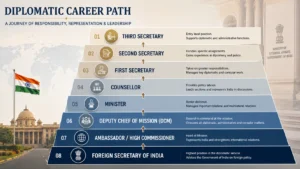
Career Progression Overview
| Rank | Primary Role |
|---|---|
| Third Secretary | Entry-level diplomat undergoing practical diplomatic training |
| Second Secretary | Handles political, economic, commercial, or consular responsibilities |
| First Secretary | Leads important diplomatic divisions and supervises junior officers |
| Counsellor | Senior diplomatic advisor managing specialized portfolios |
| Minister | Senior leadership role assisting the Ambassador or High Commissioner |
| Deputy Chief of Mission | Second-in-command of an Embassy or High Commission |
| Ambassador / High Commissioner | Head of India’s diplomatic mission in another country |
| Foreign Secretary | Administrative head of the Ministry of External Affairs |
1. Third Secretary
This is the first overseas posting after completing training.
As a Third Secretary, officers begin their diplomatic careers by learning embassy operations and assisting senior diplomats.
Responsibilities
- Political reporting
- Consular assistance
- Visa and passport services
- Research and documentation
- Cultural diplomacy
- Public diplomacy initiatives
- Supporting senior officers
This stage provides practical exposure to international diplomacy and embassy administration.
2. Second Secretary
After gaining experience, officers are promoted to Second Secretary.
At this level, officers independently manage diplomatic portfolios and interact more frequently with foreign government officials.
Responsibilities
- Political affairs
- Economic diplomacy
- Trade promotion
- Commercial relations
- Education cooperation
- Cultural exchange
- Citizen services
Second Secretaries play an active role in strengthening bilateral relations.
3. First Secretary
The First Secretary is a senior diplomatic position responsible for leading major sections within an Embassy or High Commission.
Responsibilities
- Supervising diplomatic staff
- Managing political reporting
- Coordinating trade initiatives
- Leading public diplomacy programmes
- Negotiating bilateral issues
- Advising senior diplomats
This position involves greater leadership and policy responsibilities.
4. Counsellor
A Counsellor is a senior officer responsible for handling complex diplomatic matters and advising the Ambassador.
Responsibilities
- Strategic policy analysis
- High-level negotiations
- International cooperation
- Security matters
- Economic partnerships
- Supervising embassy divisions
- Representing India in official meetings
Counsellors often specialize in areas such as defence, commerce, political affairs, or multilateral diplomacy.
5. Minister
The Minister is among the senior-most officers in an Indian diplomatic mission.
They work closely with the Ambassador and oversee major diplomatic operations.
Responsibilities
- Leading large diplomatic teams
- Managing embassy administration
- Negotiating international agreements
- Coordinating with foreign governments
- Supervising multiple diplomatic wings
- Handling high-priority strategic issues
Ministers often act on behalf of the Ambassador when required.
6. Deputy Chief of Mission (DCM)
The Deputy Chief of Mission is the second-highest-ranking officer in an Embassy or High Commission.
Responsibilities
- Managing day-to-day embassy operations
- Supervising all diplomatic sections
- Coordinating with the Ministry of External Affairs
- Acting as Head of Mission in the Ambassador’s absence
- Crisis management
- Administrative leadership
The DCM plays a vital role in ensuring the smooth functioning of the mission.
7. Ambassador / High Commissioner
This is one of the most prestigious positions in the Indian Foreign Service.
An Ambassador represents India in countries that are not members of the Commonwealth, while a High Commissioner heads India’s mission in Commonwealth nations.
Responsibilities
- Represent India officially
- Lead the Embassy or High Commission
- Negotiate bilateral agreements
- Promote India’s strategic interests
- Meet foreign heads of state and senior officials
- Protect Indian citizens abroad
- Guide diplomatic policy implementation
The Ambassador serves as India’s principal diplomatic representative in the host country.
8. Foreign Secretary of India
The Foreign Secretary is the highest-ranking career diplomat in India.
As the administrative head of the Ministry of External Affairs (MEA), the Foreign Secretary plays a central role in shaping India’s foreign policy and coordinating diplomatic initiatives across the world.
Responsibilities
- Advise the Government on foreign policy
- Lead the Ministry of External Affairs
- Coordinate with Indian Missions worldwide
- Represent India at international forums
- Oversee diplomatic strategy
- Supervise senior IFS officers
- Manage international crises and negotiations
Appointment to this position reflects decades of distinguished service and leadership.
Factors Influencing Promotions
Promotions in the Indian Foreign Service are based on multiple factors, including:
- Years of service
- Performance appraisal
- Leadership ability
- Administrative experience
- Diplomatic achievements
- Vacancy availability
- Government service rules
Meritorious officers may receive important international assignments and leadership roles throughout their careers.
Opportunities Beyond Embassy Postings
An IFS officer’s career is not limited to Embassies and High Commissions.
They may also serve in:
- Ministry of External Affairs (New Delhi)
- Prime Minister’s Office (on deputation)
- National Security Council Secretariat
- International organizations
- United Nations missions
- WTO negotiations
- Multilateral forums
- Regional cooperation organizations
- Government committees on foreign affairs
- Special diplomatic assignments
These assignments broaden an officer’s experience and contribute to India’s international engagement.
Why Career Growth in IFS is Unique
The Indian Foreign Service offers opportunities rarely found in other careers.
Throughout their service, officers:
- Live and work in multiple countries
- Learn new languages and cultures
- Represent India globally
- Influence international policy
- Build worldwide diplomatic networks
- Handle international negotiations
- Lead major diplomatic missions
- Contribute to global peace and cooperation
This combination of national service and international exposure makes the IFS one of the most respected career paths in India.
Key Takeaway
An IFS officer’s career is a journey of continuous growth, responsibility, and international service. Starting as a Third Secretary, officers gradually rise through increasingly important diplomatic positions, eventually leading Indian missions abroad or serving as the Foreign Secretary of India.
For those passionate about diplomacy, international relations, and representing India across the world, the Indian Foreign Service provides an exceptional career with unmatched global exposure and leadership opportunities.
IFS Officer Training
Becoming an Indian Foreign Service (IFS) Officer involves much more than clearing the UPSC Civil Services Examination. After selection, officers undergo extensive professional training that prepares them to represent India in diplomatic missions across the world.
The training focuses on developing diplomatic skills, understanding international relations, mastering foreign policy, learning foreign languages, and gaining practical experience in government administration and international affairs.
IFS training is designed to transform successful UPSC candidates into professional diplomats capable of handling complex global challenges while representing India’s interests with confidence and professionalism.
Overview of IFS Officer Training
| Training Stage | Purpose |
|---|---|
| Foundation Course | Introduces civil services, governance, ethics, and public administration |
| Specialized Diplomatic Training | Professional training in diplomacy and international relations |
| Foreign Language Training | Learning a Compulsory Foreign Language (CFL) |
| Domestic Attachments | Exposure to government institutions and ministries |
| International Attachments | Practical training at Indian Missions abroad |
| First Overseas Posting | Practical diplomatic experience as Third Secretary |
Stage 1: Foundation Course
After the final service allocation, all newly selected civil servants begin their journey with a Foundation Course.
During this stage, officers from different services—including IAS, IPS, IFS, IRS, and other Group A services—train together.
The Foundation Course helps officers:
- Understand the Indian administrative system
- Learn constitutional values
- Develop leadership qualities
- Build teamwork and communication skills
- Understand ethics in public service
- Strengthen physical fitness and discipline
- Build inter-service coordination
This common training promotes collaboration among officers who may work together throughout their careers.
Stage 2: Specialized Diplomatic Training
After completing the Foundation Course, IFS probationers undergo specialized training at the:
Sushma Swaraj Institute of Foreign Service (SSIFS), New Delhi
The Sushma Swaraj Institute of Foreign Service (SSIFS) is the premier training institute for Indian diplomats.
Here, officers receive intensive education in diplomacy and international affairs.
Subjects covered include:
- International Relations
- Indian Foreign Policy
- International Law
- Diplomatic Protocol
- Global Governance
- International Organizations
- Economic Diplomacy
- Trade Negotiations
- Public Diplomacy
- Strategic Affairs
- Cyber Diplomacy
- Consular Services
- Crisis Management
- International Security
The curriculum combines classroom learning with practical simulations and case studies.
Stage 3: Foreign Language Training
One of the unique features of IFS training is learning a Compulsory Foreign Language (CFL).
Based on the requirements of the Ministry of External Affairs, probationers are assigned a foreign language that is relevant to future diplomatic postings.
Languages may include:
- French
- Spanish
- Arabic
- Mandarin Chinese
- Russian
- Japanese
- German
- Persian
- Portuguese
- Korean
- Other strategically important languages
Learning the local language enables diplomats to communicate effectively, understand cultural nuances, and build stronger relationships in their assigned country.
Stage 4: Attachments with Government Institutions
To understand how different parts of the Government of India function, IFS probationers are attached to various institutions.
These attachments may include:
- Ministry of External Affairs
- Parliament of India
- Armed Forces
- State Governments
- District Administration
- Public Sector Organizations
- Border Security Agencies
- Economic and Trade Institutions
These experiences help officers understand India’s governance and policymaking processes before representing the country abroad.
Stage 5: International Exposure
IFS probationers also receive exposure to India’s diplomatic network through attachments with Indian Missions abroad.
This practical training introduces them to:
- Embassy administration
- Consular services
- Political reporting
- Trade promotion
- Public diplomacy
- Cultural diplomacy
- Bilateral cooperation
- Crisis response
- Visa and passport services
Working alongside experienced diplomats helps probationers understand the realities of international assignments.
Stage 6: Diplomatic Skills Development
Throughout the training programme, officers develop the professional skills required for diplomacy.
Key areas include:
- Negotiation techniques
- Public speaking
- Cross-cultural communication
- Conflict resolution
- Strategic thinking
- Policy analysis
- Leadership
- Media interaction
- Official correspondence
- Event management
- Protocol and etiquette
These skills are essential for representing India effectively in international forums.
Stage 7: First Overseas Posting
After successfully completing training, officers receive their first diplomatic posting, usually as a Third Secretary in an Indian Embassy or High Commission.
Under the guidance of senior diplomats, they begin handling responsibilities such as:
- Political reporting
- Economic analysis
- Consular work
- Passport and visa services
- Public diplomacy
- Cultural programmes
- Trade promotion
- Assistance to Indian citizens abroad
This marks the beginning of their professional diplomatic career.
Skills Developed During Training
IFS training is designed to build a well-rounded diplomat capable of working in diverse international environments.
Probationers develop:
- Diplomatic communication
- International negotiation
- Policy drafting
- Leadership
- Public administration
- Cross-cultural adaptability
- Crisis management
- Analytical thinking
- International law awareness
- Foreign language proficiency
- Professional ethics
These competencies prepare officers for increasingly responsible roles throughout their careers.
IFS vs IAS – What’s the Difference?
Choosing between the Indian Administrative Service (IAS) and the Indian Foreign Service (IFS) is one of the biggest decisions for UPSC aspirants. Both are among the most prestigious civil services in India, but they offer entirely different career paths, responsibilities, work environments, and opportunities.
While IAS officers are responsible for the administration and governance of India at the district, state, and central levels, IFS officers represent India internationally by handling diplomacy, foreign policy, international negotiations, and protecting India’s interests abroad.
Neither service is inherently better than the other—the right choice depends on your interests, personality, and long-term career goals.
IFS vs IAS: Quick Comparison
| Feature | IFS Officer | IAS Officer |
|---|---|---|
| Full Form | Indian Foreign Service | Indian Administrative Service |
| Service Type | Central Civil Service | All India Service |
| Recruitment | UPSC Civil Services Examination | UPSC Civil Services Examination |
| Cadre Allocation | Ministry of External Affairs | State Cadre |
| Primary Role | Diplomacy & Foreign Relations | Administration & Governance |
| Work Location | India & Foreign Countries | Primarily India |
| Ministry | Ministry of External Affairs | State Governments & Central Government |
| Public Interaction | Moderate | Very High |
| International Exposure | Extensive | Limited |
| Uniform | No | No |
| Highest Position | Foreign Secretary | Cabinet Secretary |
Difference in Roles
IFS Officer
The primary responsibility of an IFS officer is to represent India internationally.
They work on:
- Diplomacy
- International relations
- Foreign policy
- Trade negotiations
- Consular services
- International organizations
- Bilateral cooperation
- Strategic partnerships
Their work directly impacts India’s relationship with other nations.
IAS Officer
IAS officers manage governance and public administration within India.
Their responsibilities include:
- District administration
- Policy implementation
- Revenue administration
- Development projects
- Disaster management
- Law and order coordination
- Public welfare programmes
- Government administration
They work closely with citizens and government departments.
Work Environment
IFS Officer
IFS officers spend a large part of their careers working in:
- Embassies
- High Commissions
- Consulates
- Permanent Missions
- Ministry of External Affairs
They frequently move between India and overseas postings.
IAS Officer
IAS officers primarily serve within India.
Typical workplaces include:
- District Collector Office
- State Secretariat
- Central Ministries
- Government Departments
- Public Sector Organizations
They are deeply involved in administration and governance at different levels.
Salary Comparison
Both services receive salaries under the 7th Central Pay Commission.
| Component | IFS | IAS |
|---|---|---|
| Entry-Level Pay | ₹56,100 | ₹56,100 |
| Pay Commission | 7th CPC | 7th CPC |
| Promotions | Regular | Regular |
| Government Accommodation | Yes | Yes |
| Medical Benefits | Yes | Yes |
| Pension Benefits | Yes | Yes |
However, IFS officers posted abroad receive Foreign Allowances, diplomatic benefits, and overseas facilities that can significantly increase their overall compensation.
IAS officers, on the other hand, receive state and central government allowances based on their postings.
Powers and Authority
IAS Officer
IAS officers possess significant executive and administrative authority.
They may:
- Implement government policies
- Supervise district administration
- Coordinate law and order with police
- Lead development projects
- Manage disaster response
- Exercise powers under various laws and regulations
Their decisions directly affect governance and public administration.
IFS Officer
IFS officers exercise diplomatic authority rather than executive administrative powers.
Their responsibilities include:
- Representing India internationally
- Negotiating treaties
- Protecting Indian citizens abroad
- Advising on foreign policy
- Strengthening bilateral relations
- Promoting India’s global interests
Their influence is primarily in diplomacy and international affairs.
Lifestyle Comparison
IFS Officer
Advantages:
- Live in different countries
- International work environment
- Learn foreign languages
- Experience diverse cultures
- Travel extensively
- Represent India globally
Challenges:
- Frequent relocations
- Adjusting to different cultures
- Living away from extended family
- Handling international crises
IAS Officer
Advantages:
- Direct impact on society
- Leadership in governance
- Public recognition
- Wide administrative authority
- Opportunity to implement development programmes
Challenges:
- Heavy administrative workload
- Political and public pressure
- Emergency responsibilities
- Long working hours
Which Service Should You Choose?
Choose IFS if you:
- Are passionate about international relations
- Enjoy diplomacy and global affairs
- Want to represent India abroad
- Like learning foreign languages and cultures
- Prefer international assignments and travel
Choose IAS if you:
- Want to lead governance and administration
- Enjoy solving public policy challenges
- Want to work directly with citizens
- Aspire to manage districts, states, or central ministries
- Seek leadership roles in India’s administrative system
IFS vs IAS: Side-by-Side Comparison
| Parameter | IFS | IAS |
|---|---|---|
| Nature of Work | Diplomacy | Administration |
| Primary Focus | Foreign Policy | Governance |
| Work Area | International | Domestic |
| Cadre | Ministry of External Affairs | State Cadre |
| Foreign Posting | Yes | Limited |
| International Travel | Extensive | Occasional |
| Public Interaction | Moderate | Very High |
| Administrative Authority | Limited | Extensive |
| Global Exposure | Very High | Moderate |
| Career Goal | Represent India Abroad | Govern India Internally |
Final Verdict
Both the Indian Administrative Service (IAS) and the Indian Foreign Service (IFS) are among the most prestigious careers offered through the UPSC Civil Services Examination. The better choice depends entirely on your interests and career aspirations.
If your passion lies in governance, administration, public policy, and working directly with people, the IAS is likely to be the better fit.
If you are fascinated by international relations, diplomacy, global politics, and representing India on the world stage, the Indian Foreign Service offers a unique and rewarding career.
Success in either service requires dedication, integrity, and a commitment to serving the nation.
IFS vs IPS – What’s the Difference?
The Indian Foreign Service (IFS) and the Indian Police Service (IPS) are two of the most prestigious services recruited through the UPSC Civil Services Examination (CSE). Although both officers are selected through the same examination, their careers, responsibilities, work environments, and areas of expertise are completely different.
An IFS Officer represents India internationally, handling diplomacy, foreign policy, and international relations. In contrast, an IPS Officer is responsible for maintaining law and order, preventing crime, investigating offences, and ensuring internal security within India.
Both services offer immense opportunities to serve the nation, but the nature of work, lifestyle, authority, and career progression differ significantly.
IFS vs IPS: Quick Comparison
| Feature | IFS Officer | IPS Officer |
|---|---|---|
| Full Form | Indian Foreign Service | Indian Police Service |
| Service Type | Central Civil Service | All India Service |
| Recruitment | UPSC Civil Services Examination | UPSC Civil Services Examination |
| Cadre | Ministry of External Affairs | State Cadre |
| Primary Role | Diplomacy & Foreign Relations | Law Enforcement & Public Safety |
| Work Location | India & Foreign Countries | Primarily India |
| Ministry | Ministry of External Affairs | Ministry of Home Affairs (Cadre controlled) |
| Uniform | No | Yes |
| International Posting | Yes | Limited |
| Highest Position | Foreign Secretary | Director General of Police (State Cadre) / Senior Central Positions |
Difference in Roles
IFS Officer
IFS officers represent India on the international stage.
Their responsibilities include:
- Foreign policy implementation
- Diplomatic negotiations
- Trade promotion
- International cooperation
- Cultural diplomacy
- Consular services
- Protecting Indian citizens abroad
- Representing India at international organizations
Their work focuses on strengthening India’s relationships with other countries.
IPS Officer
IPS officers are responsible for maintaining internal security and enforcing the law.
Their responsibilities include:
- Crime prevention
- Criminal investigations
- Law and order
- Intelligence coordination
- Counter-terrorism operations
- Traffic management
- VIP security
- Disaster response
- Cybercrime investigations
IPS officers work directly with the public and police personnel to maintain peace and security.
Work Environment
IFS Officer
IFS officers work in:
- Ministry of External Affairs
- Indian Embassies
- High Commissions
- Consulates
- Permanent Missions
- International Organizations
Their postings alternate between India and foreign countries throughout their career.
IPS Officer
IPS officers work across India in:
- Police Stations
- District Police Headquarters
- Commissionerates
- State Police Headquarters
- Central Armed Police Organizations
- Intelligence Agencies
- Investigation Agencies
Their work often involves field operations and emergency situations.
Salary Comparison
Both IFS and IPS officers receive salary under the 7th Central Pay Commission.
| Component | IFS | IPS |
|---|---|---|
| Entry-Level Pay | ₹56,100 | ₹56,100 |
| Pay Commission | 7th CPC | 7th CPC |
| Government Accommodation | Yes | Yes |
| Official Vehicle | Yes (Eligibility-based) | Yes |
| Medical Benefits | Yes | Yes |
| Pension Benefits | Yes | Yes |
However, IFS officers posted abroad receive Foreign Allowances, diplomatic benefits, and overseas facilities that can substantially increase their total compensation.
IPS officers receive allowances based on their posting, responsibilities, and applicable government rules.
Powers and Authority
IFS Officer
IFS officers exercise diplomatic authority.
Their powers include:
- Representing India internationally
- Negotiating international agreements
- Advising on foreign policy
- Managing diplomatic missions
- Protecting Indian citizens abroad
- Promoting India’s interests overseas
Their authority is primarily exercised in international diplomacy rather than domestic administration.
IPS Officer
IPS officers possess statutory policing powers under Indian law.
They are responsible for:
- Enforcing laws
- Maintaining public order
- Supervising police investigations
- Preventing crime
- Leading police operations
- Managing security during public events
- Responding to emergencies
Their authority is exercised within the legal framework governing policing and public safety.
Lifestyle Comparison
IFS Officer
Advantages
- International lifestyle
- Overseas postings
- Exposure to global cultures
- Diplomatic privileges
- Foreign language learning
- Extensive international travel
- High global exposure
Challenges
- Frequent relocation between countries
- Living away from extended family
- Adapting to new cultures
- Managing international crises
- Constant changes in work environment
IPS Officer
Advantages
- Direct public service
- Leadership in policing
- Dynamic field assignments
- Strong administrative authority
- Opportunity to improve public safety
- High public recognition
Challenges
- High-pressure work environment
- Long and irregular working hours
- Emergency duties
- Security risks
- Frequent transfers
- Operational stress
Which Service Should You Choose?
Choose IFS if you:
- Enjoy international relations
- Love diplomacy and global politics
- Want to represent India abroad
- Prefer negotiation over enforcement
- Like travelling and learning about different cultures
- Want a globally oriented career
Choose IPS if you:
- Want to enforce the law
- Are interested in policing and investigations
- Prefer field leadership
- Enjoy solving real-world security challenges
- Want to maintain law and order
- Can perform well under pressure
IFS vs IPS: Side-by-Side Comparison
| Parameter | IFS | IPS |
|---|---|---|
| Nature of Work | Diplomacy | Law Enforcement |
| Main Focus | Foreign Affairs | Internal Security |
| Work Area | International | Domestic |
| Uniform | No | Yes |
| Public Interaction | Moderate | Very High |
| International Exposure | Extensive | Limited |
| Field Work | Limited | Extensive |
| Administrative Work | High | High |
| Foreign Posting | Yes | Rare |
| Leadership | Diplomatic Missions | Police Forces |
| Primary Objective | Represent India Abroad | Protect Citizens & Maintain Law |
Final Verdict
Both the Indian Foreign Service (IFS) and the Indian Police Service (IPS) offer exceptional opportunities to serve the nation, but they cater to different interests and career aspirations.
Choose the Indian Foreign Service if your passion lies in diplomacy, international relations, global policy, and representing India on the world stage.
Choose the Indian Police Service if you are motivated by maintaining law and order, leading police forces, combating crime, and ensuring the safety and security of citizens.
Ultimately, the “better” service is the one that aligns with your skills, interests, and long-term career goals.
UPSC Preparation Tips for IFS Aspirants
Cracking the Indian Foreign Service (IFS) requires much more than clearing the UPSC Civil Services Examination. Since the IFS is one of the most sought-after services, candidates usually need a high All India Rank to secure their preferred service. This means your preparation must be comprehensive, consistent, and focused on building both knowledge and analytical skills.
An aspiring IFS officer should not only master the UPSC syllabus but also develop a strong understanding of international relations, global politics, diplomacy, India’s foreign policy, and current international affairs. Along with academic preparation, excellent writing skills, communication abilities, and a balanced personality are equally important.
This section provides a complete roadmap to help you prepare effectively for the UPSC Civil Services Examination with the goal of joining the Indian Foreign Service.
Step 1: Understand the UPSC Examination
Before starting your preparation, understand the complete structure of the UPSC Civil Services Examination.
The examination consists of three stages:
- Preliminary Examination
- Main Examination
- Personality Test (Interview)
Each stage evaluates different skills, so your preparation should be aligned accordingly.
Step 2: Understand the UPSC Syllabus Thoroughly
Many aspirants start reading books without first understanding the syllabus. This is one of the biggest mistakes.
Read the complete syllabus carefully and identify topics related to:
- History
- Geography
- Indian Polity
- Economy
- Environment
- Science & Technology
- Ethics
- Essay
- International Relations
- Current Affairs
Keep a printed copy of the syllabus at your study desk and regularly refer to it while studying.
Step 3: Build a Strong Foundation with NCERT Books
NCERT books provide conceptual clarity and are the foundation of UPSC preparation.
Start with NCERTs for:
- History
- Geography
- Economics
- Political Science
- Sociology
- Environment
- Science
After building a strong base, move on to standard reference books.
Step 4: Study Standard Reference Books
Once your basics are clear, study reliable reference books for each subject.
Some commonly recommended resources include:
| Subject | Recommended Resource |
|---|---|
| Indian Polity | M. Laxmikanth |
| Modern History | Spectrum |
| Economy | Standard UPSC Economy Book + Economic Survey (latest) |
| Geography | NCERT + Atlas |
| Environment | Standard Environment Resources |
| Ethics | Ethics reference books and case studies |
| International Relations | Newspapers, government publications, and current affairs resources |
Avoid collecting too many books. Revise a limited set of trusted resources multiple times.
Step 5: Read Newspapers Every Day
Current affairs play a crucial role in all stages of the UPSC examination, especially for IFS aspirants.
Focus on:
- National news
- International relations
- Government policies
- Economy
- Parliament
- Supreme Court judgments
- International organizations
- Bilateral relations
- Global conflicts
- Climate and environmental issues
Rather than memorizing facts, try to understand the background, causes, and implications of important events.
Step 6: Develop Strong Knowledge of International Relations
Since IFS officers deal with diplomacy and foreign affairs, a solid understanding of international relations is highly beneficial.
Study topics such as:
- India’s foreign policy
- India’s relations with neighbouring countries
- G20
- BRICS
- QUAD
- BIMSTEC
- ASEAN
- United Nations
- WTO
- IMF
- World Bank
- Global conflicts
- Strategic partnerships
- Maritime security
- Climate diplomacy
This knowledge will help in the Main Examination and the Personality Test.
Step 7: Prepare Current Affairs Consistently
Current affairs should be studied throughout the year rather than only before the examination.
Cover:
- Government schemes
- International summits
- Economic developments
- Science & Technology
- Environment
- International agreements
- Awards
- Reports and indices
- Defence exercises
- Space missions
Prepare concise notes for quick revision.
Step 8: Improve Answer Writing Skills
The UPSC Main Examination is descriptive, making answer-writing practice essential.
Practice writing answers regularly to improve:
- Structure
- Clarity
- Time management
- Presentation
- Logical flow
- Balanced arguments
- Use of examples
Evaluate your answers and identify areas for improvement.
Step 9: Choose the Right Optional Subject
The optional subject contributes significantly to the final merit score.
Choose an optional based on:
- Interest in the subject
- Availability of study material
- Previous academic background (if helpful)
- Guidance and mentorship
- Past performance in mock tests
Do not select an optional solely because it is considered “popular.”
Step 10: Revise Regularly
Revision is essential for retaining information and improving recall during the examination.
A practical revision strategy includes:
- Daily revision of topics studied
- Weekly consolidation of notes
- Monthly revision of completed subjects
- Revision before mock tests
- Final revision before the examination
Multiple revisions are generally more effective than reading new material repeatedly.
Step 11: Attempt Mock Tests
Mock tests help simulate the actual examination environment and identify strengths and weaknesses.
For Prelims:
- Practice objective questions
- Improve accuracy
- Enhance time management
For Mains:
- Practice descriptive answers
- Improve presentation
- Receive feedback on writing quality
Regular mock tests also help build confidence.
Step 12: Prepare for the Personality Test
The UPSC Personality Test evaluates your overall personality rather than factual knowledge alone.
Prepare by:
- Reading newspapers regularly
- Following current affairs
- Improving communication skills
- Participating in mock interviews
- Understanding your Detailed Application Form (DAF)
- Developing balanced opinions on important issues
For IFS aspirants, awareness of international affairs, diplomacy, and global developments can be particularly useful during discussions.
Common Mistakes to Avoid
Many aspirants struggle because of avoidable mistakes.
Avoid the following:
- Starting preparation without understanding the syllabus
- Reading too many books simultaneously
- Ignoring current affairs
- Neglecting answer-writing practice
- Skipping revision
- Avoiding mock tests
- Following multiple strategies at once
- Comparing your preparation with others
- Ignoring physical and mental well-being
Consistency is more valuable than studying excessively for a short period.
One-Year Preparation Roadmap
| Phase | Focus Area |
|---|---|
| Months 1–3 | NCERTs, basic concepts, understanding the syllabus |
| Months 4–6 | Standard books, current affairs, note-making |
| Months 7–9 | Optional subject, answer writing, revision, mock tests |
| Months 10–12 | Full-length mock tests, intensive revision, interview awareness, current affairs updates |
This is a sample roadmap. Candidates should adapt it according to their preparation level and available time.
Daily Study Plan (Sample)
| Activity | Suggested Duration |
|---|---|
| Newspaper & Current Affairs | 1–2 Hours |
| General Studies | 4–5 Hours |
| Optional Subject | 2–3 Hours |
| Revision | 1–2 Hours |
| Answer Writing / MCQs | 1 Hour |
Adjust the schedule based on your strengths, weaknesses, and daily routine.
Essential Skills for Future IFS Officers
Beyond academic preparation, develop these skills:
- Communication skills
- Analytical thinking
- Leadership
- Decision-making
- Public speaking
- Negotiation skills
- Ethical judgment
- Emotional intelligence
- Adaptability
- Awareness of global affairs
- Cultural sensitivity
These qualities are valuable not only in the UPSC interview but throughout an IFS career.
Final Preparation Tips
- Stay consistent rather than studying irregularly.
- Focus on understanding concepts instead of memorizing facts.
- Revise multiple times before the examination.
- Practice answer writing every week.
- Solve previous years’ question papers.
- Stay updated with national and international developments.
- Maintain a healthy routine with adequate sleep and regular breaks.
- Believe in the process and remain patient—UPSC preparation is a marathon, not a sprint.