
UPSC Preparation Strategy 2027: Complete Roadmap to Crack the Civil Services Examination
Preparing for the UPSC Civil Services Examination (CSE) is a long-term journey that demands discipline, consistency, and a well-planned strategy. Every year, lakhs of aspirants begin their preparation, but only a small percentage successfully clear all three stages—Preliminary Examination, Main Examination, and Personality Test (Interview). While the competition is intense, success is achievable with the right preparation approach, reliable study resources, regular revision, and continuous self-assessment.
A successful UPSC preparation strategy is not about studying for the maximum number of hours or collecting dozens of books. Instead, it is about understanding the exam, building strong conceptual knowledge, staying updated with current affairs, practicing answer writing, solving previous years’ question papers, and revising consistently over time.
Whether you are starting from scratch, preparing alongside a job, or planning your second or third attempt, this guide provides a structured roadmap to help you prepare efficiently. From creating a realistic study plan to choosing the right books, managing current affairs, practicing mock tests, and avoiding common mistakes, every stage of the preparation journey is covered in a practical and organized manner.
UPSC Preparation at a Glance
| Particular | Details |
|---|---|
| Exam | UPSC Civil Services Examination (CSE) |
| Conducting Body | Union Public Service Commission (UPSC) |
| Preparation Duration | Ideally 12–18 Months (varies by candidate) |
| Exam Stages | Prelims, Mains, Interview |
| Daily Study Time | 6–10 Hours (depending on schedule and experience) |
| Core Preparation Areas | NCERTs, Standard Books, Current Affairs, Answer Writing, Mock Tests, Revision |
| Recommended Newspaper | The Hindu or The Indian Express |
| Best Practice Material | Previous Year Question Papers (PYQs) & Mock Tests |
| Revision Importance | Multiple revisions are essential for long-term retention |
| Suitable For | Beginners, College Students, Working Professionals, Repeat Aspirants |
Why a Preparation Strategy Matters
The UPSC Civil Services Examination has a vast syllabus covering history, geography, polity, economy, environment, science and technology, ethics, essay writing, current affairs, and an optional subject. Without a structured preparation plan, candidates often spend months studying topics that contribute little to their performance while neglecting high-priority areas.
A well-designed preparation strategy helps you:
- Understand the examination before beginning your studies.
- Build a strong conceptual foundation using the right resources.
- Cover the syllabus systematically without feeling overwhelmed.
- Allocate sufficient time for current affairs, revision, and practice.
- Improve answer writing and analytical thinking for the Main Examination.
- Track your progress through mock tests and previous year papers.
- Reduce stress by following a realistic and achievable study schedule.
Rather than studying randomly, aspirants should approach UPSC preparation as a series of well-defined phases, with each phase building upon the previous one.
Is UPSC the Right Career Choice for You?
Before investing months or years in preparation, it is important to understand what the Civil Services Examination demands. UPSC is not simply an academic test—it evaluates knowledge, analytical ability, decision-making, communication skills, ethical judgment, and consistency over a long period.
You may be well-suited for UPSC preparation if you:
- Enjoy learning about Indian society, governance, economics, history, geography, and public policy.
- Can maintain a disciplined study routine over many months.
- Are willing to revise repeatedly instead of constantly chasing new resources.
- Can learn from mistakes and improve through mock tests and answer writing.
- Are prepared to remain patient, as success often requires more than one attempt.
At the same time, aspirants should avoid common misconceptions such as believing that success depends on studying 15–16 hours a day or purchasing every popular book in the market. A focused plan, quality study material, regular practice, and consistent revision are generally far more effective than excessive study hours.
Remember: There is no single “perfect” UPSC preparation strategy. The best plan is one that matches your educational background, available time, strengths, weaknesses, and learning style while remaining consistent throughout the preparation journey.
Understand the UPSC Examination Before You Start Preparing
One of the biggest mistakes made by first-time aspirants is beginning their preparation without understanding the structure of the Civil Services Examination. Many candidates purchase books, join coaching institutes, or create study timetables before they fully understand how UPSC evaluates candidates.
The Civil Services Examination is designed to assess much more than factual knowledge. It evaluates conceptual understanding, analytical thinking, decision-making ability, writing skills, ethical judgment, and personality. Every stage of the examination tests a different set of abilities, which is why your preparation strategy should be integrated from the very beginning.
Instead of preparing separately for the Preliminary Examination, Main Examination, and Interview, aspirants should understand how these stages are interconnected and build a preparation plan that supports all three simultaneously.
The Three Stages of the UPSC Civil Services Examination
The UPSC Civil Services Examination is conducted in three successive stages. A candidate must qualify for each stage to progress to the next.
| Stage | Purpose | Nature |
|---|---|---|
| Preliminary Examination | Shortlists candidates for the Main Examination | Objective (MCQ) |
| Main Examination | Evaluates analytical ability, writing skills, and subject knowledge | Descriptive |
| Personality Test (Interview) | Assesses personality, communication, decision-making, and suitability for public service | Face-to-face Interview |
Each stage plays a distinct role in the selection process, and preparation should reflect these differences.
How the Three Stages Are Connected
Many beginners treat the Preliminary Examination as the first goal and postpone preparation for the Main Examination until after qualifying Prelims. This often creates unnecessary pressure because there is very little time between the Preliminary and Main Examinations.
A more effective strategy is to prepare for the Main Examination from the beginning while simultaneously practicing objective questions for the Preliminary Examination. Since a large portion of the syllabus overlaps, this integrated approach helps candidates build deeper conceptual understanding and reduces last-minute preparation.
For example:
- Reading the Constitution helps in both Prelims and General Studies Paper II of the Mains.
- Studying the Economy builds conceptual clarity for objective questions as well as analytical answers.
- Current affairs are important across the Preliminary Examination, Main Examination, Essay, and Interview.
- Regular answer writing improves the ability to organize thoughts, which also strengthens conceptual understanding for objective questions.
Why Most Aspirants Struggle
Success in UPSC is often affected more by preparation mistakes than by a lack of intelligence. Many candidates spend months working hard but not necessarily working in the right direction.
Some of the most common mistakes include:
- Starting preparation without reading the official syllabus.
- Ignoring previous years’ question papers.
- Collecting too many books instead of mastering a few standard resources.
- Focusing only on Prelims and delaying Mains preparation.
- Reading current affairs without making concise revision notes.
- Taking mock tests without analysing mistakes.
- Revising too little before the examination.
Avoiding these mistakes early can save months of preparation and improve overall efficiency.
The Integrated Preparation Approach
Rather than dividing preparation into isolated stages, build a routine where every activity contributes to multiple parts of the examination.
| Study Activity | Prelims | Mains | Interview |
|---|---|---|---|
| Reading NCERTs | ✓ | ✓ | — |
| Standard Books | ✓ | ✓ | — |
| Current Affairs | ✓ | ✓ | ✓ |
| Previous Year Papers | ✓ | ✓ | — |
| Answer Writing Practice | — | ✓ | ✓ |
| Mock Tests | ✓ | ✓ | — |
| Editorial Analysis | ✓ | ✓ | ✓ |
| Revision | ✓ | ✓ | ✓ |
This integrated method ensures that every hour of study contributes to more than one stage of the examination, making preparation both efficient and sustainable.
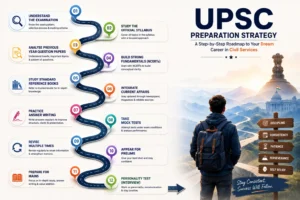
CareerMint’s 5-Phase UPSC Preparation Framework
Cracking the UPSC Civil Services Examination is not about studying everything at once. The syllabus is too vast, and attempting to cover all subjects simultaneously often leads to confusion and burnout. A structured preparation journey is far more effective than an unplanned approach.
To simplify the process, CareerMint recommends dividing UPSC preparation into five practical phases. Each phase has a clear objective, specific study resources, and measurable outcomes. By completing one phase before moving to the next, aspirants can build a strong foundation and avoid common preparation mistakes.
Phase 1: Foundation Building (Months 1–3)
Goal
Develop a clear understanding of the examination and build strong conceptual fundamentals.
Many beginners make the mistake of purchasing advanced reference books immediately. Instead, the first few months should focus on understanding the syllabus, analysing previous year question papers, and strengthening basic concepts through NCERT textbooks.
What to Do
- Read the official UPSC syllabus thoroughly.
- Analyse at least the last 10 years of Preliminary and Main Examination question papers.
- Complete NCERT textbooks (Class VI–XII) for History, Geography, Polity, Economics, Science, and Society.
- Begin reading a newspaper daily.
- Start making concise notes instead of copying entire chapters.
Expected Outcome
By the end of this phase, you should:
- Understand the complete syllabus.
- Recognize frequently asked topics.
- Build conceptual clarity.
- Develop the habit of daily newspaper reading.
Phase 2: Concept Building (Months 4–7)
Goal
Cover the entire General Studies syllabus using standard reference books.
Once the fundamentals are clear, shift your focus to mastering standard resources recommended by successful candidates and experts. This is the stage where your knowledge becomes deeper and more analytical.
What to Do
- Study one standard book for each subject.
- Continue reading newspapers and linking current affairs to static topics.
- Complete your first reading of the optional subject.
- Solve chapter-wise previous year questions.
- Prepare concise revision notes for every subject.
Expected Outcome
After this phase, you should:
- Complete the majority of the General Studies syllabus.
- Develop confidence in core subjects.
- Build a reliable set of personal revision notes.
Phase 3: Integration Phase (Months 8–10)
Goal
Integrate static subjects with current affairs and begin answer writing.
This is where preparation becomes examination-oriented. Instead of simply reading books, you should begin applying your knowledge through writing practice, discussion, and regular problem-solving.
What to Do
- Practice answer writing for General Studies.
- Start essay writing practice.
- Continue optional subject preparation.
- Revise completed subjects every week.
- Solve Prelims MCQs regularly.
- Connect current affairs with the syllabus instead of studying them separately.
Expected Outcome
At the end of this phase, you should:
- Improve analytical thinking.
- Develop answer presentation skills.
- Build confidence in writing descriptive answers.
- Learn to connect multiple subjects together.
Phase 4: Testing & Performance Improvement (Months 11–12)
Goal
Evaluate your preparation and eliminate weaknesses.
Many candidates take mock tests but never analyse them properly. A mock test is valuable only when every mistake is reviewed and corrected.
What to Do
- Attempt full-length Prelims mock tests.
- Practice sectional tests for weak subjects.
- Write full-length Mains answers.
- Analyse every mistake after each mock.
- Revise topics where accuracy is low.
- Focus on time management and question selection.
Expected Outcome
By the end of this phase, you should:
- Increase accuracy.
- Improve speed.
- Identify weak areas.
- Gain confidence under exam conditions.
CareerMint Tip: Spend almost as much time analysing a mock test as you spend attempting it. Understanding why you made mistakes is more valuable than simply knowing your score.
Phase 5: Revision & Examination Phase (Final 2–3 Months)
Goal
Strengthen memory, improve recall, and stay exam-ready.
The final months should focus on revision rather than learning new topics. At this stage, consistency and recall are more important than expanding your study material.
What to Do
- Revise short notes and highlighted concepts.
- Solve Previous Year Question Papers again.
- Attempt full-length mock tests.
- Revise current affairs systematically.
- Practice quick fact revision.
- Maintain a healthy sleep schedule and avoid unnecessary stress.
Expected Outcome
By the examination, you should:
- Have completed multiple revisions.
- Feel confident with your notes.
- Be comfortable managing exam pressure.
- Enter the examination with a clear strategy.
CareerMint’s 5-Phase Preparation Timeline
| Phase | Duration | Primary Focus | Main Outcome |
|---|---|---|---|
| Phase 1 | Months 1–3 | Syllabus, PYQs, NCERTs, Foundation | Strong conceptual clarity |
| Phase 2 | Months 4–7 | Standard Books & Core Subjects | Complete General Studies foundation |
| Phase 3 | Months 8–10 | Current Affairs, Answer Writing, Optional | Integrated preparation |
| Phase 4 | Months 11–12 | Mock Tests & Performance Analysis | Exam readiness |
| Phase 5 | Final 2–3 Months | Revision, PYQs & Full-Length Tests | Peak performance before the exam |
CareerMint Strategy Principle
One of the biggest reasons candidates fail is trying to do everything at the same time. The most successful aspirants build their preparation in stages—first understanding concepts, then applying them, testing themselves, and finally revising repeatedly. Progressing through these phases with discipline is more effective than constantly changing books, strategies, or study plans.
12-Month UPSC Preparation Plan
A well-structured study plan helps aspirants complete the syllabus without unnecessary stress. Instead of trying to finish everything at once, divide your preparation into monthly milestones. This approach ensures that each subject receives adequate attention while leaving sufficient time for revision, mock tests, and answer writing.
The following roadmap is designed for beginners and can be adjusted based on your academic background, available study time, and previous preparation.
Month 1: Understand the Examination & Build Your Foundation
The first month should focus on understanding the examination rather than rushing into advanced books.
Objectives
- Read the official UPSC syllabus thoroughly.
- Analyse the last 10 years of Prelims and Mains question papers.
- Start reading The Hindu or The Indian Express daily.
- Begin NCERT textbooks for History and Geography.
- Create a daily study routine.
Target
By the end of the month, you should understand how UPSC asks questions and what the syllabus actually demands.
Month 2: Complete Basic Concepts
Continue strengthening your fundamentals through NCERTs while developing the habit of making concise notes.
Objectives
- Complete remaining NCERTs for Polity, Economy, Environment, Science, and Society.
- Continue newspaper reading.
- Start maintaining current affairs notes.
- Revise subjects studied during Month 1.
Target
Complete the first reading of all important NCERT books.
Month 3: Start Standard Reference Books
Now move from basic textbooks to standard UPSC resources.
Objectives
- Indian Polity – M. Laxmikanth
- Modern History – Spectrum
- Physical Geography – G.C. Leong
- Indian Economy – Standard reference book
- Continue current affairs.
Target
Finish at least two major subjects using standard books.
Month 4: Expand General Studies Coverage
Begin connecting static subjects with current affairs.
Objectives
- Environment
- Art & Culture
- Science & Technology
- Continue Polity and Economy revision.
- Solve topic-wise previous year questions.
Target
Cover around 50–60% of the General Studies syllabus.
Month 5: Begin Optional Subject Preparation
The optional subject contributes 500 marks in the Main Examination, making it one of the most significant scoring areas.
Objectives
- Select the optional subject.
- Complete the first reading.
- Start making concise notes.
- Continue General Studies preparation.
Target
Build a solid foundation in your optional subject.
Month 6: Start Answer Writing Practice
Knowledge alone is not enough. Candidates must learn to express their ideas effectively within the prescribed time limit.
Objectives
- Write one General Studies answer every day.
- Practice one essay every week.
- Continue current affairs.
- Revise previously completed subjects.
Target
Develop speed, structure, and clarity in answer writing.
Month 7: Strengthen Current Affairs Integration
At this stage, begin linking current affairs with the static syllabus instead of treating them separately.
Objectives
- Revise monthly current affairs.
- Link news with Polity, Economy, Environment, and International Relations.
- Continue answer writing.
- Solve Prelims MCQs regularly.
Target
Build an integrated understanding of current affairs.
Month 8: Intensive Revision & Practice
Revision should now become part of your daily schedule.
Objectives
- First full revision of completed subjects.
- Practice Prelims MCQs.
- Continue answer writing.
- Improve optional subject preparation.
Target
Identify weak areas before mock testing begins.
Month 9: Full-Length Mock Tests
Now shift from studying to evaluating your preparation.
Objectives
- Attempt one full-length Prelims mock every week.
- Write sectional Mains tests.
- Analyse mistakes thoroughly.
- Revise weak topics immediately.
Target
Improve accuracy, speed, and confidence.
Month 10: Performance Improvement
Focus on correcting mistakes rather than learning new resources.
Objectives
- Continue mock tests.
- Strengthen weak subjects.
- Revise short notes.
- Practice elimination techniques for Prelims.
Target
Achieve consistent scores in mock examinations.
Month 11: Final Revision
Avoid starting new books during this stage.
Objectives
- Revise notes.
- Solve previous year papers again.
- Revise current affairs.
- Continue mock tests with reduced frequency.
Target
Improve recall and retention.
Month 12: Exam Readiness
The final month should focus on maintaining confidence and staying mentally prepared.
Objectives
- Revise concise notes only.
- Sleep well and maintain a healthy routine.
- Avoid unnecessary study material.
- Practice a few quality mock tests.
- Stay confident and avoid comparing your preparation with others.
Target
Enter the examination with confidence, clarity, and a calm mindset.
12-Month Preparation Roadmap
| Month | Primary Focus | Key Outcome |
|---|---|---|
| Month 1 | Syllabus, PYQs & Exam Understanding | Preparation Direction |
| Month 2 | NCERT Completion | Strong Fundamentals |
| Month 3 | Standard Books | Concept Building |
| Month 4 | General Studies Expansion | Wider Subject Coverage |
| Month 5 | Optional Subject | Optional Foundation |
| Month 6 | Answer Writing | Writing Skills |
| Month 7 | Current Affairs Integration | Analytical Thinking |
| Month 8 | Revision | Better Retention |
| Month 9 | Mock Tests | Performance Evaluation |
| Month 10 | Weak Area Improvement | Higher Accuracy |
| Month 11 | Final Revision | Strong Recall |
| Month 12 | Exam Readiness | Peak Performance |
CareerMint Expert Tip
Treat this roadmap as a flexible framework, not a rigid timetable. Some aspirants may complete the syllabus faster, while others may need additional time depending on their background. The key is consistent progress, regular revision, and honest self-evaluation rather than comparing your pace with others.
Subject-wise UPSC Preparation Strategy
Every subject in the UPSC Civil Services Examination demands a different preparation approach. While some subjects require conceptual clarity, others focus on analytical thinking, map practice, current affairs integration, or answer presentation. Therefore, following the same study method for every subject is rarely effective.
The key is to understand the nature of each subject and prepare accordingly. Below is a practical strategy for every major General Studies subject.
Indian Polity Preparation Strategy
Indian Polity is one of the highest-scoring and most predictable subjects in both the Preliminary and Main Examination. Since governance and constitutional issues are regularly in the news, this subject also overlaps significantly with current affairs.
Preparation Strategy
- First, understand the structure of the Indian Constitution before memorizing Articles.
- Learn the relationship between the Executive, Legislature, and Judiciary.
- Read constitutional amendments only after understanding the original provisions.
- Connect current affairs with constitutional concepts, judgments, and government policies.
- Revise important Articles and Constitutional Bodies regularly.
Common Mistakes
- Memorizing Articles without understanding concepts.
- Ignoring Supreme Court judgments.
- Studying only factual information.
History Preparation Strategy
History is not about memorizing dates. UPSC expects candidates to understand historical developments, causes, consequences, and their influence on modern India.
Preparation Strategy
Divide History into:
- Ancient India
- Medieval India
- Modern India
- Art & Culture
Focus more on Modern History because it carries higher weightage in both Prelims and Mains.
While studying:
- Understand events chronologically.
- Learn reform movements.
- Connect freedom struggle events.
- Prepare timelines for quick revision.
Common Mistakes
- Trying to memorize every date.
- Ignoring Art & Culture.
- Reading multiple History books.
Geography Preparation Strategy
Geography combines conceptual understanding with practical application. Many UPSC questions require map interpretation and linking geography with environmental issues and current affairs.
Preparation Strategy
- Begin with Physical Geography.
- Understand landforms and climate before Indian Geography.
- Practice maps every week.
- Connect Geography with disasters, agriculture, monsoon, and environmental issues.
- Follow current developments such as cyclones, earthquakes, and climate reports.
Common Mistakes
- Ignoring map practice.
- Memorizing locations without understanding geographical concepts.
Indian Economy Preparation Strategy
Economy is one of the most dynamic subjects because many questions are linked to current affairs.
Preparation Strategy
Instead of memorizing definitions:
Learn
- Inflation
- GDP
- Fiscal Policy
- Monetary Policy
- Banking
- Budget
- Taxation
- Economic Survey
Try to understand why government decisions are taken instead of only learning what they are.
Follow:
- Union Budget
- Economic Survey
- RBI policies
Common Mistakes
- Memorizing economic terms.
- Ignoring current affairs.
- Avoiding numerical concepts completely.
Environment & Ecology Preparation Strategy
Environment has become one of the most important scoring areas in recent UPSC examinations.
Preparation Strategy
Study:
- Biodiversity
- National Parks
- Climate Change
- Pollution
- International Environmental Conventions
- Wildlife Protection
Link everything with current affairs.
For example:
If COP meetings are in the news, revise:
- UNFCCC
- Paris Agreement
- Kyoto Protocol
Common Mistakes
- Memorizing species lists.
- Ignoring environmental reports.
Science & Technology Preparation Strategy
UPSC does not expect candidates to become scientists. Instead, it tests awareness of scientific developments and their applications.
Preparation Strategy
Focus on:
- Biotechnology
- Space Technology
- Artificial Intelligence
- Robotics
- Quantum Computing
- Defence Technology
- Health Technology
Read news regularly and understand practical applications.
Common Mistakes
- Reading engineering textbooks.
- Studying unnecessary technical details.
Ethics (GS Paper IV) Preparation Strategy
Ethics is one of the highest-scoring papers because it rewards clarity of thought rather than memorization.
Preparation Strategy
Prepare:
- Definitions
- Examples
- Case Studies
- Quotations
- Real-life administrative examples
Practice writing ethical solutions within time limits.
Common Mistakes
- Memorizing definitions only.
- Ignoring case study practice.
Essay Preparation Strategy
Essay writing is a skill developed through continuous practice.
Preparation Strategy
Every essay should have:
- Strong introduction
- Logical structure
- Balanced arguments
- Real-life examples
- Data where appropriate
- Positive conclusion
Practice one essay every week and seek feedback whenever possible.
Common Mistakes
- Writing without a structure.
- Presenting only one-sided arguments.
- Ignoring conclusion quality.
Current Affairs Preparation Strategy
Current Affairs is not a separate subject—it strengthens almost every paper in the UPSC examination.
Focus Areas
- Governance
- Economy
- Environment
- International Relations
- Science & Technology
- Social Issues
- Government Schemes
Instead of collecting information from multiple sources, limit yourself to reliable resources and revise them consistently.
Optional Subject Preparation Strategy
The optional subject contributes 500 marks to the Main Examination, making it one of the most influential components of your final score.
Choose an optional subject based on:
- Genuine interest
- Availability of study material
- Syllabus size
- Previous academic background (if helpful, but not mandatory)
- Availability of guidance and answer-writing support
Once selected, avoid changing your optional subject midway unless absolutely necessary. Consistent preparation and multiple revisions usually produce better results than repeatedly switching subjects.
Subject-wise Preparation Summary
| Subject | Primary Focus | Preparation Tip |
|---|---|---|
| Indian Polity | Constitution & Governance | Focus on concepts before Articles |
| History | Modern India & Freedom Struggle | Learn events chronologically |
| Geography | Physical + Indian Geography | Practice maps regularly |
| Economy | Concepts & Current Affairs | Understand policies, don’t memorize definitions |
| Environment | Ecology & Climate | Link with current affairs |
| Science & Technology | Applications | Focus on recent developments |
| Ethics | Case Studies | Use real-life examples and balanced reasoning |
| Essay | Structure & Analysis | Practice regularly with feedback |
| Current Affairs | Integration | Connect news with the syllabus |
| Optional Subject | Depth & Revision | Choose wisely and stay consistent |
CareerMint Strategy
The biggest difference between average and successful UPSC aspirants is not the number of books they read it’s how effectively they revise, apply concepts, and connect different subjects. Treat every subject as part of an integrated preparation plan rather than studying them in isolation.
Current Affairs Strategy for UPSC
Current affairs play a crucial role in every stage of the UPSC Civil Services Examination. They influence not only the Preliminary Examination but also the Main Examination, Essay paper, and Personality Test. However, many aspirants spend several hours reading newspapers without knowing which news is relevant or how to revise it later.
An effective current affairs strategy is not about reading everything published every day. Instead, it is about selecting relevant topics, understanding their background, linking them with the UPSC syllabus, and revising them regularly.
Why Current Affairs Matter in UPSC
Unlike many competitive examinations that focus mainly on static knowledge, UPSC frequently asks questions that combine current developments with fundamental concepts.
For example:
- A question on the Indian Parliament may be linked to a recent constitutional amendment.
- A question on Climate Change may refer to the latest COP conference.
- An Economy question may be based on the Union Budget or RBI policy decisions.
- International Relations questions often originate from recent diplomatic developments.
This is why current affairs should always be studied alongside the static syllabus.
The Best Sources for Current Affairs
Instead of following multiple websites, magazines, and YouTube channels, limit yourself to a few reliable sources and revise them consistently.
| Source | Purpose |
|---|---|
| The Hindu or The Indian Express | Daily national and international news |
| PIB (Press Information Bureau) | Government schemes, policies, official announcements |
| PRS Legislative Research | Bills, Acts, and Parliamentary updates |
| Yojana Magazine | Social issues, governance, and development |
| Kurukshetra Magazine | Rural development and agriculture |
| Union Budget | Economy and government priorities |
| Economic Survey | Economic concepts and policy analysis |
| Ministry Websites | Authentic information on government initiatives |
CareerMint Tip: It is better to master a few trusted sources than to read five newspapers and remember nothing.
How to Read The Hindu in 45–60 Minutes
One of the biggest mistakes beginners make is reading the newspaper like a daily magazine. UPSC preparation requires a selective approach.
Step 1: Start with National News (10–15 Minutes)
Read articles related to:
- Parliament and legislative developments
- Supreme Court and High Court judgments
- Constitutional issues
- Government policies and schemes
- Election-related reforms
- Governance and public administration
Skip:
- Political speeches
- Party conflicts
- Local political news
- Celebrity news
Step 2: Read International News (10 Minutes)
Focus on:
- India’s relations with other countries
- International organizations (UN, IMF, World Bank, WTO, WHO)
- Major global summits
- International agreements
- Geopolitical developments affecting India
Skip:
- Foreign domestic politics that have no impact on India.
- General crime and entertainment news.
Step 3: Economy Section (10 Minutes)
Pay attention to:
- RBI policies
- Inflation
- GDP growth
- Fiscal policy
- Monetary policy
- Government initiatives
- Banking reforms
- Employment reports
Ignore daily stock market fluctuations unless they have policy significance.
Step 4: Science & Technology (5–10 Minutes)
Read about:
- Space missions
- Artificial Intelligence
- Biotechnology
- Health innovations
- Defence technology
- Digital governance
Avoid overly technical research papers unless they have public policy implications.
Step 5: Environment (5 Minutes)
Focus on:
- Climate change
- Biodiversity
- Wildlife conservation
- National parks
- Environmental conventions
- Disaster management
- Renewable energy
Step 6: Editorials (15 Minutes)
Editorials are valuable because they improve analytical thinking and answer-writing skills.
While reading editorials, ask yourself:
- What is the issue?
- Why has it happened?
- What are its advantages?
- What are its challenges?
- What solutions can be suggested?
- Which UPSC syllabus topic does it relate to?
Do not memorize editorial opinions. Instead, understand different perspectives and build balanced arguments.
How to Make Current Affairs Notes
The biggest mistake aspirants make is writing pages of notes that they never revise.
Instead, create short, structured notes.
For every important topic, include:
- What happened?
- Background
- Why is it important?
- Advantages
- Challenges
- Government initiatives
- Way forward
Keep each topic within one or two pages so that revision becomes easier before the examination.
Link Current Affairs with the UPSC Syllabus
Current affairs should never be studied as an independent subject. Every important news item should be connected to the relevant General Studies paper.
| Current Affairs Topic | Related UPSC Subject |
|---|---|
| Constitutional Amendment | Polity |
| Inflation & RBI Policy | Economy |
| COP Climate Summit | Environment |
| Chandrayaan Mission | Science & Technology |
| India–US Relations | International Relations |
| Census & Population Data | Society & Governance |
| Disaster Management | Geography & Environment |
| Government Welfare Scheme | Governance & Social Justice |
This habit helps you retain information longer and improves answer writing in the Main Examination.
Monthly Current Affairs Revision Strategy
Reading current affairs every day is only half the job. Without revision, much of the information is forgotten.
A practical revision cycle is:
- Daily: Review key news and update notes.
- Weekly: Revise all notes created during the week.
- Monthly: Revise the entire month’s important topics and solve related MCQs.
- Before Prelims: Revise concise monthly notes instead of rereading newspapers.
- Before Mains: Focus on analytical issues, government reports, committee recommendations, and case studies.
Common Mistakes in Current Affairs Preparation
Avoid these common errors:
- Reading multiple newspapers every day.
- Making lengthy notes that are difficult to revise.
- Ignoring the background of important issues.
- Depending only on monthly magazines without following daily news.
- Reading news without connecting it to the UPSC syllabus.
- Spending hours on political debates or television discussions.
- Never revising current affairs after reading them.
Answer Writing Strategy for UPSC Mains
The UPSC Main Examination is not a test of how much information you know—it is a test of how effectively you present that information within a limited time. Every year, many candidates with excellent knowledge score lower than expected because they struggle to organize their answers, write concisely, or complete the paper on time.
Developing answer writing skills early helps improve analytical thinking, enhances revision, and prepares you for the descriptive nature of the Main Examination. Rather than waiting until after the Preliminary Examination, aspirants should gradually build this habit during their preparation.
Why Answer Writing is Important
Answer writing is more than writing paragraphs. It helps you:
- Improve analytical thinking.
- Learn how to structure ideas logically.
- Present balanced viewpoints.
- Manage time during the examination.
- Identify gaps in conceptual understanding.
- Improve retention through active recall.
Even if your answer is not perfect initially, regular practice leads to noticeable improvement over time.
When Should You Start Answer Writing?
One of the most common questions among beginners is whether they should start answer writing immediately.
The answer depends on your preparation stage.
| Preparation Stage | Should You Practice Answer Writing? |
|---|---|
| First 2–3 Months | Focus on understanding concepts and reading the syllabus. Write only short notes. |
| After Building Basics | Start writing one or two answers daily. |
| After Completing Major Subjects | Practice sectional tests regularly. |
| Before Mains | Write full-length GS papers and essays under exam conditions. |
The objective is to develop writing skills gradually instead of waiting until the final months.
The CareerMint IBC Framework
Every UPSC answer should have a logical structure. A simple and effective approach is the IBC Framework:
I – Introduction
The introduction should define the topic or provide relevant context in 2–3 sentences.
Possible ways to begin:
- Definition
- Constitutional provision
- Recent current affairs
- Government report
- Committee recommendation
- Statistical data
B – Body
The body is the most important part of the answer.
Organize it using:
- Headings
- Sub-headings
- Bullet points
- Flowcharts
- Tables
- Diagrams (where relevant)
Always answer every part of the question instead of writing everything you know about the topic.
C – Conclusion
End with a balanced, solution-oriented conclusion.
Good conclusions often include:
- Way Forward
- Government initiatives
- Constitutional values
- Sustainable development
- Inclusive growth
- International best practices (where relevant)
Avoid ending abruptly.
Understand the Directive Words
Many aspirants lose marks because they do not understand what the question actually demands.
| Directive Word | What UPSC Expects |
|---|---|
| Discuss | Explain the topic with balanced arguments. |
| Examine | Analyze the issue in depth using evidence. |
| Evaluate | Present merits, demerits, and your judgment. |
| Critically Examine | Include both strengths and weaknesses before concluding. |
| Analyse | Break the topic into components and explain relationships. |
| Comment | Give a reasoned opinion supported by facts. |
| Compare | Highlight similarities and differences. |
| Differentiate | Focus on distinctions between concepts. |
Understanding these directive words is as important as knowing the subject itself.
How to Improve Answer Presentation
A well-presented answer is easier for the examiner to evaluate.
Use:
- Clear headings
- Short paragraphs
- Bullet points
- Underlined keywords
- Flowcharts
- Maps (for Geography)
- Simple diagrams (where relevant)
- Tables for comparisons
Presentation should improve clarity—not make the answer decorative.
Time Management During the Mains Examination
The biggest challenge in the Main Examination is completing the paper within the allotted time.
A practical strategy is:
- Spend the first few minutes scanning the paper.
- Start with questions you can answer confidently.
- Allocate time according to the marks assigned.
- Avoid spending excessive time on a single answer.
- Reserve a few minutes at the end to review your responses.
Remember, a good answer written for every question usually scores better than excellent answers for only a few questions with several left unanswered.
Weekly Answer Writing Plan
Consistency matters more than writing dozens of answers in one sitting.
| Day | Practice Task |
|---|---|
| Monday | 2 General Studies answers |
| Tuesday | 2 General Studies answers |
| Wednesday | 1 Essay outline + 2 GS answers |
| Thursday | Optional Subject answers |
| Friday | Ethics case study practice |
| Saturday | Timed sectional test |
| Sunday | Review answers, identify mistakes, and rewrite one weak answer |
This routine helps improve both writing speed and answer quality over time.
Common Mistakes in Answer Writing
Avoid these mistakes:
- Writing long introductions.
- Ignoring the actual demand of the question.
- Missing one part of a multi-dimensional question.
- Writing lengthy paragraphs without headings.
- Using excessive quotations or statistics without relevance.
- Repeating the same points in different words.
- Ending answers without a clear conclusion.
- Not practicing under timed conditions.
UPSC Revision Strategy: How to Remember More in Less Time
Revision is one of the most important aspects of UPSC preparation. Completing the syllabus is only half the journey—the real challenge is remembering and applying that knowledge in the examination. Due to the vast syllabus, aspirants often forget topics they studied just a few weeks earlier if they do not revise systematically.
An effective revision strategy focuses on strengthening memory, identifying weak areas, and improving recall under exam conditions. Instead of repeatedly reading books from beginning to end, candidates should adopt structured revision techniques that make learning more efficient and sustainable.
Why Revision Matters More Than Reading New Books
Many aspirants believe that reading more books automatically increases their chances of success. In reality, revising the same trusted resources multiple times is usually more beneficial than constantly adding new material.
Regular revision helps you:
- Strengthen long-term memory.
- Improve recall speed during the examination.
- Connect concepts across different subjects.
- Identify weak areas before the examination.
- Reduce exam-related stress and confusion.
CareerMint Tip: Reading a good book three times is generally more valuable than reading three different books once.
The CareerMint Revision Cycle
A structured revision schedule helps move information from short-term memory to long-term memory.
| Revision Stage | When to Revise | Purpose |
|---|---|---|
| First Revision | Within 24 hours | Prevent early forgetting |
| Second Revision | After 7 days | Strengthen understanding |
| Third Revision | After 30 days | Improve long-term retention |
| Fourth Revision | Before Mock Tests | Identify weak areas |
| Final Revision | Before the Examination | Improve recall and confidence |
This simple cycle reduces the need to relearn topics from scratch.
Active Recall: Test Your Memory Instead of Rereading
One of the most effective learning techniques is Active Recall. Instead of repeatedly reading your notes, try to retrieve the information from memory before checking the answer.
How to Practice Active Recall
- Close your book after completing a topic.
- Write down everything you remember.
- Solve previous year questions without referring to notes.
- Explain the topic in your own words.
- Create self-made quizzes or flashcards.
Active recall strengthens memory because the brain learns more effectively when it actively retrieves information rather than passively reviewing it.
Spaced Repetition: Revise at the Right Time
Spaced repetition means reviewing information at gradually increasing intervals rather than revising everything every day.
A simple schedule could be:
- Day 1
- Day 7
- Day 30
- Day 60
- Before the examination
Each revision takes less time because the concepts become more familiar.
The Feynman Technique
If you cannot explain a topic in simple language, you probably have not understood it completely.
Follow these steps:
- Choose a topic.
- Explain it as if you are teaching a beginner.
- Identify gaps in your explanation.
- Revisit the source material.
- Simplify the explanation further.
This technique is particularly useful for subjects such as Polity, Economy, Ethics, and Geography.
Interleaving: Mix Subjects Instead of Studying One for Hours
Studying a single subject continuously for many hours can reduce concentration and retention.
Instead, alternate between related subjects.
Example
Morning
- Polity
Afternoon
- Geography
Evening
- Current Affairs
Night
- Revision & MCQs
This variation keeps the brain engaged and improves the ability to switch between concepts—an important skill in the UPSC examination.
Create One-Page Revision Notes
Instead of revising entire books before the examination, prepare concise revision sheets for every important topic.
A one-page revision sheet may include:
- Definitions
- Important facts
- Constitutional Articles
- Diagrams
- Flowcharts
- Important committees
- Government schemes
- Current affairs linkage
The objective is to revise an entire topic within a few minutes.
Maintain a Mistake Notebook
One habit followed by many successful candidates is maintaining a notebook dedicated to mistakes.
Record:
- Incorrect MCQs.
- Frequently forgotten facts.
- Weak topics.
- Repeated conceptual errors.
- Difficult current affairs.
Review this notebook before every mock test and during the final revision phase. Correcting repeated mistakes often leads to greater improvement than studying entirely new material.
How to Revise Different Subjects
| Subject | Best Revision Method |
|---|---|
| Polity | Revise Articles, flowcharts, and landmark judgments. |
| History | Timelines, mind maps, and cause-effect charts. |
| Geography | Maps, diagrams, and concept summaries. |
| Economy | Concept notes, Budget highlights, and Economic Survey summaries. |
| Environment | Species lists, conventions, protected areas, and current affairs. |
| Science & Technology | Application-based notes linked with recent developments. |
| Ethics | Definitions, case studies, and real-life examples. |
| Current Affairs | Monthly notes, issue-wise summaries, and PYQ linkage. |
Common Revision Mistakes
Avoid these common errors:
- Starting new books during the final weeks.
- Reading without testing yourself.
- Ignoring previous year questions.
- Revising only favourite subjects.
- Making lengthy notes that are difficult to review.
- Skipping revision because the syllabus feels incomplete.
- Not analysing mistakes made in mock tests.
Mock Test Strategy for UPSC
Mock tests are an essential part of UPSC preparation because they help you evaluate your knowledge, improve time management, and develop the confidence needed for the actual examination. However, simply attempting a large number of mock tests does not guarantee better performance. The real improvement comes from analysing mistakes, understanding why they occurred, and refining your preparation accordingly.
Think of mock tests as a feedback mechanism rather than just a scoring exercise. Every test should help you identify strengths, uncover weak areas, and adjust your study plan.
Why Mock Tests are Important
Mock tests simulate the pressure and environment of the actual examination. They help you:
- Evaluate your preparation objectively.
- Improve speed and accuracy.
- Develop effective time management skills.
- Build confidence before the examination.
- Identify conceptual gaps.
- Reduce exam anxiety through regular practice.
A candidate who regularly analyses mock tests is often better prepared than someone who only reads books.
When Should You Start Taking Mock Tests?
The timing of mock tests depends on your preparation stage.
| Preparation Stage | Mock Test Approach |
|---|---|
| First 2–3 Months | Focus on topic-wise quizzes and previous year questions. |
| After Completing Basic Subjects | Begin sectional mock tests. |
| After Completing Most of the Syllabus | Attempt full-length Prelims and Mains mock tests. |
| Final 2–3 Months | Practice regularly under exam-like conditions and focus on analysis. |
Avoid waiting until the last few weeks to take your first mock test.
Prelims Mock Test Strategy
The Preliminary Examination tests conceptual clarity, factual knowledge, and decision-making under time pressure.
Effective Approach
- Start with topic-wise MCQs after completing each subject.
- Gradually move to sectional tests.
- Attempt full-length tests after covering most of the syllabus.
- Practice under the same time limit as the actual examination.
- Mark questions for review instead of spending excessive time on difficult ones.
Remember that improving your accuracy is generally more valuable than attempting every question.
Mains Mock Test Strategy
Unlike Prelims, the Main Examination evaluates analytical thinking and answer presentation.
Focus Areas
- Write answers within the prescribed word limit.
- Practice completing the paper within the allotted time.
- Use headings, bullet points, flowcharts, and diagrams where appropriate.
- Review whether every part of the question has been addressed.
- Compare your answers with model solutions to identify areas for improvement.
The objective is to improve both the quality and consistency of your answers.
How to Analyse Every Mock Test
Many aspirants spend three hours taking a mock test but only a few minutes reviewing it. In reality, the analysis is often more valuable than the test itself.
After each mock test, ask yourself:
- Which questions did I answer correctly because I understood the concept?
- Which questions were incorrect due to conceptual gaps?
- Which mistakes resulted from careless reading?
- Which topics need additional revision?
- Did I manage my time effectively?
- Did I make unnecessary guesses?
Maintain a record of recurring mistakes and revisit those topics during revision.
Accuracy vs Number of Attempts
A common misconception is that attempting the maximum number of questions always leads to a better score. In reality, your strategy should balance attempts with accuracy.
| Focus Area | Why It Matters |
|---|---|
| Conceptual Clarity | Helps answer unfamiliar questions confidently. |
| Accuracy | Reduces negative marking in Prelims. |
| Time Management | Ensures all questions receive adequate attention. |
| Smart Elimination | Increases the probability of selecting the correct answer. |
| Consistent Revision | Improves performance across successive mock tests. |
Rather than comparing the number of attempts with others, monitor whether your accuracy is improving over time.
Track Your Progress
Maintain a simple performance tracker after every mock test.
| Parameter | Record |
|---|---|
| Mock Test Number | Test Name or Date |
| Score | Marks Obtained |
| Accuracy (%) | Correct ÷ Attempted |
| Weak Subjects | Topics Needing Improvement |
| Common Mistakes | Careless Errors, Conceptual Gaps, Guesswork |
| Action Plan | Revision and Practice Tasks |
Tracking your performance helps identify patterns and measure progress over several weeks.
Common Mistakes During Mock Test Preparation
Avoid these common errors:
- Taking mock tests without analysing the results.
- Judging preparation only by mock scores.
- Ignoring previous year questions.
- Attempting too many random test series simultaneously.
- Memorising answers instead of understanding concepts.
- Skipping revision after every test.
- Becoming discouraged by low initial scores.
Remember that mock tests are designed to improve your preparation not define your ability.
Daily Study Routine for UPSC Preparation
One of the most common questions among UPSC aspirants is, “How many hours should I study every day?” There is no single answer because every candidate has a different background, learning speed, and daily schedule. Some aspirants are full-time students, while others are balancing college, work, or family responsibilities.
Instead of focusing only on the number of study hours, focus on consistent, distraction-free learning with regular revision and practice. A well-planned routine should balance concept building, current affairs, revision, answer writing, and mock test practice.
How Many Hours Should You Study?
Quality of study is always more important than quantity. A focused six-hour session is often more productive than twelve hours of distracted reading.
| Preparation Stage | Recommended Study Time |
|---|---|
| Beginner | 5–6 hours/day |
| Intermediate | 7–8 hours/day |
| Serious Full-Time Aspirant | 8–10 hours/day |
| Final Revision Phase | 10–12 hours/day (with regular breaks) |
The goal is to build a routine that you can follow consistently for months rather than studying intensely for a few days and burning out.
6-Hour Daily Study Plan
This schedule is suitable for beginners, college students, or aspirants with limited study time.
| Time | Activity |
|---|---|
| 7:00 – 8:30 AM | General Studies Subject (Concept Building) |
| 8:30 – 9:00 AM | Short Break |
| 9:00 – 10:00 AM | Current Affairs & Newspaper |
| 10:00 – 11:30 AM | Second Subject / Optional |
| Evening (1 Hour) | Revision + MCQs or Answer Writing |
Daily Focus
- Learn one new topic.
- Read the newspaper.
- Revise yesterday’s work.
- Solve 20–30 MCQs or write one answer.
8-Hour Daily Study Plan
Recommended for full-time aspirants who have completed the basics and want balanced preparation.
| Time | Activity |
|---|---|
| 7:00 – 9:00 AM | General Studies Subject 1 |
| 9:30 – 10:30 AM | Current Affairs |
| 11:00 – 1:00 PM | General Studies Subject 2 |
| 2:00 – 3:00 PM | Optional Subject |
| 4:00 – 5:00 PM | Answer Writing / MCQs |
| 7:00 – 8:00 PM | Revision |
Daily Focus
- Two major subjects.
- Newspaper analysis.
- Optional subject preparation.
- Practice and revision.
10-Hour Daily Study Plan
Suitable for aspirants preparing full-time after completing their graduation.
| Time | Activity |
|---|---|
| Morning | General Studies Subject 1 |
| Late Morning | General Studies Subject 2 |
| Afternoon | Optional Subject |
| Evening | Current Affairs |
| Night | Revision, MCQs, and Answer Writing |
Daily Focus
- Cover multiple subjects without compromising revision.
- Practice answer writing regularly.
- Revise short notes before ending the day.
12-Hour Daily Study Plan
This routine is generally appropriate only during the final preparation or revision phase. It should not be followed continuously for several months unless you can maintain your health and concentration.
| Session | Activity |
|---|---|
| Session 1 | General Studies Subject 1 |
| Session 2 | General Studies Subject 2 |
| Session 3 | Optional Subject |
| Session 4 | Current Affairs |
| Session 5 | Answer Writing / MCQs |
| Session 6 | Revision & Mistake Notebook |
Take a 10–15 minute break after every 90–120 minutes of focused study to maintain concentration.
Sample Weekly Study Plan
A weekly plan helps ensure that every important area of preparation receives attention.
| Day | Primary Focus |
|---|---|
| Monday | Polity + Current Affairs |
| Tuesday | History + MCQs |
| Wednesday | Geography + Answer Writing |
| Thursday | Economy + Current Affairs |
| Friday | Environment & Science |
| Saturday | Optional Subject + Essay Practice |
| Sunday | Revision + Mock Test + Performance Analysis |
This schedule can be adjusted according to your strengths, weaknesses, and examination timeline.
Productivity Tips for Consistent Preparation
Following a routine consistently is more important than creating the “perfect” timetable.
Some habits that can improve productivity include:
- Set realistic daily goals instead of trying to complete an entire subject in one day.
- Study in focused sessions and avoid multitasking.
- Keep your phone away during study sessions or use focus mode.
- Revise the previous day’s topics before starting something new.
- Maintain a checklist to track completed tasks.
- Sleep for 7–8 hours and include light physical activity to stay mentally fresh.
- Leave some buffer time each week to catch up on unfinished topics.
Common Mistakes While Following a Study Routine
Avoid these common mistakes:
- Copying another aspirant’s timetable without adapting it to your schedule.
- Studying continuously without taking breaks.
- Ignoring revision in favour of new topics.
- Spending excessive time on one favourite subject while neglecting others.
- Changing the timetable every few days.
- Measuring productivity only by the number of hours studied.
Remember, a timetable is useful only if you can follow it consistently.
Common Mistakes to Avoid During UPSC Preparation
Every year, thousands of aspirants begin their UPSC journey with enthusiasm, yet only a small percentage complete the process successfully. While the syllabus is challenging, many candidates struggle not because of a lack of ability, but because of avoidable mistakes in their preparation strategy.
Understanding these common pitfalls early can help you save time, reduce stress, and prepare more effectively.
1. Starting Without Understanding the Syllabus
Many beginners immediately purchase books and join courses without first reading the official UPSC syllabus.
Why It’s a Mistake
Without understanding what UPSC actually asks, it becomes difficult to distinguish important topics from unnecessary information.
What You Should Do
- Read the official syllabus carefully.
- Analyze previous year question papers.
- Keep a copy of the syllabus while studying.
2. Reading Too Many Books
One of the biggest misconceptions is that success depends on reading as many books as possible.
Why It’s a Mistake
Multiple books often lead to confusion, duplicated information, and insufficient revision.
Better Approach
- Choose one standard book for each subject.
- Revise it multiple times.
- Add extra resources only when necessary.
3. Ignoring Previous Year Question Papers (PYQs)
Previous year papers are one of the most reliable indicators of UPSC’s approach.
Why It’s a Mistake
Without PYQs, aspirants often study topics that rarely appear while overlooking frequently tested areas.
Better Approach
- Solve at least the last 10 years of Prelims and Mains questions.
- Analyze recurring themes and question patterns.
- Use PYQs to guide your preparation.
4. Neglecting Current Affairs
Some aspirants focus only on static subjects and postpone current affairs.
Why It’s a Mistake
Current affairs influence multiple papers, including General Studies, Essay, and the Interview.
Better Approach
- Read a newspaper consistently.
- Link current events with the syllabus.
- Revise current affairs every week and month.
5. Delaying Answer Writing Practice
Many candidates believe answer writing should begin only after completing the syllabus.
Why It’s a Mistake
Writing is a skill that improves gradually. Delaying practice often leads to poor presentation and time management in the Mains examination.
Better Approach
- Start with simple answers after building your fundamentals.
- Increase difficulty gradually.
- Practice under time limits.
6. Ignoring Revision
Completing the syllabus without revision often results in poor recall during the examination.
Why It’s a Mistake
Without revision, concepts fade over time and confidence decreases.
Better Approach
- Follow a structured revision cycle.
- Maintain concise notes.
- Revise weak areas regularly.
7. Making Lengthy Notes
Some aspirants spend more time creating notes than actually studying.
Why It’s a Mistake
Bulky notebooks become difficult to revise before the examination.
Better Approach
Create concise notes containing:
- Keywords
- Flowcharts
- Diagrams
- Important facts
- Current affairs linkage
8. Comparing Your Preparation with Others
Every aspirant has a different educational background, learning speed, and preparation timeline.
Why It’s a Mistake
Constant comparison creates unnecessary stress and reduces motivation.
Better Approach
Compare your current performance with your previous performance instead of comparing yourself with others.
9. Following Too Many Sources
Watching multiple YouTube channels, reading different magazines, and switching between coaching materials creates information overload.
Why It’s a Mistake
Too many sources reduce consistency and increase confusion.
Better Approach
- Select a limited number of trusted resources.
- Complete them thoroughly.
- Revise them repeatedly.
10. Ignoring Health and Sleep
Many aspirants reduce sleep and skip exercise to study longer.
Why It’s a Mistake
Poor sleep affects concentration, memory, and decision-making.
Better Approach
- Sleep for 7–8 hours.
- Eat balanced meals.
- Include light exercise or walking.
- Take short breaks during study sessions.
11. Depending Entirely on Coaching
Coaching can provide guidance, but it cannot replace self-study.
Why It’s a Mistake
Candidates who rely only on classroom lectures often spend insufficient time revising and practising independently.
Better Approach
Use coaching, if you choose to, as a support system while taking responsibility for your own preparation.
12. Chasing Every New Strategy
Every year, new study plans, booklists, and preparation hacks become popular.
Why It’s a Mistake
Frequently changing your strategy interrupts consistency and wastes valuable time.
Better Approach
Choose a well-planned strategy, review it periodically, and make changes only when genuinely needed.
13. Ignoring Mock Test Analysis
Many aspirants focus only on their scores instead of understanding why they made mistakes.
Why It’s a Mistake
Without analysis, the same errors are repeated in future tests.
Better Approach
After every mock test:
- Review incorrect answers.
- Identify conceptual gaps.
- Note recurring mistakes.
- Revise weak topics before the next test.
14. Studying Without Clear Daily Goals
Sitting at your desk without knowing what you want to accomplish often leads to unproductive study sessions.
Better Approach
Start each day with specific goals, such as:
- Finish one chapter of Polity.
- Solve 30 Prelims MCQs.
- Write two Mains answers.
- Revise yesterday’s notes.
Small, measurable goals help maintain momentum.
15. Losing Patience Too Early
UPSC preparation is a long-term process. Many aspirants become discouraged if they do not see immediate results.
Better Approach
Focus on continuous improvement rather than quick outcomes. Consistency over several months is more valuable than occasional bursts of intensive study.
Recommended Resources for UPSC Preparation
Choosing the right study material is one of the most important decisions during UPSC preparation. With thousands of books, coaching notes, websites, and online resources available, beginners often feel overwhelmed. The key is not to collect more resources but to master a limited number of reliable ones.
The following list includes standard resources that have been widely used by successful aspirants. You do not need to read every book listed below. Select the resources that suit your preparation level and revise them consistently.
Essential NCERT Books
NCERT textbooks provide the foundation for many UPSC subjects. They help build conceptual clarity before moving to advanced reference books.
| Subject | Recommended NCERT |
|---|---|
| History | Class 6–12 History NCERTs |
| Geography | Class 6–12 Geography NCERTs |
| Polity | Class 9–12 Political Science NCERTs |
| Economics | Class 9–12 Economics NCERTs |
| Science | Class 6–10 Science NCERTs |
| Environment | Biology NCERT (Class 12 – Selected Chapters) |
| Society | Class 11 & 12 Sociology NCERTs |
CareerMint Tip: Read NCERTs for understanding concepts not for memorizing every line.
Standard Reference Books
After completing NCERTs, move to standard reference books that cover the UPSC syllabus in greater depth.
| Subject | Recommended Book |
|---|---|
| Indian Polity | Indian Polity – M. Laxmikanth |
| Modern History | A Brief History of Modern India – Spectrum Publications |
| Ancient & Medieval History | NCERTs + Select Reference Material |
| Geography | Certificate Physical and Human Geography – G.C. Leong |
| Indian Economy | Standard Economy Reference Book suitable for UPSC |
| Environment | Standard Environment Reference Book + Current Affairs |
| Ethics | Lexicon for Ethics, Integrity & Aptitude (or equivalent) |
| Art & Culture | Indian Art and Culture – Nitin Singhania |
Remember that repeated revision of one trusted resource is more valuable than collecting multiple books for the same subject.
Newspapers for Current Affairs
A newspaper should help you understand issues rather than simply collect facts.
| Newspaper | Best For |
|---|---|
| The Hindu | Editorials, governance, international relations, environment |
| The Indian Express | Policy analysis, economy, editorials, current affairs |
Choose one newspaper and read it consistently.
Government Publications
Government reports and publications provide authentic information for General Studies, Essay, and Interview preparation.
| Publication | Purpose |
|---|---|
| Economic Survey | Economic analysis and policy understanding |
| Union Budget | Government priorities and financial policies |
| Yojana Magazine | Governance, social issues, and development |
| Kurukshetra Magazine | Rural development, agriculture, and government initiatives |
Focus on understanding key themes rather than memorizing every detail.
Official Government Websites
Official websites are valuable because they provide accurate and updated information directly from government sources.
| Website | Purpose |
|---|---|
| UPSC Official Website | Notifications, syllabus, examination updates |
| Press Information Bureau (PIB) | Government schemes, policy announcements |
| PRS Legislative Research | Bills, Acts, Parliamentary proceedings |
| India Year Book (selected topics) | Government programmes and national data |
Use official sources to verify important information whenever possible.
Previous Year Question Papers (PYQs)
Previous year papers should be an integral part of your preparation.
Recommended Practice
- Solve at least the last 10 years of Prelims papers.
- Analyse General Studies Mains questions topic-wise.
- Identify recurring themes and frequently tested concepts.
- Use PYQs to guide revision and answer writing.
Mock Test Resources
Mock tests help evaluate your preparation and improve exam temperament.
Look for platforms that provide:
- Detailed explanations.
- Performance analysis.
- Topic-wise tests.
- Full-length Prelims papers.
- Mains answer evaluation.
The quality of feedback matters more than the number of tests you attempt.
Essential Online Resources
The internet provides access to authentic reports, government documents, and educational content. Use it selectively.
| Resource | Purpose |
|---|---|
| PIB Releases | Government initiatives and official announcements |
| PRS Legislative Research | Legislative developments and policy analysis |
| RBI Publications | Banking, inflation, and monetary policy |
| NITI Aayog Reports | Development policies and governance |
| Ministry Websites | Schemes, reports, and official data |
Avoid depending on social media posts for factual information.
Recommended Study Tools
Simple tools can make your preparation more organised and efficient.
| Tool | Use |
|---|---|
| Notebook or Digital Notes | Topic-wise revision notes |
| Flashcards | Active recall and quick revision |
| Mind Maps | Concept connections and summaries |
| Monthly Current Affairs Notes | Consolidated revision before exams |
| Mistake Notebook | Tracking recurring errors from mocks |
Choose tools that fit your study style and help you revise regularly.
Resource Selection Checklist
Before adding a new resource, ask yourself:
- Does it cover a gap in my preparation?
- Am I already using another resource for the same topic?
- Will I have enough time to revise it?
- Is it from a reliable and authentic source?
- Does it align with the UPSC syllabus?
If the answer to most of these questions is No, you probably do not need that resource.